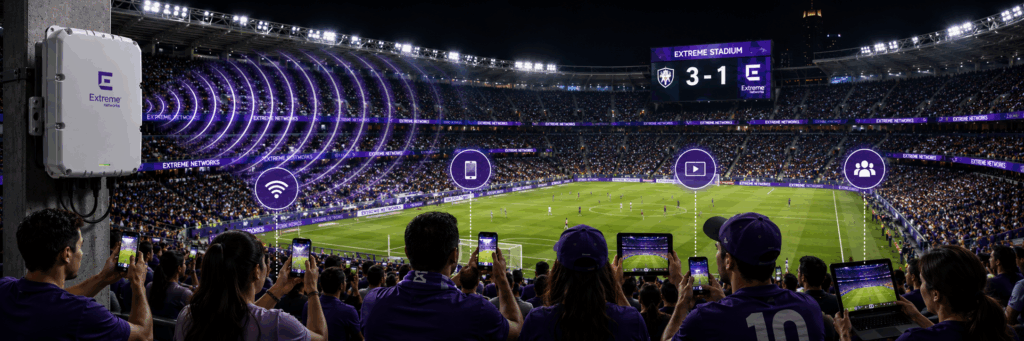

WiFi NOW’s TAKE: Extreme Networks historically acquired most of its Wi-Fi technology and portfolio through acquisition of such companies as Aerohive – but has since made wireless an integral and critical part of their product strategy. Extreme’s recent release of a new family Wi-Fi 7 products is proof of exactly that: The company is ramping up its focus on wireless and on Wi-Fi hardware excellence. The company is mostly famous for its work on stadium Wi-Fi and analytics for the National Football League but should actually be recognised as being a leading provider of enterprise solutions into a variety of verticals.
Extreme Networks has unveiled a broad set of new Wi-Fi 7 access points, completing what the company describes as its full Wi-Fi 7 hardware portfolio. Speaking to WiFi NOW in a recent Tech Watch interview, wireless industry veteran and Extreme Networks‘ Chief Innovation Officer David Coleman outlined the company’s latest strategy, which combines differentiated hardware design, expanded 6 GHz capabilities, and a growing focus on AI-driven networking. The announcement came during Extreme Connect 2026 in Orlando, where the company introduced new premium-tier, mid-range, and value-tier Wi-Fi 7 access points. According to Coleman, completing the portfolio is a significant milestone after more than a year of rolling out Wi-Fi 7 products across different market segments.
Wi-Fi 7 is really about 6 GHz
While much of the industry conversation has already shifted towards Wi-Fi 8, David Coleman believes the real story today remains Wi-Fi 7 and, in particular, the continued expansion of the 6 GHz band.
“Wi-Fi 7 is really bringing home the whole 6 GHz story,” David Coleman said, noting that the industry still has substantial work ahead in deploying Wi-Fi 7 networks and taking advantage of its advanced capabilities. He also highlighted the ongoing importance of regulatory efforts, especially in regions such as Europe where access to the full 6 GHz band remains limited.
Ruggedized Wi-Fi 7 for stadiums and demanding environments
Among the most notable product announcements were Extreme’s new weatherised Wi-Fi 7 access points, including the AP5060D and AP5060U. These IP67-rated access points are designed for outdoor deployments such as stadiums but can also be used indoors in challenging environments including warehouses and industrial facilities. David Coleman emphasised that Extreme’s approach differs from many competitors by integrating weatherisation directly into the access point rather than relying on third-party enclosures.
The new units support tri-band 4×4 operation across 2.4 GHz, 5 GHz, and 6 GHz, feature dedicated sensors, 10 Gbps uplinks, and support both low-power indoor (LPI) and Automated Frequency Coordination (AFC)-enabled standard-power operation. David Coleman was particularly enthusiastic about AFC-enabled standard-power operation, describing it as one of the most important developments for enterprise Wi-Fi. The ability to use higher transmit power indoors and outdoors could significantly improve coverage and performance for many enterprise deployments.
Flexible antenna design tackles global regulatory complexity
Another highlight was the introduction of the AP5022FX, a uniquely designed Wi-Fi 7 access point intended to address the challenges created by differing 6 GHz regulations around the world. The device supports external antennas for 2.4 GHz and 5 GHz operation while incorporating an internal 6 GHz radio for regions where external 6 GHz antennas are not permitted.
The design allows Extreme to maintain a common hardware platform across multiple regulatory regions rather than creating separate product variants for each market. According to David Coleman, the solution offers enterprises the antenna flexibility needed for warehouses, high-density venues, and specialized indoor environments while remaining compliant with local spectrum rules.
Value-tier Wi-Fi 7 arrives
Extreme also announced its value-tier Wi-Fi 7 products, including the AP3020, AP3020X, and a new Wi-Fi 7 wall plate access point targeted at hospitality, student housing, and multi-dwelling units. Although value-tier products often receive less attention than flagship models, David Coleman pointed out that they typically become vendors’ highest-volume products due to their attractive price points.
The new wall plate AP received particular attention at the event, combining dual-radio Wi-Fi 7 capabilities, integrated Ethernet ports, and IoT connectivity within a compact design intended to blend unobtrusively into hotel rooms and residential environments.
AI moves beyond AI Ops
Looking beyond hardware, David Coleman believes the next major competitive battleground will be AI. Extreme used its Orlando event to discuss its Agentic AI strategy and the company’s Agent One platform. While AI-assisted network operations have become commonplace, Coleman argues the industry is entering a new phase where AI will increasingly influence all aspects of enterprise networking.
He also expects network control functions to migrate closer to the edge rather than residing entirely in the cloud. This trend, combined with advances in AI processors and accelerated software development tools, could dramatically speed up innovation across the networking industry.
Wi-Fi 8: Intelligence at the edge
Although Wi-Fi 8 is still several years away from widespread deployment, David Coleman believes its most important differentiator will not be improvements in radio performance but the integration of AI processing directly into networking hardware. “We’re going to start seeing AI neuro-processors in the hardware,” he said, describing this as the beginning of a new generation of intelligent networking platforms capable of executing increasingly sophisticated functions at the edge.
For now, however, Extreme Networks‘ message is clear: the industry is still early in the Wi-Fi 7 cycle, and the combination of 6 GHz spectrum, AFC-enabled standard-power operation, differentiated hardware, and AI-powered management leaves plenty of room for innovation before Wi-Fi 8 arrives.
Watch the full Tech Watch interview with David Coleman for additional insights into Wi-Fi 7, 6 GHz, AFC, AI, and the future of enterprise networking.