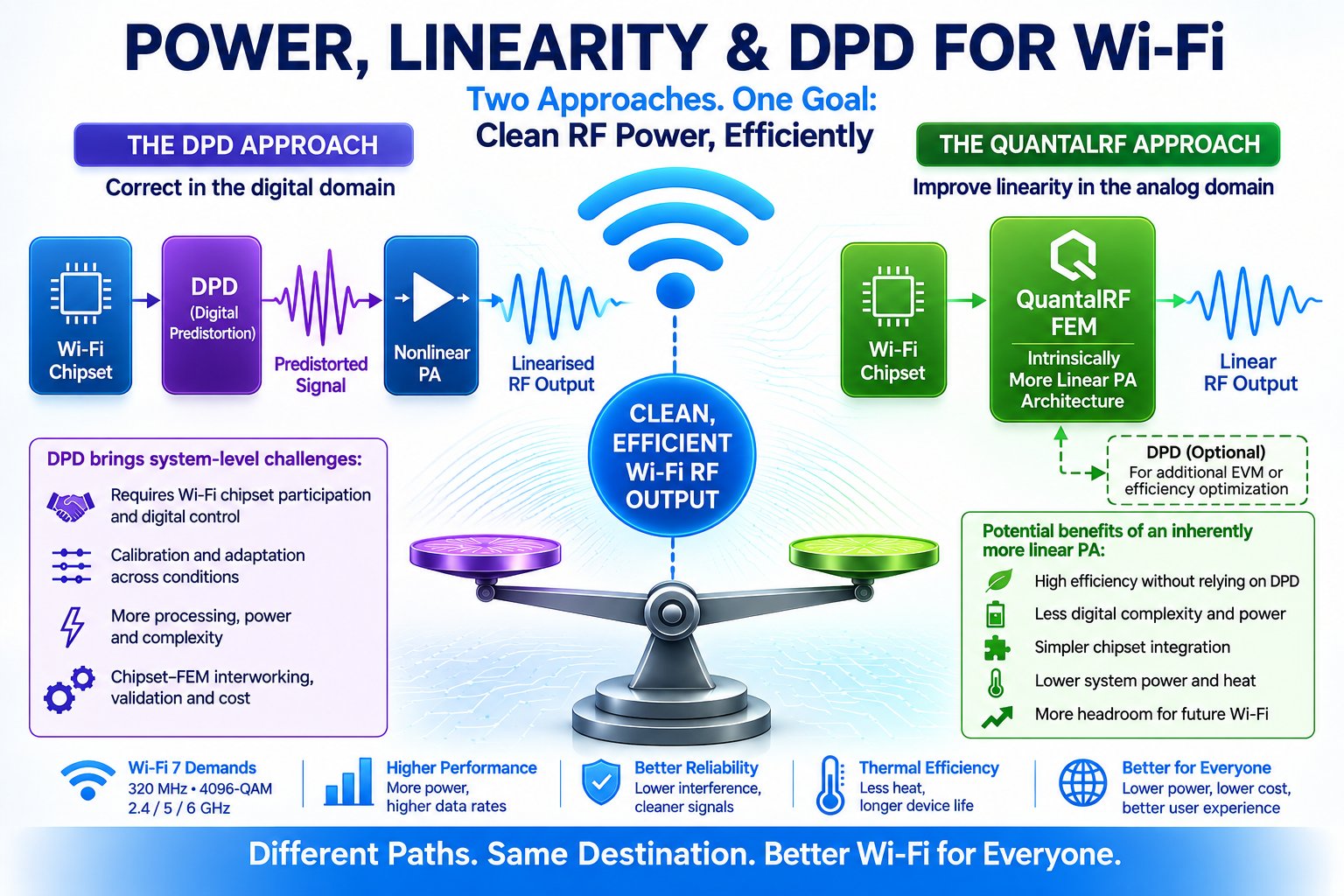

As Wi-Fi moves to wider channels, higher-order modulation, and more demanding performance requirements, the RF front end faces a fundamental challenge: delivering enough transmit power while keeping the signal clean and the power consumption under control. Simply building a more powerful amplifier is not the answer. Power amplifiers become increasingly nonlinear as they are driven harder, while operating them more conservatively typically sacrifices efficiency. This tension between output power, linearity, signal quality, and power efficiency has become one of the central challenges in Wi-Fi RF design.
Digital pre-distortion, or DPD, offers one way to improve that trade-off. But DPD also adds digital processing, calibration, control, and integration requirements involving both the Wi-Fi chipset and the RF front end. There is another possibility: Improve the underlying analog RF architecture so that less digital correction is required in the first place. This is the approach being pursued by companies including QuantalRF.
Why more transmit power is not necessarily better
Transmit power matters. More RF power can extend coverage, improve link robustness, and help maintain higher data rates as signal conditions deteriorate. But the useful output of a Wi-Fi transmitter is not determined simply by how many Watts—or milliwatts – its power amplifier can generate. The PA must amplify a highly complex Wi-Fi waveform while preserving its shape. As an amplifier is driven closer to its maximum output capability, its response becomes increasingly nonlinear. Peaks in the input signal are no longer reproduced proportionally at the output, and the transmitted waveform begins to distort.
The engineering problem is therefore not simply to generate more RF power. It is to generate more usable, sufficiently linear RF power efficiently. Those are very different objectives.
Wi-Fi is a difficult signal to amplify
Wi-Fi uses OFDM, in which many subcarriers are transmitted simultaneously. At certain moments these signals combine to create instantaneous peaks substantially higher than the average transmitted power. This is usually described in terms of peak-to-average power ratio, or PAPR. The PA must be capable of handling these peaks without introducing excessive distortion. One conventional way of achieving this is to operate the amplifier below the region where it becomes strongly nonlinear. This is known as power back-off.
Back-off helps preserve signal quality, but it comes at a price: the PA is generally being operated away from the point at which it can deliver its maximum output and potentially its best efficiency. This creates the fundamental Wi-Fi PA trade-off:
- More output power → greater risk of nonlinearity
- More back-off → better linearity but potentially lower efficiency
Neither extreme is attractive.
What PA distortion does to Wi-Fi
A nonlinear PA does more than slightly change the shape of the transmitted waveform. Distortion inside the intended Wi-Fi channel increases error vector magnitude, or EVM. EVM measures how far the actual transmitted modulation deviates from the ideal modulation. As EVM deteriorates, the receiver has greater difficulty distinguishing the intended constellation points. Nonlinearity can also create spectral regrowth, causing transmitted energy to spread beyond the intended signal spectrum. The transmitter must remain within applicable spectral requirements while avoiding excessive interference with adjacent channels and services.
This becomes particularly important with high-order modulation. Wi-Fi 7 introduced 4096-QAM, encoding 12 bits in each modulation symbol. Its constellation contains 4,096 possible points packed much more closely together than lower-order QAM schemes. The smaller the distance between those points, the less distortion the system can tolerate. A PA that can produce a high headline output power therefore does not necessarily produce that power at the signal quality required for the highest Wi-Fi modulation rates.
For Wi-Fi, linear output power is often more meaningful than maximum output power.
Wi-Fi 7 makes the trade-off harder
Wi-Fi 7 pushes several RF requirements simultaneously. It supports channels as wide as 320 MHz, compared with a maximum of 160 MHz in Wi-Fi 6/6E, while 4096-QAM increases the required modulation accuracy. Much of this performance is targeted at the 6 GHz band, where RF front-end performance is already challenging.
At the same time, high-performance access points may contain numerous RF chains. An efficiency penalty of a few hundred milliwatts in one RF chain can therefore become a considerably larger system-level issue when multiplied across the radios and spatial streams in an access point. The consequences are not limited to power consumption.
Power lost in the RF electronics becomes heat. That heat has to be removed through the enclosure, heat sinks, thermal materials, airflow, or other thermal-engineering measures. This can increase component cost, mechanical complexity, product size, and potentially reduce the operating margin of other components. The question facing RF designers is therefore increasingly: How can we produce clean Wi-Fi RF power without turning electrical power into excessive heat?
DPD: Correcting nonlinearity before it happens
One answer is digital pre-distortion, or DPD. The concept initially sounds counterintuitive. Instead of sending the original waveform directly to the PA, the transmitter deliberately alters – or pre-distorts – the signal in the digital domain. The pre-distortion is designed to have approximately the opposite characteristics of the PA’s known nonlinear behaviour. The PA then distorts this deliberately modified waveform, and the two effects partially cancel.
In simplified form: Original digital signal → Pre-distortion → Nonlinear PA → More linear RF output DPD can therefore allow a PA to operate closer to regions where it can produce greater output power or operate more efficiently while still achieving the required transmitted signal quality. The technique has long been important in cellular infrastructure, where PA efficiency represents a major part of radio power consumption.
As Wi-Fi bandwidths, modulation requirements, and power constraints increase, DPD is becoming increasingly relevant to Wi-Fi as well. But DPD is not just a FEM feature. There is an important complication. DPD cannot simply be added to a FEM as though it were another passive RF component. The digital processing that generates the pre-distorted waveform is associated with the transmitter signal chain and therefore requires participation from the Wi-Fi chipset and its digital baseband architecture.
The Wi-Fi chipset needs to know how the particular PA behaves and apply the appropriate correction. Depending on the implementation, the system may need calibration, characterisation, feedback or observation mechanisms, adaptation to operating conditions, and digital control of the RF front end. This means that DPD requires interworking between the Wi-Fi chipset and the FEM. That has significant commercial and engineering consequences.
A FEM supplier cannot necessarily develop an advanced DPD solution independently and expect it to work transparently with every Wi-Fi chipset. The chipset vendor, FEM vendor, and system manufacturer may need to collaborate on interfaces, control, calibration, algorithms, characterisation, and validation. Different PAs behave differently. Their characteristics can also vary with output power, frequency, temperature, supply voltage, manufacturing variation, and other operating conditions. A DPD implementation therefore has to correct the behaviour of a real RF device rather than an abstract ideal amplifier. The result can be considerable integration and validation work.
The hidden costs of DPD
DPD can improve PA performance, but the benefits need to be considered against the additional system complexity. Among the potential requirements are:
- Chipset support. The Wi-Fi SoC or associated processing platform must support the required digital predistortion functions and control mechanisms.
- FEM characterization. The chipset needs sufficiently accurate information about the nonlinear behaviour it is attempting to correct.
- Calibration. The PA response may need to be characterized during development, manufacturing, startup, or operation depending on the architecture.
- Adaptation. PA behaviour can change with frequency, temperature, output level, and other conditions.
- Interworking. Chipset and FEM suppliers must ensure that the digital and RF portions of the solution operate correctly together.
- Validation. Every supported chipset/FEM combination may require additional testing across bands, channels, power levels, bandwidths, modulation schemes, and operating conditions.
- Processing and power. DPD itself requires computation and potentially additional observation or control circuitry, consuming some of the power and silicon resources that the technique is intended ultimately to save.
- Time and cost. Engineering integration, software development, characterization, and qualification all add to the cost and complexity of bringing a Wi-Fi platform to market.
This is an important distinction. DPD can improve the performance of the PA, but it does so partly by moving some of the RF challenge into digital processing, software, calibration, and system integration. For a cellular base station, that trade-off may be readily justified because of the amount of RF power involved. For a cost-sensitive Wi-Fi platform containing multiple RF chains, the calculation can be different.
Could the PA itself simply be more linear?
DPD therefore raises a more fundamental question: What if the RF front end required less digital correction in the first place? This is the approach being pursued by QuantalRF, which is developing highly integrated Wi-Fi FEMs using CMOS RF-SOI technology and an amplifier architecture designed to improve intrinsic linearity and power efficiency.
QuantalRF’s approach is significant because it attacks the problem primarily in the analog RF domain rather than assuming that PA nonlinearity must subsequently be corrected in the digital domain. The company’s patented amplifier technology includes magnetically coupled feedback and associated techniques intended to improve PA linearity and efficiency. At a high level, a controlled portion of the RF behaviour is fed back within the amplifier architecture so that the PA itself behaves more linearly.
The objective is straightforward even if the underlying RF engineering is sophisticated: Produce a cleaner amplified Wi-Fi signal before digital correction becomes necessary.
QuantalRF: Reducing dependence on DPD
QuantalRF says its architecture can deliver significantly better power efficiency while meeting Wi-Fi linearity requirements without relying on DPD. That claim needs to be understood carefully. It does not mean that QuantalRF’s current FEMs cannot use DPD. In fact, current QuantalRF Elementum product documentation includes DPD support, which the company says can provide additional EVM or power-efficiency improvements.
The architectural distinction is instead that QuantalRF aims to make DPD optional rather than fundamental to achieving competitive PA performance. This potentially changes the system-level equation.
If a FEM can achieve the required output power, EVM, and efficiency without DPD, a device maker may be able to avoid some of the digital processing, chipset/FEM interworking, characterisation, calibration, and validation associated with a DPD-dependent implementation. Where a chipset and system do support DPD, the technique can potentially be applied on top of an already more linear PA to pursue still greater performance. The two approaches are therefore not mutually exclusive.
Two ways of attacking the same problem
This points toward two broad engineering strategies for future Wi-Fi transmitters: One is to accept that the PA becomes significantly nonlinear when pushed toward greater output and efficiency, then use increasingly sophisticated digital techniques to compensate for that behaviour. In simplified form: Wi-Fi chipset → DPD → PA → Linearised RF output
The other strategy is to improve the underlying PA architecture so that the RF signal is sufficiently linear with less—or potentially no—digital correction: Wi-Fi chipset → More intrinsically linear PA → RF output. DPD can then become an additional optimization rather than a prerequisite.
This distinction matters because the best PA cannot necessarily be judged in isolation. A solution that appears attractive when considering only RF output power and efficiency may look different once the power, silicon, software, calibration, validation, and engineering resources required elsewhere in the platform are included. The relevant metric is increasingly system efficiency and complexity, not PA efficiency alone.
The front end is becoming a system-level design problem
The evolution of Wi-Fi is increasingly blurring the boundary between digital baseband processing and analog RF design. DPD is a good example. It uses digital processing to solve an analog RF problem. QuantalRF represents another direction: changing the analog architecture so that less corrective work may be required from the digital system. Neither approach can be evaluated solely from a PA data-sheet headline.
Wi-Fi equipment vendors ultimately care about the performance of the complete system: achievable transmit power, EVM, efficiency, heat generation, cost, integration effort, chipset compatibility, reliability, and time to market. As Wi-Fi continues toward wider channels, higher-order modulation, and increasingly capable access points and client devices, the industry will need to extract more usable RF performance from every watt of electrical power.
The question may therefore not be whether DPD is good or bad. A more useful question is: How much digital correction should a well-designed Wi-Fi RF front end need in the first place? That question takes us directly into the next part of this series: How Wi-Fi Front Ends Are Changing.
WiFi NOW’s take: DPD is an impressive engineering tool, but it is not free. Correcting PA nonlinearity in the digital domain requires processing, control, integration, and – critically – cooperation between the Wi-Fi chipset and the RF front end. That can add engineering cost and complexity to an already demanding Wi-Fi platform. This is why approaches such as QuantalRF’s are particularly interesting.
If more of the linearity and efficiency problem can be solved in the analog RF architecture itself, DPD could become an optional performance enhancement rather than something the system depends upon. For the Wi-Fi industry, the objective should not simply be the PA with the highest output power or even the highest PA efficiency. The real prize is high-quality RF power delivered with the lowest practical total system power, heat, cost, and complexity.