
WiFi NOW’s TAKE: Ultra-low power IoT silicon is already a megatrend sweeping the wireless IoT industry – but ambient power drives the concept of high power efficiency (via energy harvesting) into a new dimension. We believe ambient power architectures are highly promising and that they will assume their rightful place existing wireless IoT ecosystems within a couple of years.
The next major breakthrough in IoT may not be a faster wireless standard or a more capable processor. It may simply be eliminating the battery. This is the vision presented by Patricia Bower, Chief Operating Officer of Haila Technologies, who believes ambient power technology could reduce the power consumption of wireless connectivity by up to 1,000 times. If successful, the technology could make battery-free Wi-Fi and Bluetooth sensors practical across billions of connected devices.
Today, battery maintenance remains one of the biggest barriers to large-scale IoT deployments. Whether it’s smart buildings, industrial sensors, logistics tracking, healthcare devices, or automotive electronics, replacing batteries is expensive, labour-intensive, and often impractical. Ambient power technology aims to remove that obstacle altogether.
The IoT market is doubling
According to figures from IoT Analytics, the number of connected IoT devices is expected to grow from approximately 18.5 billion devices in 2024 to nearly 39 billion by 2030. Roughly 80% of those connections will rely on just three wireless technologies: Wi-Fi, Bluetooth, and cellular. That explosive growth creates an enormous challenge: How do you power tens of billions of sensors economically over many years?
The answer, says Patricia Bower, is not simply larger batteries—but radically more efficient communications.
Rethinking wireless connectivity
Traditional Wi-Fi and Bluetooth radios were never designed for ultra-low-power sensing applications. Even though modern chipsets have become dramatically more efficient, maintaining a complete protocol stack still consumes significant energy. Haila instead focuses on redesigning the communications architecture itself.
Rather than supporting the full capabilities of modern Wi-Fi, ambient-powered devices transmit only small amounts of sensor data at very low data rates. The result is average power consumption measured in single-digit microwatts, compared to milliwatts for conventional wireless devices. For many IoT applications, this level of performance is more than sufficient.
Two approaches to ultra-low-power wireless
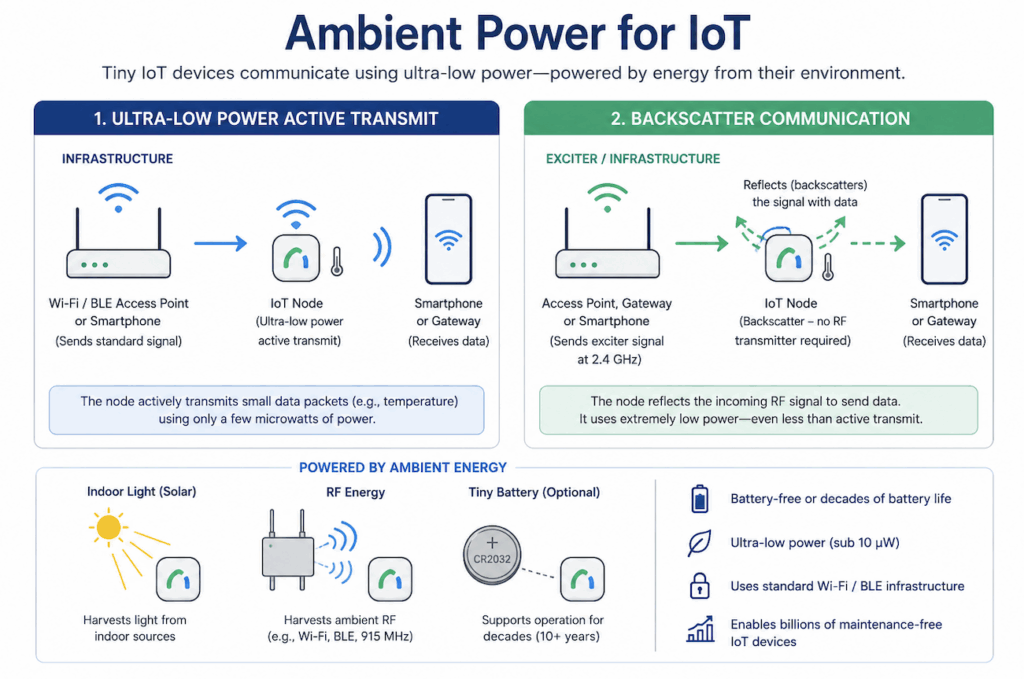
Haila is developing two complementary technologies. The first is ultra-low-power active transmission, where the device still generates its own radio signal but using an entirely new low-power RF architecture. The devices remain compatible with existing Wi-Fi and Bluetooth infrastructure while consuming dramatically less energy.
The second—and perhaps more intriguing—is backscatter communication. Instead of generating its own radio transmission, a backscatter device reflects an existing wireless signal already present in the environment. The technique has long been used in RFID systems, but Haila is adapting it for Wi-Fi and Bluetooth networks.
Because the radio does not need to generate RF power, energy consumption falls even further, making battery-free operation practical using harvested light or RF energy.
Existing standards—not proprietary networks
One of the most significant aspects of ambient IoT is that it does not require entirely new wireless ecosystems. Industry standards groups are already working on incorporating ambient-power concepts into existing protocols. Within IEEE, Task Group 802.11bp is developing Ambient Power WLAN specifications, while 3GPP Release 19 includes work on Ambient IoT for cellular networks.
The objective is to preserve compatibility with existing infrastructure while dramatically reducing protocol overhead and power consumption. That means future ambient-powered sensors could communicate directly with standard Wi-Fi access points, smartphones, and gateways.
Battery-free sensing is already becoming real
Haila demonstrated several prototype systems illustrating where the technology is heading. These include:
- Battery-free Wi-Fi temperature and humidity sensors powered entirely from indoor light
- RF energy-harvested Wi-Fi sensor nodes
- Bluetooth temperature sensors capable of operating for decades from a single CR2032 coin cell
- Ultra-low-cost Bluetooth logistics and asset-tracking tags using either tiny printed batteries or no battery
- While still early, these demonstrations suggest that practical battery-free wireless devices are rapidly moving from research into commercial development.
Where the first markets will emerge
According to Bower, the strongest commercial interest today comes from smart buildings and home automation, where large numbers of maintenance-free sensors could significantly reduce installation and operating costs. Other promising markets include:
- Industrial monitoring
- Automotive electronics
- Healthcare and patient monitoring
- Logistics and inventory tracking
- Asset management
Logistics, in particular, appears to be gaining momentum thanks to Bluetooth-based backscatter tags that could dramatically lower the cost of tracking goods throughout supply chains.
A fundamental shift for IoT
Ambient power is about much more than improving battery life. If wireless communications can operate using harvested energy alone, many IoT devices may no longer require batteries at all. That changes the economics of deploying sensors at massive scale while reducing maintenance costs and environmental impact.
The challenge now shifts to the wireless industry itself. Existing protocols must evolve to support these ultra-low-power devices without sacrificing interoperability or security. If those efforts succeed, ambient-powered Wi-Fi and Bluetooth could become one of the most important developments in IoT over the next decade—quietly enabling billions of connected devices that simply never need their batteries replaced.