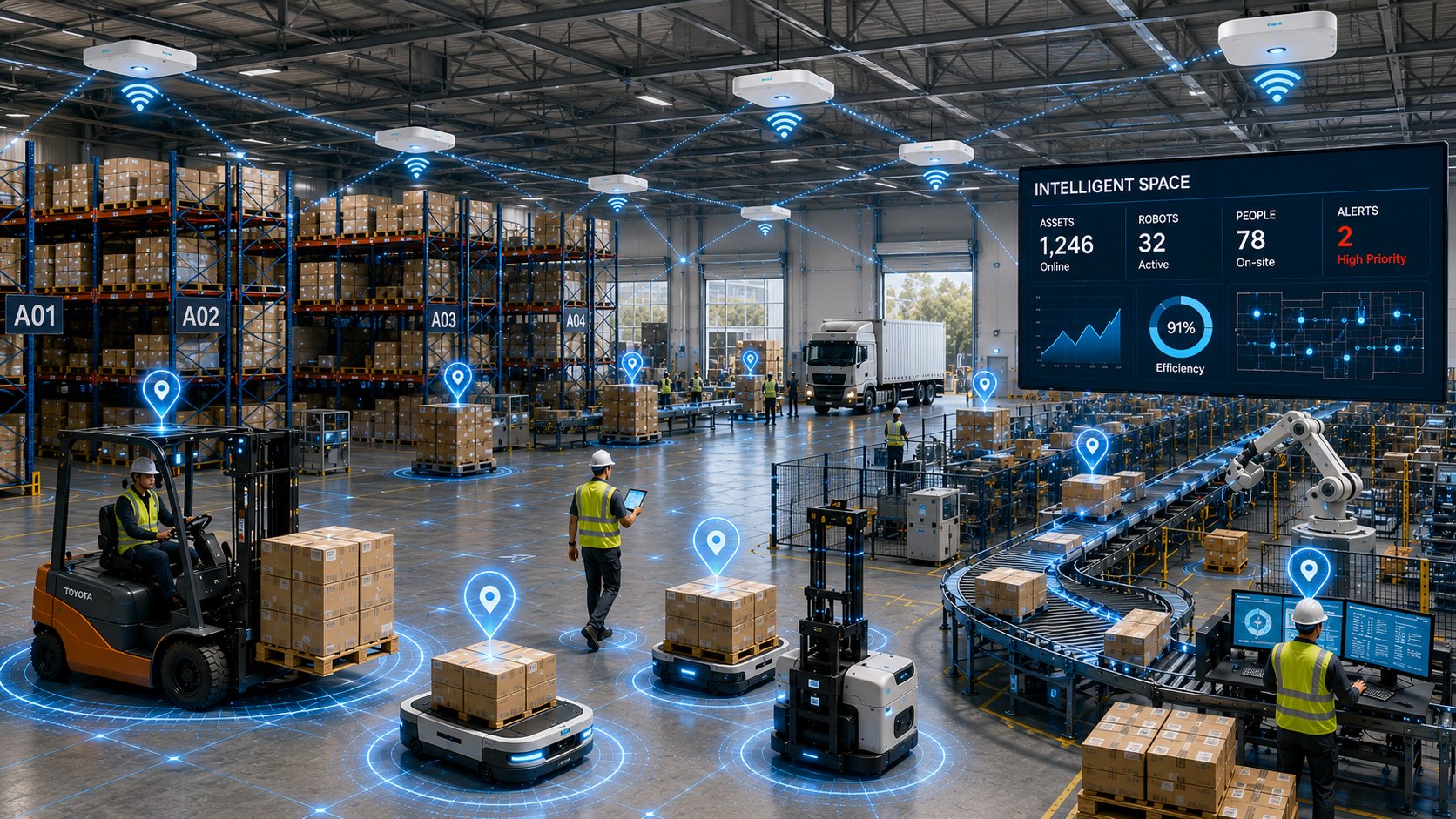

From knowing where things are to understanding what’s happening
The first generation of industrial location systems answered a simple question: Where is my equipment? Today’s enterprises require much more. Modern factories, warehouses, hospitals, airports, and logistics centres increasingly rely on automation, robotics, artificial intelligence, and digital twins.
These technologies all depend on one critical input: Knowing where people, machines, vehicles, tools, and inventory are – accurately and continuously. This is where ultra-wideband is becoming one of the most important enabling technologies for the next generation of intelligent industrial environments. UWB no longer simply tracks assets – instead it provides the precise spatial awareness that allows physical operations to become intelligent.
Why centimetres matter
In many industrial environments, knowing that a pallet is “somewhere in Warehouse A” is no longer enough. Autonomous mobile robots must know exactly where the pallet is before they can collect it and production systems must know precisely where tools are located before beginning the next manufacturing step. Hospitals need to locate life-saving equipment immediately. Factories increasingly coordinate fleets of robots operating simultaneously within shared spaces. The difference between one metre and ten centimetres can determine whether automation succeeds—or fails.
From RTLS to Enterprise Location Intelligence
For years, UWB has been associated with Real-Time Location Systems (RTLS). Traditional RTLS answers questions such as: Where is this forklift? Where is this patient monitor? Where is this pallet? Today’s systems are required to go much further. Location has become another operational data source alongside video, sensors, enterprise software, and AI. Instead of simply locating objects, organisations increasingly analyse movement patterns, optimise workflows, coordinate robots, improve safety, and automate decisions. The result is what many now describe as Enterprise Location Intelligence.
Building Intelligent Spaces
An intelligent space continuously understands what is happening within it. It knows:
- Where equipment is
- Where inventory is moving
- Where robots are operating
- Which production step is occurring
- Which pathways are congested
- Where safety risks are developing
In other words: Precise location becomes another digital layer describing the physical world. This information feeds warehouse management systems, manufacturing execution systems, robotics platforms, enterprise AI, and increasingly digital twins. In this way, location transforms into operational intelligence.
The rise of Physical AI
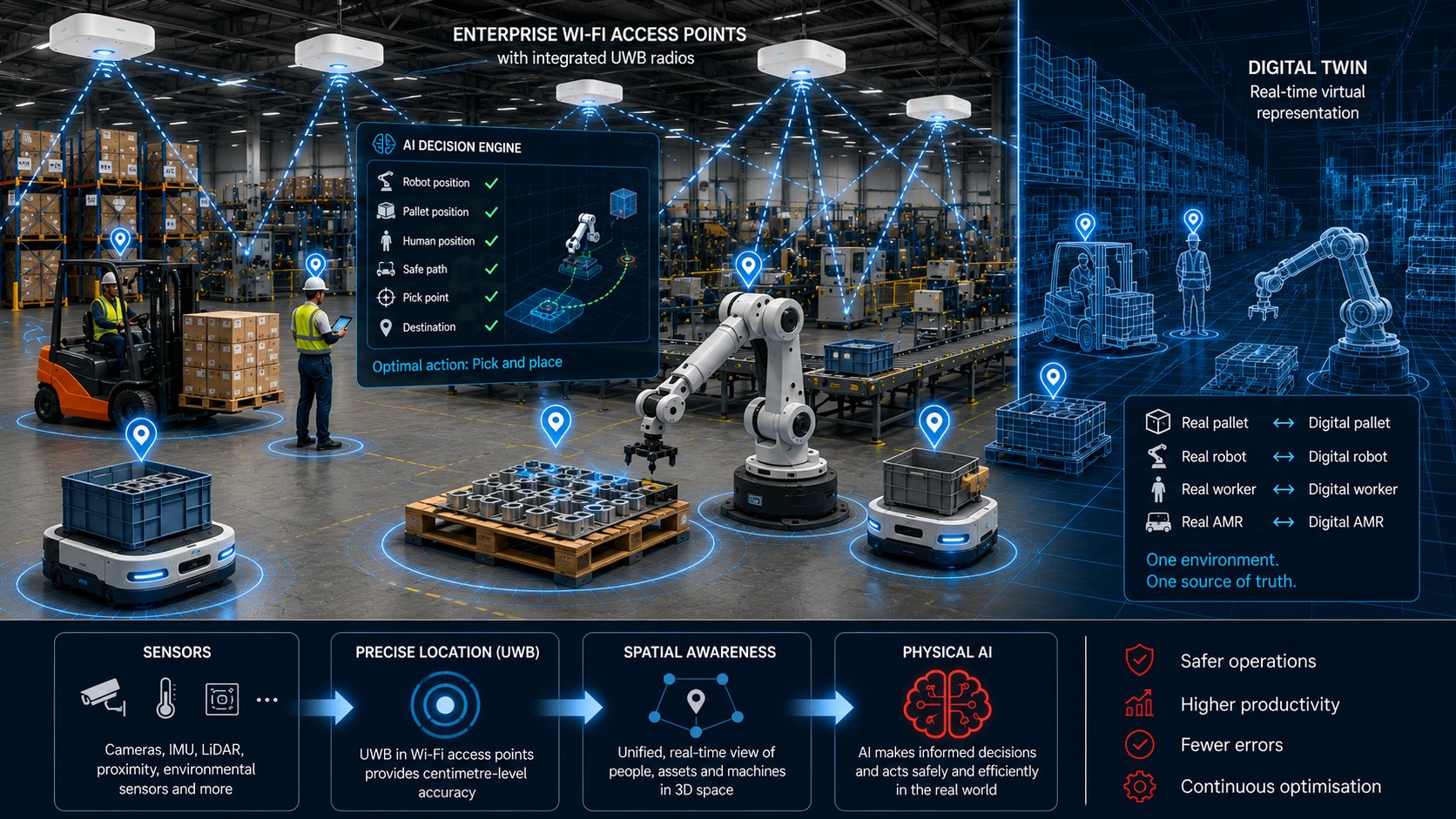
Artificial intelligence has largely focused on digital information—documents, images, speech, and software. Physical AI extends intelligence into the real world in the following ways: Robots must understand where objects are. Autonomous vehicles must understand their surroundings. Factories must coordinate people and machines safely. Digital twins require continuously updated information describing physical operations. Without accurate location data, Physical AI cannot reliably understand or interact with the real world. UWB provides one of the critical sensing layers that makes this possible.
Industries adopting UWB
- Industrial UWB deployments continue to expand across numerous sectors:
- Manufacturing: Factories track tools, workpieces, forklifts, robots, and production assets while optimising manufacturing workflows.
- Warehousing and Logistics: Distribution centres locate pallets, containers, autonomous vehicles, and inventory while improving order fulfilment and reducing search times.
- Healthcare: Hospitals locate infusion pumps, wheelchairs, monitors, and other critical equipment while improving operational efficiency.
- Airports: Ground-support equipment, baggage carts, service vehicles, and maintenance assets can all be tracked in real time.
- Mining and Construction: Worker safety, vehicle coordination, and equipment utilisation all benefit from precise location awareness.
The ecosystem behind Intelligent Spaces: Wi-Fi infrastructure
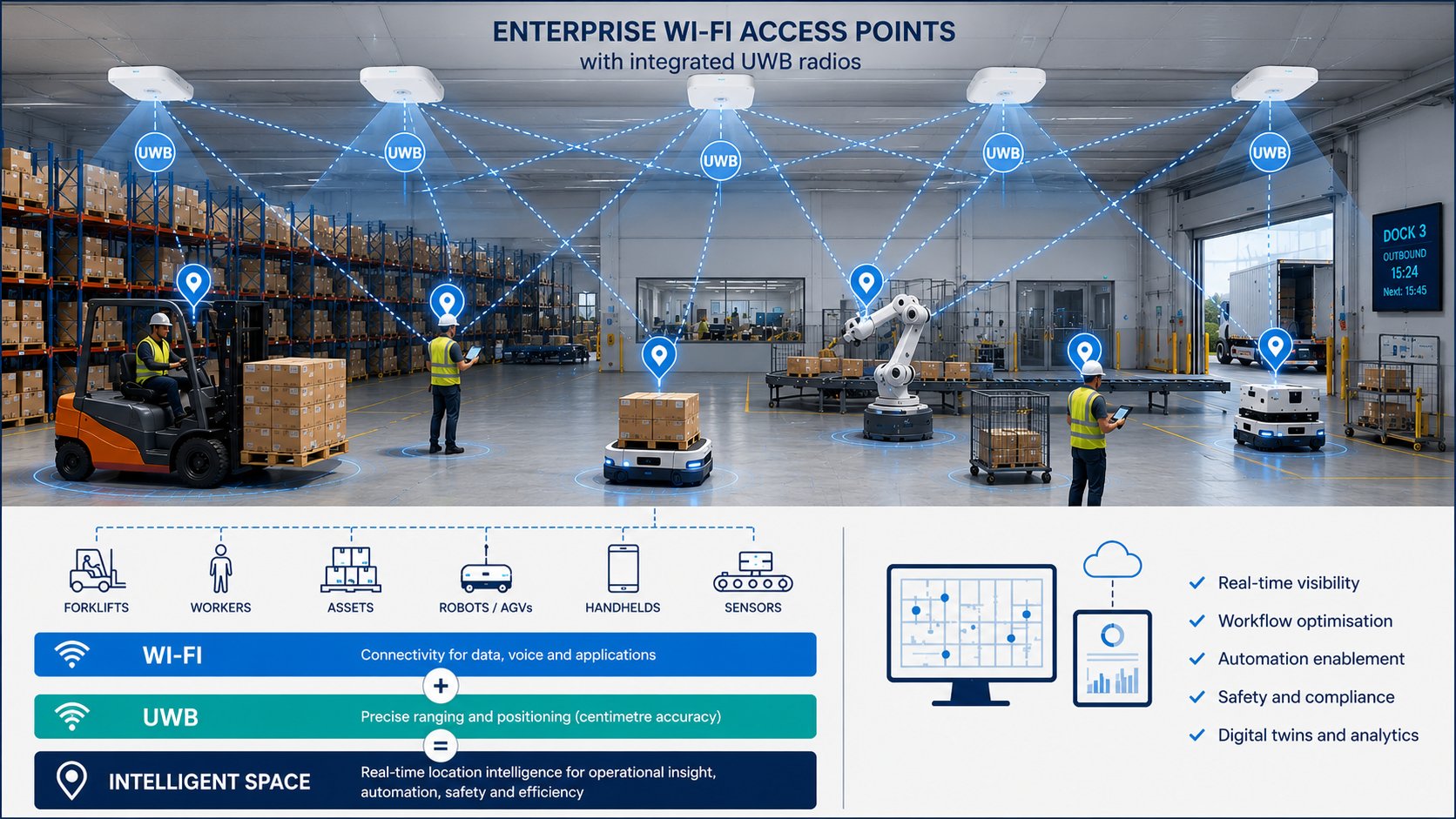
One of the strongest trends in enterprise wireless is the convergence of connectivity and positioning. Enterprise Wi-Fi already provides the communications infrastructure throughout factories, hospitals, campuses, warehouses, and public venues. As UWB radios become integrated into enterprise Wi-Fi access points, organisations can add precise location capabilities without deploying an entirely separate infrastructure.
This is a significant step towards making location services a standard feature of enterprise wireless networks rather than a specialised overlay. Connectivity and positioning increasingly become two complementary services delivered by the same Wi-Fi infrastructure. For enterprise IT organisations, this lowers deployment costs, simplifies management, and significantly reduces the barrier to adopting intelligent location services. Over time, the combination of Wi-Fi connectivity and UWB precision could make spatial awareness as fundamental to enterprise networks as wireless connectivity itself.
Challenges remain
Despite rapid growth, several challenges remain: Deployments require investment in infrastructure as interoperability continues to mature. Application software must integrate location data into business processes while organisations must also establish clear returns on investment before large-scale deployments. Nevertheless, location is becoming another foundational enterprise data source.
WiFi NOW’s take: Enterprise UWB is no longer simply an asset-tracking technology. It is becoming a core component of intelligent spaces, where precise location enables automation, robotics, digital twins, and Physical AI. For the Wi-Fi industry, this evolution is particularly significant. As UWB increasingly becomes integrated into enterprise Wi-Fi infrastructure, wireless networks will do more than connect devices—they will help buildings understand where people, equipment, and machines are, and support the intelligent decisions that follow. In that sense, UWB is adding a new dimension to enterprise wireless: not just connectivity, but spatial awareness.