
Based on a conversation with Johan Terve, Senior Director of Marketing at Enea.
WiFi NOW’s TAKE: ‘Wi-Fi offload’ (a better phrase is mobile/Wi-Fi convergence) has been pursued for more than a decade in various forms. The idea is for mobile phones to connect automatically to Wi-Fi services where available, appropriate, and authorised. There are multiple benefits for users, venues, and operators including excellent indoor coverage (5G coverage can be poor indoors) as well as additional connectivity capacity and higher data rates. Today, much (but not all) of ‘Wi-Fi offload’ takes place within the framework of OpenRoaming – an initiative initially conceived by Cisco and today managed and promoted by Wireless Broadband Alliance. One of the leading providers of OpenRoaming service platforms is Enea.
For decades, public Wi-Fi has suffered from the same problem: connecting is often cumbersome. Users must search for networks, accept terms and conditions, enter passwords, or create accounts before gaining access. Meanwhile, cellular roaming has evolved into a largely invisible process that “just works.” OpenRoaming aims to bring the same seamless experience to Wi-Fi.
According to Johan Terve of Enea, OpenRoaming’s vision is simple but transformative: Make Wi-Fi roaming as seamless and secure as cellular roaming.
What Is OpenRoaming?
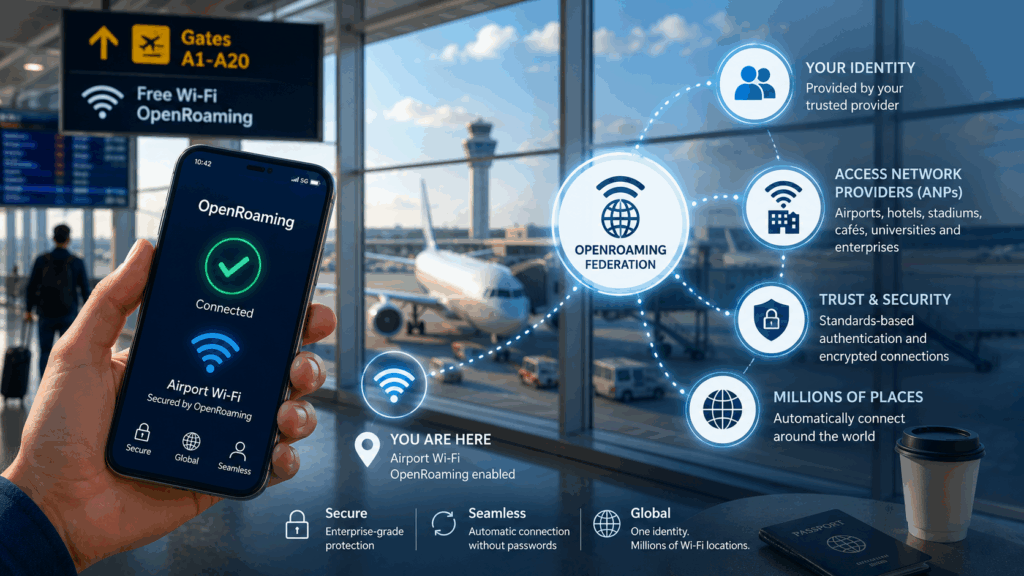
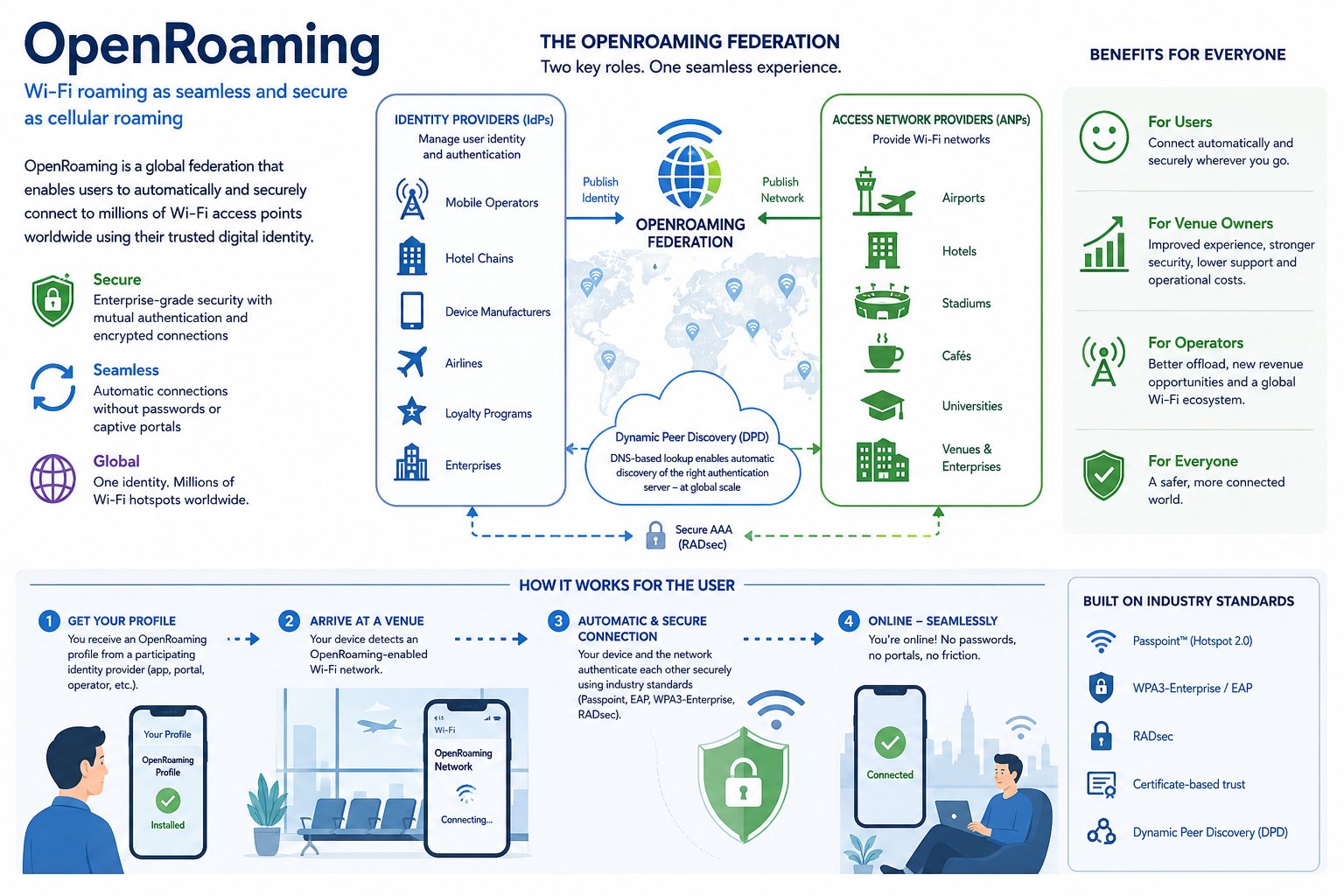
OpenRoaming is a global federation of Wi-Fi networks operated by the Wireless Broadband Alliance. It enables users to connect automatically and securely to participating Wi-Fi networks using trusted digital identities. The OpenRoaming ecosystem consists of two primary participants:
- Access Network Providers (ANPs) – organizations that operate Wi-Fi networks.
- Identity Providers (IdPs) – organizations that manage user identities and authenticate users.
Any existing Wi-Fi network can become part of OpenRoaming through software configuration and standards-based integration.
The Technology Behind the Magic
One of the challenges with traditional Wi-Fi roaming has always been scale.
Historically, roaming required bilateral agreements between network operators. While workable for a handful of partners, this approach becomes impossible when millions of Wi-Fi access points are involved. OpenRoaming solves this problem using a mechanism called Dynamic Peer Discovery (DPD). Through DNS-based lookups, a participating Wi-Fi network can automatically discover and communicate with the appropriate authentication server for a user’s identity provider.
The result is remarkable: Users can automatically connect to Wi-Fi networks they have never encountered before, provided both the network and the user’s identity provider participate in the federation.
How Users Connect
The user experience is designed to be invisible – or ‘zero touch’: A user first receives an OpenRoaming profile through an app, portal, mobile operator, device manufacturer, or another participating identity provider. Once installed, the profile remains on the device. When the device encounters an OpenRoaming-enabled network, it automatically recognises a matching federation identifier and initiates secure authentication. The user simply connects—without passwords, captive portals, or manual intervention. As Johan Terve explains, the app itself does not need to run continuously. Its primary role is to provision the identity profile. Once that profile is installed, the device can connect automatically whenever it encounters a participating network.
Carrier-grade Security Built In
Unlike traditional public Wi-Fi access, OpenRoaming relies on enterprise-grade authentication technologies. The framework uses standards such as:
- Passpoint (Hotspot 2.0)
- WPA Enterprise authentication methods
- EAP authentication
- RADsec secure RADIUS transport
- Certificate-based trust relationships
This approach not only simplifies access but also significantly improves security. Authentication is performed automatically and securely, while session encryption protects user traffic over the air.
Who Can Become an Identity Provider?
One of OpenRoaming’s most powerful features is the diversity of organizations that can act as identity providers. Examples include:
- Mobile operators
- Device manufacturers
- Hotel chains
- Airlines
- Loyalty programs
- Social media platforms
- Enterprises of all kinds
A hotel loyalty app, for example, could provision an OpenRoaming profile onto a guest’s smartphone. That same identity could then be used to connect automatically to millions of unrelated OpenRoaming hotspots worldwide. This transforms digital identities into global Wi-Fi credentials.
Why OpenRoaming Matters for Operators
For mobile operators, OpenRoaming represents a significant opportunity: Operators have long viewed ‘Wi-Fi offload’ as a way to improve indoor coverage and reduce pressure on cellular networks. However, they have often hesitated because they lacked visibility into the quality of third-party Wi-Fi networks. According to Terve, a major industry initiative is now addressing this challenge through the development of Wi-Fi Access Network Metrics (ANM).
This emerging capability would allow near real-time Wi-Fi performance information to be exchanged through standardized RADIUS attributes, enabling operators to evaluate Wi-Fi quality before steering traffic onto a network. If successful, operators could make intelligent decisions based on actual user experience rather than simply network availability.
The Road to Wi-Fi Monetization
Perhaps the most intriguing implication of OpenRoaming is its potential to create a true wholesale market for Wi-Fi access. Today, most OpenRoaming deployments operate without settlement between providers. In other words, access is generally exchanged without financial compensation. Terve believes this could change.
Once operators gain confidence in the quality of participating Wi-Fi networks through standardized performance metrics, the industry may evolve toward settlement models similar to those used in cellular roaming. This could create entirely new monetization opportunities for venue owners, enterprises, and Wi-Fi network operators.
OpenRoaming and IoT
OpenRoaming may also play an important role in simplifying IoT deployment. A joint initiative involving the Wireless Broadband Alliance and the FIDO Alliance is exploring how device certificates can be used alongside OpenRoaming to automate IoT onboarding. Devices could potentially connect automatically to available OpenRoaming networks and complete secure provisioning without user intervention. If widely adopted, this approach could remove one of the most persistent challenges in large-scale IoT deployments: secure onboarding.
Why OpenRoaming Is Still Early
Despite millions of participating access points already deployed worldwide, OpenRoaming remains in the early stages of adoption. The technical foundations are largely in place:
- Modern Wi-Fi infrastructure supports Passpoint.
- Smartphones have supported the required technologies for years.
- Federation mechanisms are operational.
- Identity ecosystems are growing.
The next phase will depend on expanding identity provider participation, developing quality-aware traffic steering, and introducing commercial settlement models.
Key Takeaways
- OpenRoaming creates a global federation for automatic and secure Wi-Fi access.
- Users connect without passwords, captive portals, or repeated registrations.
- Dynamic Peer Discovery enables roaming across millions of previously unknown Wi-Fi networks.
- Identity providers can include operators, hotels, airlines, device manufacturers, and loyalty programs.
- Emerging Wi-Fi quality metrics may enable intelligent traffic steering and future settlement models.
OpenRoaming could become a foundational technology for both Wi-Fi monetization and large-scale IoT onboarding.
Also don’t miss our full interview with Johan Terve here.