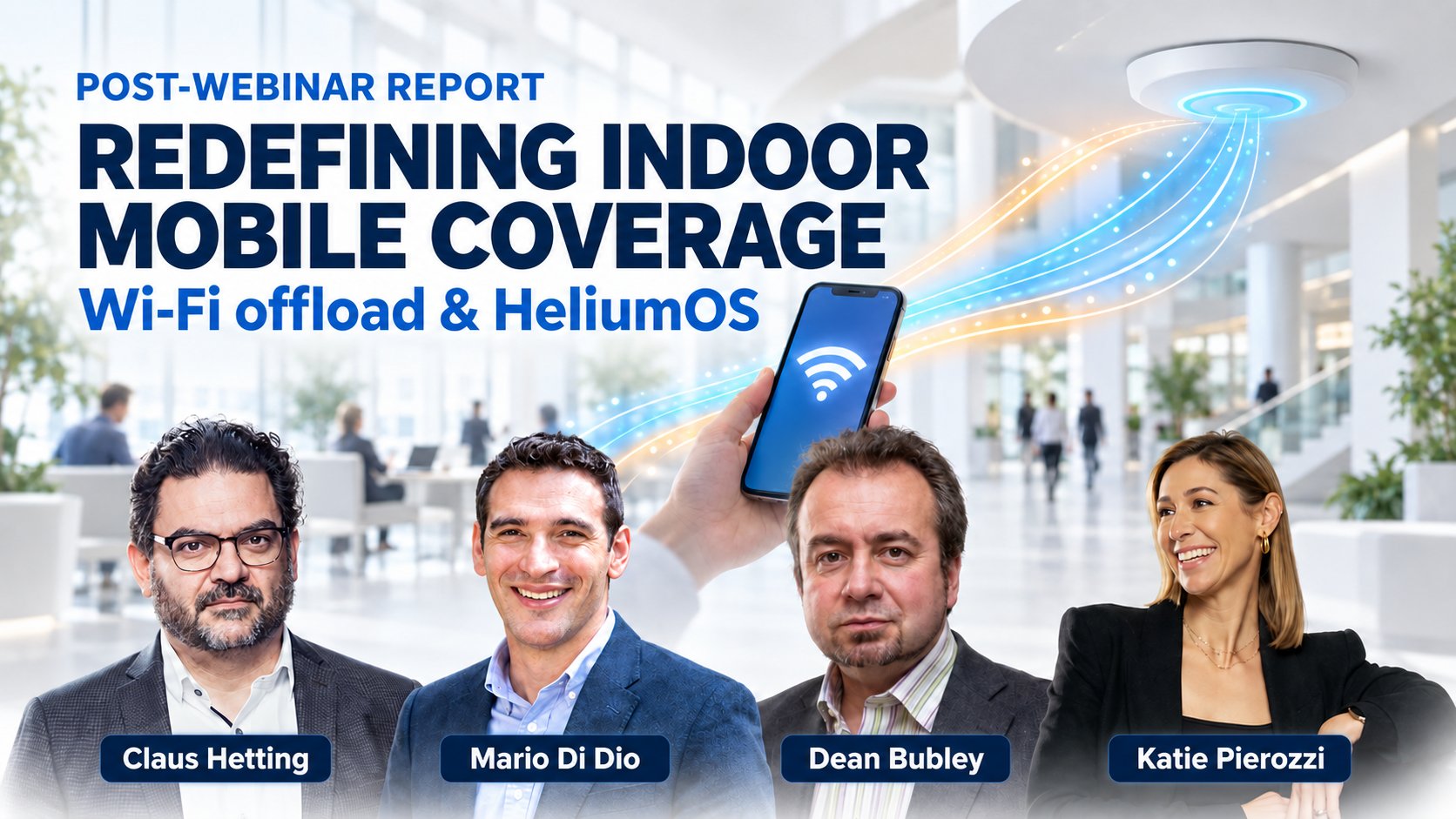

Reliable indoor mobile coverage is becoming more important while also becoming more difficult and expensive to deliver. In this detailed post-webinar report, we examine why Wi-Fi is emerging as an essential complement to cellular infrastructure and how HeliumOS aims to give mobile operators the visibility, quality control, and policy tools needed to use Wi-Fi as part of a managed mobile service.
Most mobile services are consumed indoors, but conventional mobile coverage maps say little about what happens behind coated glass, below ground, or deep inside a complex building. Even locations officially covered by a mobile network may contain basements, stairwells, car parks, elevators, conference rooms, and other areas where the practical mobile experience is poor.
At the same time, consumers and businesses are becoming more dependent on indoor connectivity. Mobile boarding passes, payment applications, QR-code menus, messaging, emergency calling, workplace applications, and connected industrial systems all need to function wherever the user happens to be.
The central question is therefore no longer whether indoor coverage matters. The question is how operators and building owners can deliver it across a vastly larger number of locations without relying exclusively on expensive indoor cellular infrastructure.
This was the focus of the recent WiFi NOW (available for viewing here) webinar featuring:
- Dean Bubley, Director of Disruptive Analysis
- Mario Di Dio, CEO of Helium
- Katie Pierozzi, CEO and Co-founder of Mambo WiFi
- Claus Hetting, CEO and Chairman of WiFi NOW
The discussion pointed towards a hybrid model in which cellular and Wi-Fi form complementary parts of the same service fabric. Helium’s newly introduced HeliumOS platform – and particularly its Wi-Fi Offload Experience gateway, known as WOX – is intended to make this model more measurable, controllable, and suitable for operator-scale deployment.
Key takeaways
- Indoor connectivity is becoming a service-quality and business-continuity issue, not merely a radio-planning problem.
- DAS, small cells, and other indoor cellular systems remain essential for many major venues, but their cost and complexity prevent them from reaching every building.
- Passpoint solves automatic Wi-Fi discovery and authentication, but operators also need real-time visibility and control over connection quality.
- Helium’s WOX gateway is designed to decide whether a subscriber should use an available Wi-Fi network – not simply whether the subscriber can connect.
- Existing enterprise and venue Wi-Fi can potentially be converted into managed offload infrastructure without replacing every access point.
- Brazil illustrates the opportunity created by extensive fibre infrastructure, high mobile usage, growing MVNO activity, and uneven mobile coverage.
- The scale of the indoor coverage challenge
- The term “indoor wireless” covers an enormous variety of environments. These include homes and apartment buildings, offices, hotels, airports, shopping centres, hospitals, factories, warehouses, mines, stadiums, and transport systems.
Dean Bubley estimates that the world contains approximately 250 billion square metres of indoor floor space. No single technology or investment model can economically provide uniform coverage across an area of this scale. Indoor coverage is also becoming technically more difficult. Modern low-emissivity glass can severely attenuate radio signals and effectively turn a building into a partial Faraday cage. Reinforced concrete, metal structures, underground areas, elevators, and shielded hospital environments create further challenges.
Meanwhile, mobile networks are increasingly using higher frequencies to deliver more capacity. Mid-band 5G provides significantly more performance than traditional low-band systems, but higher-frequency signals generally penetrate buildings less effectively. The problem could become more pronounced as operators and policymakers consider additional spectrum at 6 GHz, 7 GHz, 8 GHz, and above for future mobile systems.
The result is a difficult combination:
- Greater demand for indoor wireless services
- More applications requiring reliable connectivity everywhere
- Higher-frequency cellular networks
- Buildings that are increasingly resistant to radio penetration
Industry estimates presented by Dean Bubley suggest that a large majority of cellular usage or value is generated indoors, while more than 95% of Wi-Fi usage takes place indoors. Exact percentages depend on how traffic and locations are classified, but the strategic implication is clear: indoor performance represents a large part of the customer experience sold by mobile operators.
Why indoor cellular cannot solve every coverage problem
Distributed antenna systems, indoor small cells, repeaters, and neutral-host cellular systems remain important technologies. In major airports, stadiums, transport hubs, large corporate campuses, and other high-value locations, they may be indispensable. The limitation is scale.
Indoor cellular systems require capital, specialist engineering, operator coordination, access to appropriate spectrum, and commercial agreements between several parties. These requirements make it difficult to extend full multi-operator indoor cellular coverage to tens or hundreds of thousands of medium-sized buildings. A major international airport may justify a sophisticated DAS. A regional hotel, shopping centre, restaurant chain, or medium-sized business location may not.
This creates what Dean Bubley described as a long-tail problem. Many buildings have genuine indoor mobile coverage needs but are too small to attract an operator-funded cellular deployment. The building owner may also be reluctant to finance an expensive cellular system, particularly when the building already has high-capacity broadband, Ethernet, and enterprise Wi-Fi.
The answer is not to replace every cellular system with Wi-Fi. Rather, Wi-Fi can provide an additional indoor access layer in locations where installing or upgrading cellular infrastructure is not economically viable.
Wi-Fi needs to become part of the mobile service fabric
Wi-Fi already has the indoor footprint. The missing element has historically been the ability to incorporate independently operated Wi-Fi networks into a predictable mobile service. Captive portals remain widely used for guest access, but they introduce friction. Users may need to find the network, accept terms, provide personal information, or complete a login process. Many users simply remain on cellular rather than going through this process.
Passpoint addresses much of this problem by allowing compatible devices to discover and authenticate to participating Wi-Fi networks automatically using trusted credentials. For a mobile operator, the appropriate Passpoint profile can be included in the device or carrier configuration. MVNOs, retail brands, and other service providers can also install a Passpoint profile through an application or software development kit. This means the subscriber can connect without manually selecting an SSID or completing a captive portal.
But automatic authentication does not answer another important question: Is the available Wi-Fi network good enough to carry the subscriber’s traffic? A Passpoint-enabled device may be authorised to use a network even when the access point is congested, the backhaul is performing poorly, or the cellular connection would deliver a better experience. This lack of real-time visibility and control has contributed to operators treating third-party Wi-Fi as a best-effort service.
The Helium network combines new and existing Wi-Fi
Helium describes its network as the world’s largest decentralised Wi-Fi offload infrastructure. The network combines two deployment models. The first is greenfield deployment. A host installs a new Helium-compatible Wi-Fi access point in a location where coverage is required. The second is brownfield conversion. An existing enterprise or venue Wi-Fi network is configured for Helium offload using Passpoint and RADIUS. This allows existing infrastructure to become part of the coverage footprint without replacing every access point.
Helium says its network currently includes more than 40,000 active access points and handles more than 60 TB of mobile traffic on high-traffic days. According to the company, the network serves approximately 1.5–2 million users per day. AT&T and several MVNOs use the Helium network in the United States, while Telefónica Movistar uses the network in Mexico. Helium presented examples of deployments or converted networks in Miami, Mexico City, Atlanta Airport, New Orleans, and Hudson Yards in New York.
An important part of the model is targeted deployment: Operators can identify specific geographic areas or venues where additional capacity or coverage is needed. New access points and existing Wi-Fi networks can then be added within those locations. The objective is to direct investment towards places where Wi-Fi can solve an identifiable operator or customer-experience problem.
What is HeliumOS?
HeliumOS packages Helium’s network-management and carrier-enablement capabilities into a single platform. It consists of four principal product areas: Helium AI uses network data for monitoring, proactive maintenance, support, executive reporting, marketing, and business intelligence. WOX Gateway applies quality metrics and operator-defined policies to determine when and how subscribers should use Wi-Fi. Wi-Fi Toolkit provides software components and cloud services intended to simplify Passpoint enablement for operators, MVNOs, and other service providers.
Carrier Enablement combines MVNO operational capabilities with integrated access to the Helium network. The platform is designed to address two separate requirements. The first is making Wi-Fi easier to adopt. The second is making it easier for operators to trust Wi-Fi as a service-delivery platform. WOX is central to the second requirement.
WOX asks whether the user should connect
Mario Di Dio summarised the WOX proposition with two questions. A conventional authentication system asks: Can this user connect to the Wi-Fi network? WOX asks: Should this user connect to the Wi-Fi network? Answering the second question requires more than identity and authentication. WOX needs information about the condition of the Wi-Fi network, its backhaul, the available cellular service, and the policies established by the operator or venue.
WOX is designed to collect and compare metrics including:
- Signal strength
- Wi-Fi generation
- Connection speed
- Transmit and receive rates
- Frame loss and retry rates
- Channel utilisation
- Noise floor
- Number of connected clients
- Backhaul latency
- Cellular radio quality and utilisation
Operators can define separate policies for accepting a new connection and maintaining an existing connection. For example, a new Wi-Fi connection might only be approved if signal strength, channel utilisation, access-point load, and backhaul latency meet specified thresholds. Cellular conditions can also be considered. Offload may be prioritised when the cellular network is congested or its local radio quality is poor. WOX continues monitoring after the device connects. If the Wi-Fi service deteriorates and no longer meets the operator’s policy, the subscriber can be returned to cellular.
The process can therefore be summarised in four stages:
- Collect live measurements from the Wi-Fi connection, backhaul, cellular network, DAS, or local probes.
- Compare the available access paths against operator-defined policies.
- Approve or reject a new Wi-Fi connection.
- Continue monitoring the session and move the user away from Wi-Fi if the required quality cannot be maintained.
The distinction between admission and continuity is important. Conditions can change as more users join an access point, interference increases, or a subscriber moves through a venue. A network that was appropriate when the user connected may not remain appropriate throughout the session.
Integration without replacing the radio network
Helium describes WOX as a RADIUS passthrough proxy supporting Change of Authorization. The company says this makes it possible to introduce WOX as a software integration without installing new radio hardware. The precise architecture depends on the deployment.
At operator level, WOX can integrate with the mobile core and obtain information about cellular network conditions. At venue level, it may obtain information from a DAS provider. If direct integration is unavailable, cellular probes installed at the venue can provide an indication of local cellular coverage and congestion.
On the Wi-Fi side, metrics can be obtained directly from supported access points or through an enterprise Wi-Fi controller. Helium says it has made its metric-extraction code available as open source and is working with access-point manufacturers on implementation. The ability to work with existing multi-vendor infrastructure is critical. The economics of brownfield conversion weaken significantly if a venue must replace an otherwise capable Wi-Fi network before it can participate.
Brazil provides a compelling market case
Brazil combines several conditions that make Wi-Fi offload particularly relevant. According to figures presented by Mambo WiFi, 86% of Brazilian households had internet access in 2025, while 73% of connected homes used fibre or cable. At the same time, the presentation cited NIC.br data suggesting that 78% of Brazilians aged ten or older experience limited or precarious connectivity.
Brazil also has a large and fragmented fixed-broadband sector. Mambo cited approximately 45.6 million fixed-broadband connections distributed across around 21,000 providers. This gives the country extensive fixed infrastructure but no single provider with complete national reach. Mobile usage is exceptionally high, with more than 220 million active mobile lines and heavy use of social media, messaging, video, and other data-intensive applications.
The mobile market is dominated by Vivo, Claro, and TIM, but the country also has a growing MVNO sector. Regional ISPs, financial technology companies, retailers, and other brands increasingly want to combine fixed broadband, mobile, and digital services. For MVNOs, Wi-Fi offload offers a relatively direct economic proposition. Every eligible gigabyte moved to Wi-Fi can potentially reduce the amount of wholesale mobile capacity purchased from the host operator.
For the major mobile operators, cost reduction is only one possible motivation. Wi-Fi can improve service in airports, shopping centres, stadiums, and other locations where upgrading a DAS is uneconomic. Better indoor coverage may also help operators win business accounts and reduce customer complaints.
Mambo reports approximately 45,000 active access points in Brazil, more than 30 million registered users, and hundreds of thousands of daily authentications. Not every access point is Passpoint-ready or suitable for offload, but the installed base provides a starting point for identifying and converting valuable locations. Mambo and Helium announced their Brazilian joint venture in December 2025. The partners are working to introduce Passpoint and managed Wi-Fi offload using Mambo’s local footprint and Helium’s platform.
Captive portals and Passpoint will coexist
Passpoint will not replace every captive portal immediately. Captive portals continue to provide venues with engagement, marketing, data collection, and advertising opportunities. They also provide access to users whose devices or service providers do not have an appropriate Passpoint profile. Passpoint provides a different experience: automatic and largely invisible connectivity for users carrying a recognised credential.
Mambo expects the two models to coexist. Some users will enter through the automatic Passpoint route, while others will continue to use a captive portal. Over time, the relative share may shift as more operators, MVNOs, devices, and venues adopt Passpoint.
Wi-Fi and cellular are becoming complementary
The strongest conclusion from the webinar is that indoor connectivity will increasingly be assembled from several technologies. DAS, small cells, repeaters, private cellular networks, and neutral-host systems will remain important. Wi-Fi will not replace them everywhere. But the cost and complexity of indoor cellular infrastructure leave a large number of venues without an economically viable solution.
Wi-Fi has the installed footprint, backhaul, and indoor economics needed to address much of this gap. What operators require is confidence that subscribers will only be moved onto Wi-Fi when the network can deliver an appropriate experience. Passpoint answers the question of how the device connects. WOX is intended to answer whether it should connect and whether it should remain connected.
If this combination can operate across vendors, venues, and operator networks at scale, Wi-Fi offload can evolve from opportunistic traffic diversion into a deliberate and measurable indoor mobile coverage layer.
/Claus.