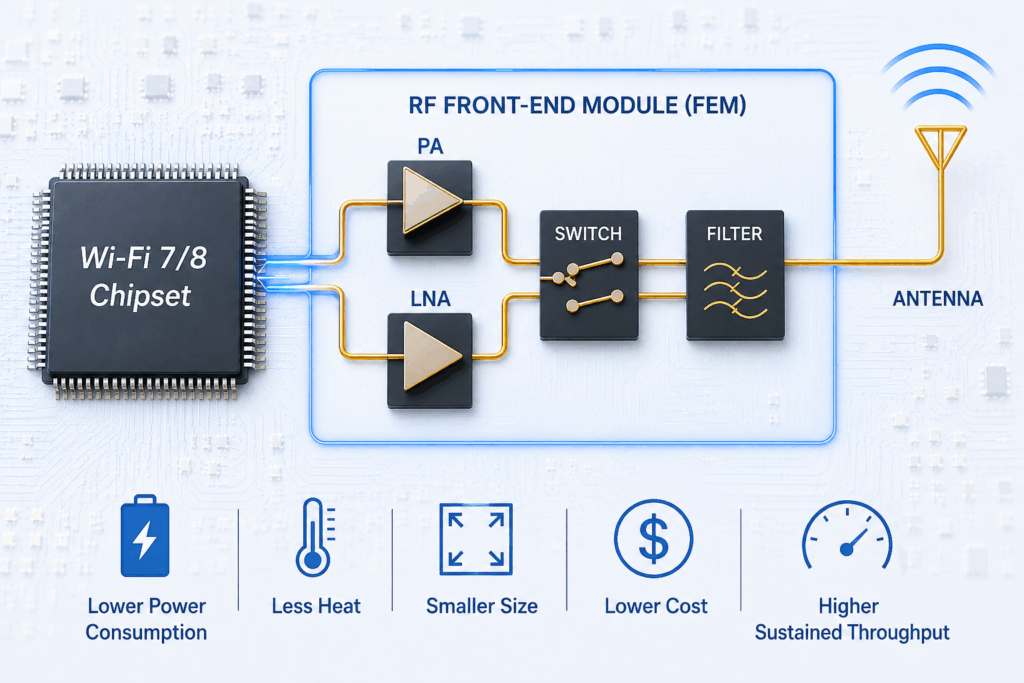

WiFI NOW’s TAKE: QuantalRF is probably the most innovative RF components provider in the world at this time because the company is proposing a radical rethink of how RF circuits (including FEMs for Wi-Fi) are designed. QuantalRF components promise a significant decrease in power consumption – a critical hardware design metric that has thus far been elusive in traditional designs.
The Wi-Fi industry has spent years chasing higher speeds, wider channels, and ever more sophisticated digital signal processing. Yet one stubborn problem remains largely unsolved: power consumption. As Wi-Fi 7 and soon Wi-Fi 8 push wireless performance to new heights, the cost of delivering that performance—in heat, energy, complexity, and device size—continues to rise. According to Dr. Ali Fard, CEO and CTO of QuantalRF, the industry may have been looking for answers in the wrong place.
In a recent WiFi NOW Tech Watch interview, Dr Ali Fard outlined a radically different approach to RF front-end design that could significantly improve efficiency while reducing system complexity and cost.
The hidden bottleneck in Wi-Fi performance
Much of the Wi-Fi industry’s innovation over the past decade has focused on digital techniques, advanced process nodes, and increasingly sophisticated chipsets. Meanwhile, RF front-end modules—the components responsible for transmitting and receiving wireless signals—have remained largely unchanged.
Fard argues that this is becoming a serious problem. As Wi-Fi systems evolve toward wider channels, higher-order modulation schemes such as 4096-QAM, and increasingly complex multi-band operation, RF power consumption rises dramatically. The resulting heat must then be managed through larger packages, heat sinks, fans, and other cooling mechanisms.
The result is a growing cost burden that extends well beyond the RF component itself. “If you buy an RF component for a dollar, you probably pay another 40 to 50 cents simply to cool it down,” Dr Ai Fard says. For access points with multiple radios and massive MIMO architectures, these costs can quickly become significant.
A challenge decades in the making
The conventional wisdom in RF design has been straightforward: improve performance by moving to better semiconductor processes and then compensate for imperfections using digital correction techniques such as digital pre-distortion (DPD). QuantalRF believes this approach has reached its limits.
Dr Ali Fard describes the RF industry as suffering from “architectural stagnation” over the past twenty years. While semiconductor materials have improved, he argues that fundamental RF architectures have remained largely unchanged. Instead of relying on increasingly complex digital correction, QuantalRF has developed what it calls an intelligent analog architecture.
The company’s Elementum platform uses a self-correcting closed-loop system that continuously compensates for distortion at the transistor level in real time. Unlike digital pre-distortion systems, no calibration cycles, digital correction hardware, or latency are involved. “It’s like an anti-spin system in a modern car,” Dr Ali Fard explains. “The system continuously adapts to changing conditions without requiring user intervention.”
Why analog intelligence matters
The concept may sound unusual in an era dominated by AI and digital processing. Yet QuantalRF‘s approach may be particularly relevant precisely because wireless systems are becoming so complex. Digital correction techniques require additional processing power, memory resources, calibration routines, and testing. As wireless workloads continue to grow, these overheads become increasingly expensive.
By contrast, QuantalRF’s closed-loop analog architecture responds instantly to real-world conditions such as temperature variations, antenna blockage, or changing operating environments. According to Fard, the correction happens continuously and autonomously without adding system latency. The result is a simpler RF subsystem with potentially fewer dependencies on external correction mechanisms.
Efficiency gains that could reshape RF economics
The performance numbers presented by QuantalRF are striking. According to Dr Ali Fard, conventional digitally corrected gallium arsenide (GaAs) front ends often achieve less than 9% efficiency under Wi-Fi 7 operating conditions. QuantalRF’s current CMOS SOI-based products reportedly achieve approximately 25% efficiency for mobile platforms and more than 30% efficiency for access point applications.
Even more intriguing is QuantalRF’s claim that its architecture could potentially push GaAs implementations toward 45% efficiency. If these figures translate into commercial deployments, the implications could be substantial:
- Lower power consumption
- Reduced thermal management costs
- Smaller packages
- Lower bill-of-materials costs
- Improved battery life for mobile devices
- Higher sustained Wi-Fi performance
- For Wi-Fi 8 systems, where efficiency and reliability are expected to become increasingly important design considerations, such gains could prove highly valuable.
Challenging RF orthodoxy
Perhaps the most interesting aspect of QuantalRF’s strategy is not the efficiency gains themselves but the philosophy behind them. Fard compares QuantalRF’s approach to architectural shifts seen elsewhere in the semiconductor industry, particularly in AI computing.
Just as companies such as NVIDIA achieved dramatic gains through architecture rather than process scaling, QuantalRF believes RF design is overdue for a similar rethink. Rather than competing solely on semiconductor materials or process technology, the company aims to redefine how RF systems operate at a fundamental level. That is a bold ambition in a market where incremental improvements have long been the norm.
What this means for Wi-Fi
Whether QuantalRF ultimately succeeds commercially remains to be seen. The RF front-end market is highly competitive and deeply entrenched. However, the broader message is difficult to ignore. As Wi-Fi evolves into a foundational platform for AI, robotics, immersive applications, and next-generation connectivity, power efficiency is becoming as important as raw throughput.
The industry has spent years optimising digital processing and networking architectures. The next major gains may come from revisiting the analog foundations of wireless communication itself. If QuantalRF is right, the future of Wi-Fi may depend not only on smarter software and faster silicon—but also on a new generation of intelligent RF architectures.
Don’t miss our full interview with Dr Ali Fard of QuantalRF here.