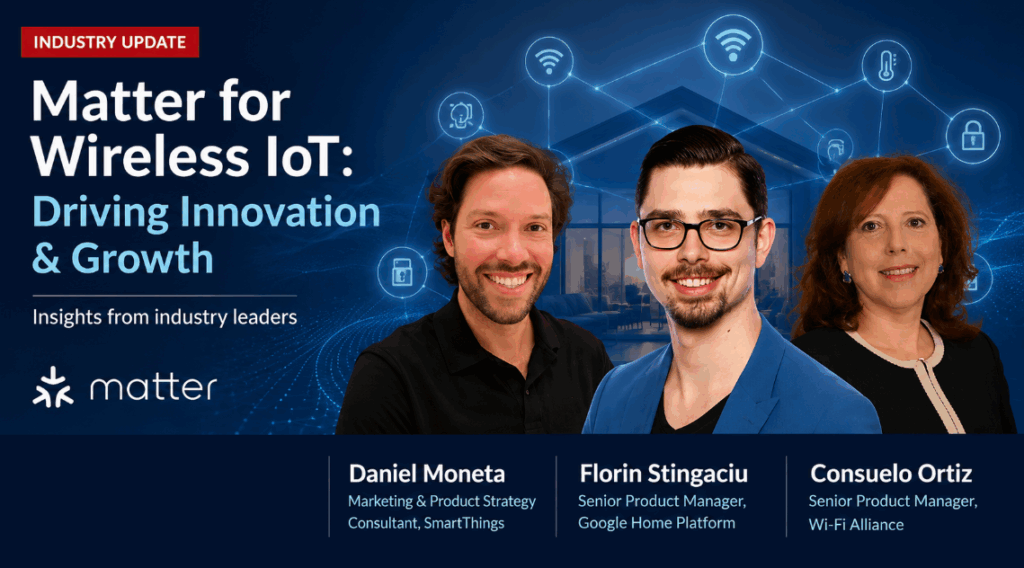

This is a summary of the WiFi NOW webinar entitled: “Matter for wireless IoT: Driving innovation & growth” (Tuesday June 30 @ 7 pm CEST / 10 am PST). The webinar can be viewed here.
Matter has reached an important milestone: Nearly four years after the smart home interoperability standard was launched, the conversation has shifted from whether Matter will succeed to what it now enables. That was the clear message from leaders representing Samsung SmartThings, Google Home, the Connectivity Standards Alliance (CSA), and the Wi-Fi Alliance during WiFi NOW’s latest Industry Update webinar.
While interoperability remains Matter’s core mission, speakers agreed that the real opportunity now lies in building intelligent services on top of a common, IP-based connectivity platform. AI, smarter home networking, and new service models for operators are all emerging as major beneficiaries of Matter’s growing ecosystem.
Interoperability is becoming infrastructure
Matter was created to solve one of the smart home’s longest-standing problems: Fragmentation. Instead of requiring device manufacturers to develop separate integrations for Google Home, Samsung SmartThings, Apple Home, Amazon Alexa, and countless other ecosystems, Matter provides a single application layer running over standard IP networking. Devices can communicate across ecosystems while manufacturers continue to deliver their own applications, services, and customer experiences. Samsung SmartThings’ Daniel Moneta stressed that this is often misunderstood
“Matter doesn’t commoditise products,” was the underlying message. Rather, it standardises the connectivity layer while leaving manufacturers free to compete through better software, industrial design, AI features, cloud services, and premium user experiences. The comparison with Wi-Fi itself is an appropriate one. Every Wi-Fi device uses the same connectivity standard, yet companies continue to differentiate through performance, features, software, and user experience. Matter aims to do exactly the same for the smart home.
Build once, innovate everywhere
Google Home Senior Product Manager Florian Stingaciu described perhaps Matter’s greatest commercial benefit: dramatically reducing development complexity. Historically, manufacturers had to maintain separate cloud integrations with every major ecosystem—a significant engineering burden that often slowed innovation. Matter changes this equation.
Manufacturers can now develop a single Matter implementation and immediately reach multiple smart home platforms. Engineering teams are freed from maintaining proprietary integrations and can instead focus on improving products, adding new functionality, and delivering richer customer experiences. Equally important, Matter does not replace first-party applications.
Those remain central to product differentiation, customer relationships, and premium services. Matter simply removes the repetitive connectivity work that previously consumed valuable engineering resources.
Broadband providers finally get a role
One of the webinar’s most interesting discussions centred on broadband service providers. Until now, ISPs have generally faced an unattractive choice: either build a complete smart home platform or stay entirely outside the market while continuing to receive customer support calls whenever connected devices fail.
Matter introduces a much more attractive middle ground. Through standardized network infrastructure capabilities, broadband providers can gain visibility into connected devices, improve diagnostics, optimise Wi-Fi networks for IoT traffic, and help customers resolve smart home problems—without needing to become full smart home ecosystem providers.
This could become one of Matter’s biggest commercial opportunities. As homes continue adding dozens of connected devices, reliable networking infrastructure becomes increasingly important. Consumers rarely blame their light bulb manufacturer when something stops working—they call their broadband provider. Matter gives operators new tools to support those customers while creating opportunities for differentiated managed Wi-Fi and smart home services.
Wi-Fi remains the foundation
The Wi-Fi Alliance highlighted the increasingly close cooperation with the Connectivity Standards Alliance. The two organisations are jointly addressing one of the industry’s most important challenges: ensuring that the networking layer and the application layer work seamlessly together. This collaboration now includes joint interoperability testing, Wi-Fi for Matter certification, improved commissioning procedures, and ongoing work to optimise Wi-Fi for battery-powered IoT devices. Certification alone, however, is not enough.
Speakers repeatedly stressed that real-world interoperability testing remains essential. Modern smart homes contain products from multiple silicon vendors, networking suppliers, ecosystems, and device manufacturers. Ensuring that these combinations work reliably requires continuous collaboration across the industry. That collaboration appears stronger than ever.
AI changes the conversation
Although interoperability dominated Matter’s early development, artificial intelligence is rapidly becoming the industry’s next focus. Every speaker pointed to AI as the natural next layer above Matter. This makes sense.
Matter already provides standardised device models, consistent communication, and local IP connectivity. AI systems can therefore understand devices using common data structures instead of proprietary interfaces. Combined with Matter’s local-first architecture, this enables faster response times, lower latency, and improved privacy compared to traditional cloud-only approaches.
Rather than relying on manually programmed automations, future AI agents could understand context, anticipate user needs, coordinate devices, optimise energy usage, or manage increasingly complex home environments automatically. Exactly how this will evolve remains uncertain. What seems increasingly clear, however, is that Matter provides the common language that AI systems will need to interact reliably with connected devices.
The most exciting applications may not exist yet
Perhaps the webinar’s most refreshing conclusion was that nobody claims to know Matter’s ultimate destination. The Internet was built long before anyone imagined streaming services or social media. Smartphones existed before mobile app ecosystems transformed the industry.
Matter may be following a similar path. Today’s focus remains connected lighting, thermostats, sensors, locks, cameras, appliances, and home networking. Tomorrow could bring intelligent robotics, autonomous home assistants, advanced energy management, healthcare applications, or entirely new categories of connected products that are difficult to predict today.
That uncertainty should not be viewed as a weakness. Quite the opposite. It suggests that Matter is evolving from a smart home standard into something much larger: foundational infrastructure upon which the next generation of connected services can be built.
The bottom line
Four years after its launch, Matter appears to have crossed an important threshold. Major ecosystems now support the standard. Certified devices continue to grow rapidly. Collaboration between standards organisations has matured. Broadband operators are beginning to recognise new commercial opportunities. And AI has emerged as the next major driver of innovation.
The plumbing is steadily falling into place. The next phase will not be defined by interoperability alone, but by the intelligence, services, and entirely new user experiences built on top of it. For the wireless IoT industry, that may prove to be Matter’s biggest achievement.
/Claus.