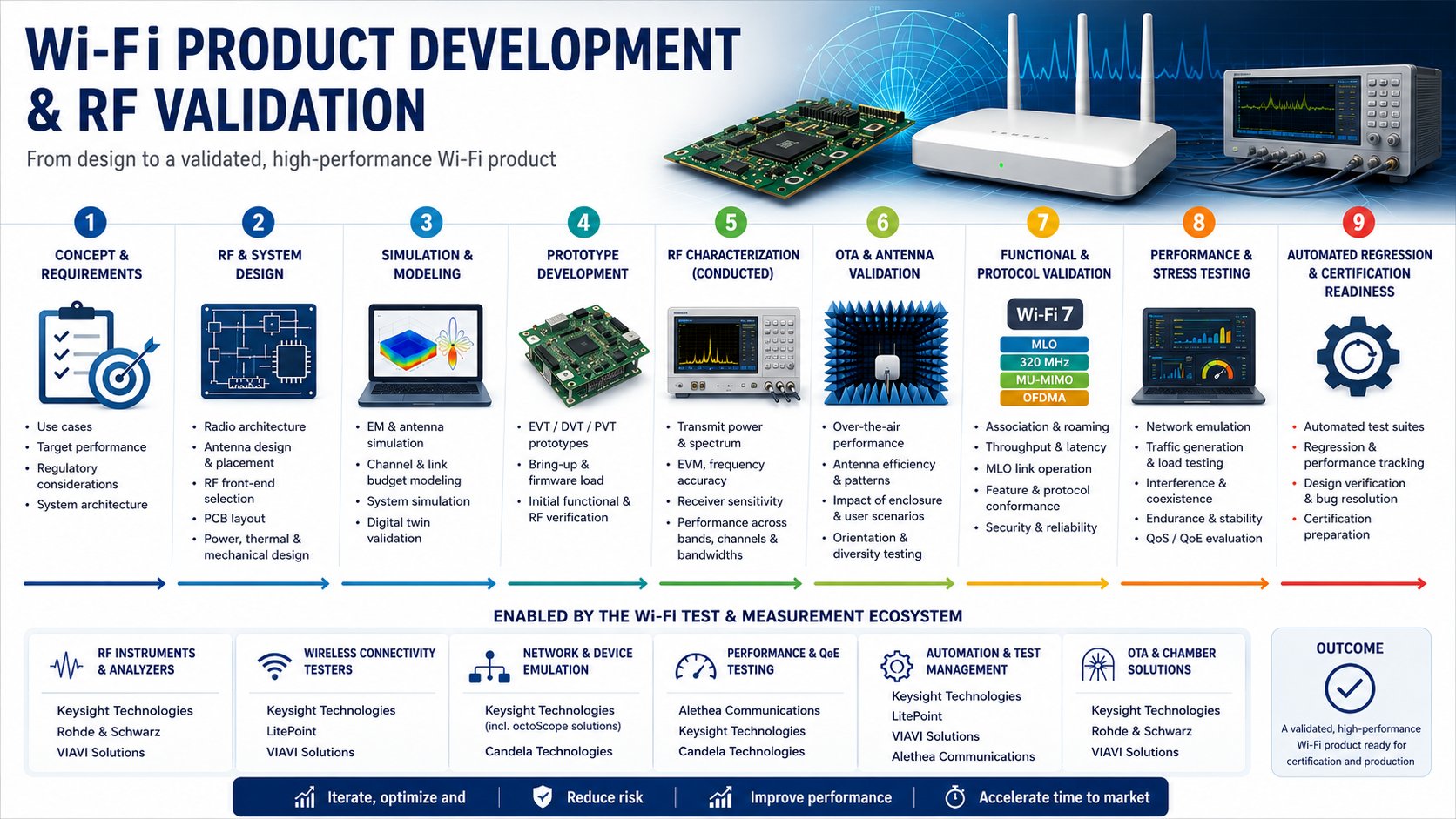

Building a Wi-Fi product is considerably more complex than integrating a Wi-Fi chipset, connecting an antenna, and verifying that the device can establish a connection. Whether the product is an enterprise access point, residential gateway, smartphone, laptop, IoT device, or another connected system, its Wi-Fi implementation must be designed and validated as a complete RF, hardware, software, and protocol system.
The process typically begins long before certification. Engineers must make decisions about radio architecture, antenna placement, RF front-end components, PCB layout, power, thermal design, shielding, and mechanical integration. Each of these decisions can affect the eventual Wi-Fi performance of the finished product.
Once prototypes become available, measurement and validation become increasingly important. Engineers need to determine not simply whether Wi-Fi works, but whether the implementation performs according to its design objectives — and whether that performance remains consistent across frequencies, channels, bandwidths, modulation schemes, operating modes, device orientations, and environmental conditions.
With Wi-Fi 6E and Wi-Fi 7 extending operation into the 6 GHz band, and Wi-Fi 7 introducing features including 320 MHz channels and Multi-Link Operation (MLO), the number of combinations that potentially need to be investigated has increased significantly.
This is where Wi-Fi test and measurement becomes a fundamental part of product development.
What needs to be tested?
Wi-Fi product validation spans several layers of the system. At the RF level, engineers characterise transmitter and receiver performance. Measurements can include output power, spectrum characteristics, error vector magnitude (EVM), frequency accuracy, receiver sensitivity, and performance across different channels and bandwidths. But conducted RF measurements tell only part of the story.
Antennas, enclosure materials, component placement, interference from other electronics, and the physical orientation of the device can substantially affect real-world performance. Over-the-air (OTA) testing therefore becomes important when validating the complete product rather than the radio subsystem alone.
Testing also moves beyond RF measurements into functional and system behaviour. Engineers may need to determine how reliably a device associates, how it performs under load, how it behaves in congested or impaired RF environments, whether roaming works as intended, and whether advanced features operate correctly.
Wi-Fi 7 adds another dimension: MLO allows devices to use multiple links across different frequency bands, creating new test scenarios involving link establishment, traffic distribution, link switching, latency, interference, and interoperability. The result is that Wi-Fi validation increasingly requires both precision RF measurement and realistic network emulation.
Creating repeatable Wi-Fi environments
One of the central challenges in Wi-Fi testing is repeatability. Testing a product against a collection of commercial access points and client devices can provide valuable interoperability information, but it is difficult to reproduce precisely the same RF and traffic conditions from one test run to another.
Laboratory test systems address this problem by creating controlled Wi-Fi environments. Test platforms can generate known RF conditions, emulate clients or networks, introduce interference and attenuation, generate traffic, and repeatedly execute defined test scenarios. RF chambers and programmable attenuation systems can further isolate the device under test from uncontrolled external signals.
This makes it possible to answer much more precise questions: What happens to throughput as signal strength deteriorates? How does latency change under load? How quickly does a client roam? How does the device respond to interference? Does an MLO implementation behave consistently when conditions on one link change?
Repeatability also makes automated regression testing possible. A firmware update can be subjected to hundreds or thousands of previously defined tests, allowing engineers to identify performance regressions that might otherwise be difficult to detect.
The Wi-Fi test & measurement ecosystem
A specialized industry has developed around these requirements. Keysight Technologies provides a broad portfolio spanning RF measurement, wireless test, network and device emulation, and automated validation. Its Wi-Fi capabilities also include technology originating from octoScope, which developed controllable Wi-Fi testbeds designed to reproduce complex wireless environments. octoScope was acquired by Spirent Communications, which was subsequently acquired by Keysight.
Rohde & Schwarz provides RF and wireless test equipment used for signal generation, signal analysis, transmitter and receiver measurements, and wireless device validation. LitePoint specializes in wireless connectivity test systems and is particularly prominent in Wi-Fi RF characterization, development, and high-volume manufacturing test.
VIAVI Solutions participates across wireless laboratory, performance, network validation, and field-testing disciplines, making it relevant at several points in the Wi-Fi validation lifecycle. Other specialists approach the problem from different directions. Alethea Communications, for example, focuses on Wi-Fi performance and experience testing, including automated benchmarking and the evaluation of devices and networks under controlled conditions.
Candela Technologies, through its LANforge platform, provides Wi-Fi client emulation, traffic generation, roaming, load, performance, and automated network testing capabilities. These companies should not necessarily be viewed as direct substitutes for one another. The Wi-Fi test ecosystem includes everything from precision RF instruments to complete network emulation environments, and sophisticated development laboratories may use several categories of equipment together.
From manual measurements to automated validation
The direction of travel is increasingly toward automation. The number of combinations involved in testing multi-band Wi-Fi products makes exhaustive manual testing impractical. Automated systems can configure devices, establish controlled RF conditions, generate traffic, collect measurements, compare results against thresholds, and repeat tests across large matrices of configurations. This is also one of the areas where AI is likely to have a growing impact.
AI-assisted systems could help engineers identify anomalous results, correlate failures across RF and protocol measurements, optimize test sequences, identify combinations most likely to expose defects, and analyse the large volumes of data generated by automated validation environments.
The objective is not simply to run more tests. It is to identify problems earlier and understand their causes faster.
Validation before certification
Product validation and certification are closely related, but they are not the same thing. Certification determines whether a product satisfies a defined set of requirements. Engineering validation asks a broader question: Does this Wi-Fi product perform the way it was designed to perform?
A device can potentially satisfy mandatory requirements while still delivering disappointing throughput, latency, range, roaming behaviour, stability, or user experience. For that reason, the strongest Wi-Fi development processes treat validation as a continuous engineering activity rather than a final checkpoint.
Simulation, RF characterization, functional testing, network emulation, performance benchmarking, interoperability testing, and automated regression testing progressively reduce uncertainty as the product moves from early prototypes toward production.
The next stage is to determine whether the finished implementation performs correctly when confronted with other Wi-Fi products, complex traffic conditions, demanding RF environments, and formal certification requirements. That is where performance, interoperability, and certification testing become the focus.
WiFi NOW’s Take:
Wi-Fi product development is becoming significantly more complex. Multi-band operation, 320 MHz channels, MLO, sophisticated antenna systems, coexistence, and increasingly demanding performance expectations mean that the number of potential test scenarios is growing rapidly.
The answer cannot simply be more testing. The industry needs smarter, more automated testing.
AI could become an important part of that transition by identifying the tests most likely to expose problems, detecting anomalies across huge datasets, correlating failures across RF, protocol, and performance layers, and helping engineers find root causes faster.
The potential business impact is significant. Better simulation, automation, and AI-assisted validation can identify design problems earlier, reduce engineering iterations, and shorten the path from prototype to production.
Ultimately, the opportunity is not just better Wi-Fi testing. It is better Wi-Fi products delivered faster – with lower development cost and risk.