

For more than twenty-five years, Wi-Fi has operated in much the same way.
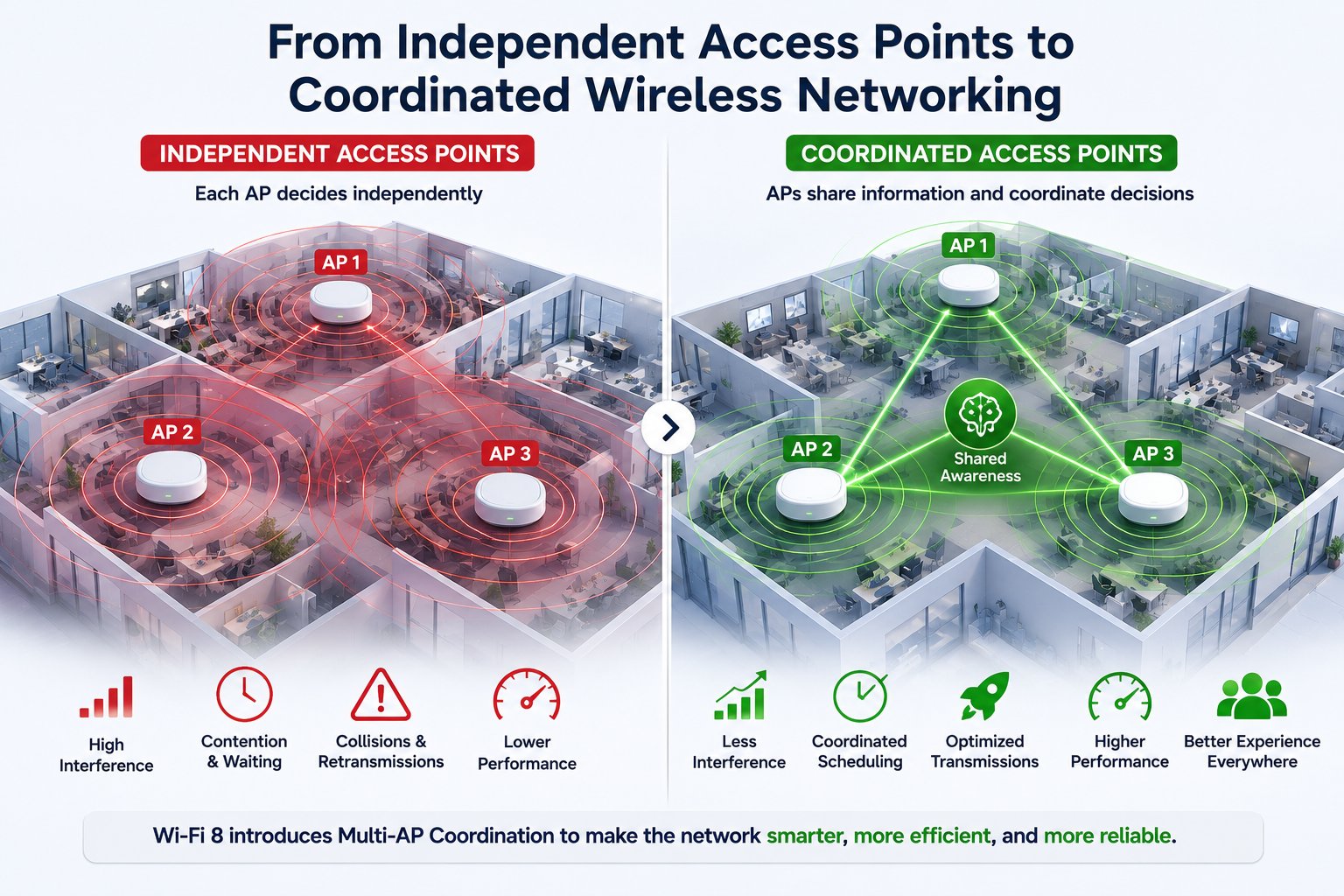
Every access point independently decides when to transmit, which clients to serve, which channels to use and how to respond to interference. This distributed architecture has been remarkably successful and has allowed Wi-Fi to scale from simple home networks to today’s enterprise, service provider and public venue deployments. But the environment in which Wi-Fi now operates has changed dramatically.
In apartment buildings, dozens of neighbouring access points may compete for the same spectrum. Enterprise campuses deploy hundreds of access points to provide seamless coverage. Stadiums, airports and convention centres must support thousands of simultaneously connected users. Service providers increasingly deploy managed mesh networks throughout the home, while industrial environments demand predictable wireless performance for automation and robotics.
In these environments, independent decision-making becomes increasingly inefficient. IEEE 802.11bn addresses this challenge through one of the most significant architectural changes in the history of Wi-Fi: Multi-AP Coordination.
Why independent access points are no longer enough
The original IEEE 802.11 protocol was designed for relatively simple networks. A typical deployment consisted of a single access point serving a small number of wireless devices. The distributed contention mechanisms built into Wi-Fi were more than adequate for these environments. Today’s networks are very different.
Coverage areas frequently overlap. Multiple access points serve the same physical space. Mesh systems create several wireless nodes within a single home. Enterprise WLANs carefully position access points to maximise capacity rather than simply extend coverage. In dense residential areas, neighbouring apartments may each contain multiple Wi-Fi networks operating on the same channels.
The result is an increasingly crowded radio environment where access points spend much of their time avoiding one another rather than serving users. Although technologies such as OFDMA, BSS Colouring and Multi-Link Operation have significantly improved wireless efficiency, they do not fundamentally change the fact that neighbouring access points still make most transmission decisions independently.
A new way of thinking about wireless networks
Multi-AP Coordination represents a change in perspective. Instead of treating each access point as an isolated device, Wi-Fi 8 increasingly views the entire wireless infrastructure as a coordinated system. Neighbouring access points can exchange information, share awareness of the radio environment and coordinate certain transmission decisions in ways that were not previously possible.
The objective is not to centralise every aspect of network operation. Rather, it is to enable neighbouring access points to cooperate when cooperation produces better overall network performance. In many respects, this represents the transition from optimising individual wireless links to optimising the wireless network itself.
What does coordination actually mean?
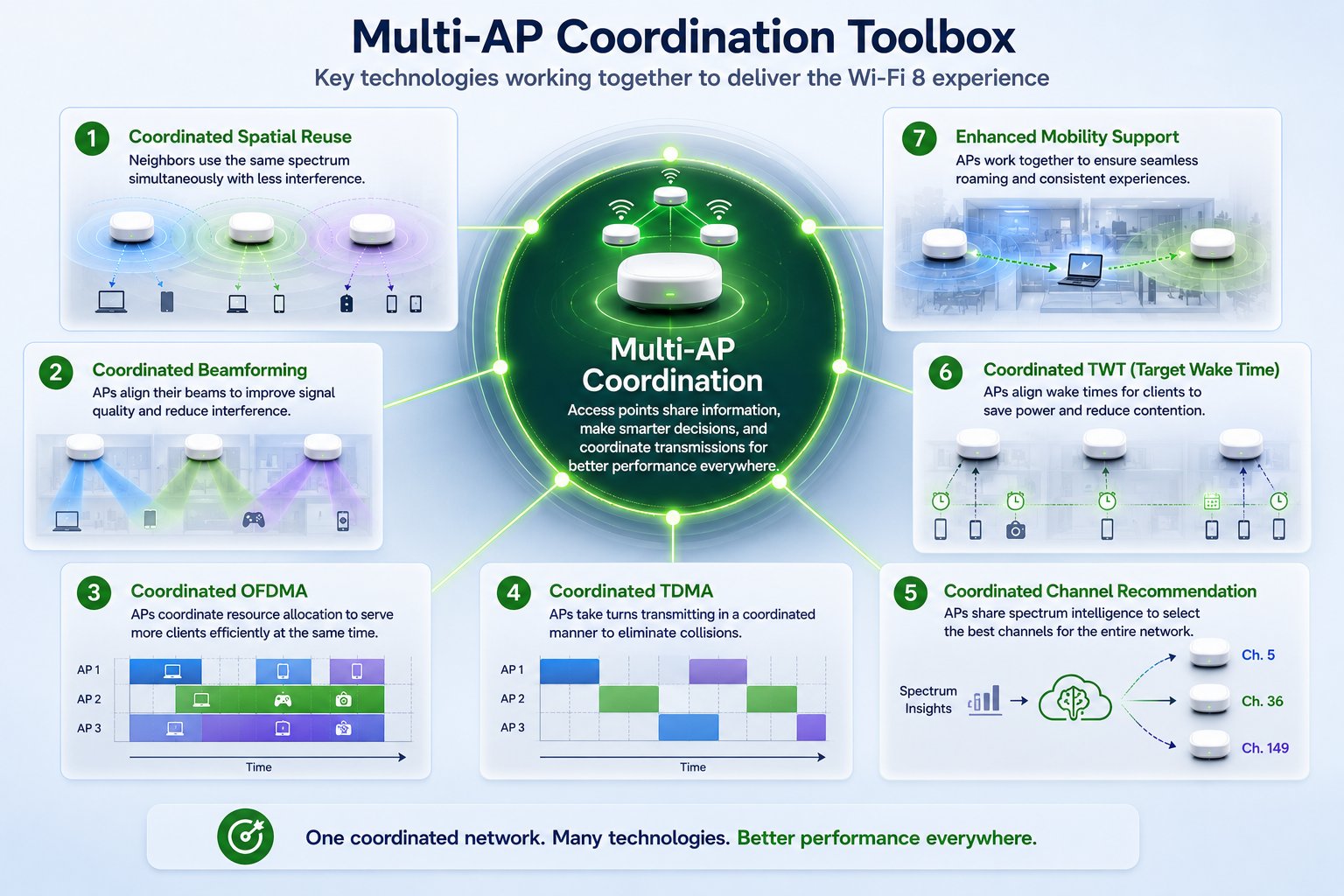
The term Multi-AP Coordination does not describe a single protocol or feature. Instead, it refers to a family of mechanisms that allow access points to work together more effectively. Depending on the deployment and the specific capabilities implemented, neighbouring access points may coordinate:
- Transmission opportunities
- Channel usage
- Spectrum reuse
- Beamforming decisions
- Traffic scheduling
- Mobility support
- Interference management
- Client servicing
Some of these capabilities require only limited information sharing. Others involve much tighter cooperation between neighbouring access points. Together, they create opportunities to reduce unnecessary contention, improve spectrum utilisation and deliver a more predictable wireless experience.
Coordinating instead of competing
Traditional Wi-Fi relies on competition for airtime. Before transmitting, an access point first determines whether the channel is busy. If another device is already transmitting, it waits. When many neighbouring networks occupy the same spectrum, this contention process can lead to increasing delays, reduced efficiency and unpredictable latency.
Multi-AP Coordination does not replace this distributed approach. Instead, it introduces mechanisms that allow neighbouring access points to make better decisions by considering the activity of nearby networks. Rather than every access point acting independently, groups of access points can increasingly cooperate to reduce conflicts and improve overall network performance.
This distinction is important. The objective is not simply to increase throughput but rather to make better use of the available airtime.
Building blocks of Multi-AP Coordination
Several of the major technologies introduced with IEEE 802.11bn support this coordinated architecture. Among them are:
- Coordinated Spatial Reuse:
Enabling neighbouring networks to make more efficient simultaneous use of spectrum.- Coordinated Beamforming:
Improving signal quality while reducing interference between overlapping access points.- Dynamic Subchannel Operation:
Allowing cleaner portions of a channel to remain usable even when part of the spectrum experiences interference.- Enhanced Multi-Link Operation:
Improving how traffic is distributed across multiple wireless links.- Improved mobility mechanisms:
Reducing service interruptions as users move between access points.Each of these technologies addresses a different aspect of network behaviour, but all contribute toward the same architectural objective: making wireless infrastructure operate more intelligently as a system rather than as a collection of independent devices. The following sections examine these technologies individually.
Benefits of coordinated networking
Although many Wi-Fi 8 technologies remain under development, the anticipated benefits of Multi-AP Coordination are already clear. Where neighbouring access points can cooperate effectively, network operators should expect:
- Better utilisation of available spectrum
- Fewer unnecessary transmission conflicts
- Lower latency variation
- Improved cell-edge performance
- Smoother roaming between access points
- Fewer dropped packets
- More consistent user experience in dense environments
Importantly, these improvements are expected to be most noticeable under challenging operating conditions rather than in ideal laboratory environments.
Why this matters for service providers
For broadband operators, Multi-AP Coordination has the potential to become one of the most commercially significant aspects of Wi-Fi 8. Many customer complaints today are not caused by insufficient broadband capacity. Instead, they result from inconsistent wireless performance within the home, interference between neighbouring networks or poor roaming behaviour in mesh deployments.
By enabling access points to cooperate more effectively, Wi-Fi 8 offers the possibility of delivering more predictable in-home Wi-Fi performance without requiring additional spectrum or dramatically higher broadband speeds. This aligns closely with the growing emphasis on managed Wi-Fi services, quality-of-experience (QoE) platforms and cloud-based optimisation systems.
Enterprise implications
Enterprise deployments are equally likely to benefit. Large office buildings, hospitals, universities, hotels and public venues routinely operate hundreds of carefully planned access points. These networks already use sophisticated radio resource management systems to optimise coverage and capacity.
Multi-AP Coordination extends this concept further by introducing standardised mechanisms that allow neighbouring access points to cooperate more directly at the wireless level. As networks become denser and applications place greater emphasis on reliability and predictable latency, this coordinated approach is expected to become increasingly valuable.
Challenges ahead
Implementing coordinated wireless networking is not without challenges. Sharing information between access points introduces additional complexity. Some coordination mechanisms may depend on low-latency backhaul connectivity or tighter integration between access points than exists today. Interoperability between equipment from different vendors will also be an important consideration as the standard matures.
For these reasons, the first generation of Wi-Fi 8 products is unlikely to implement every possible coordination mechanism. Instead, capabilities are expected to evolve over time as silicon vendors, equipment manufacturers and the Wi-Fi Alliance complete implementation and interoperability work.
WiFi NOW Perspective
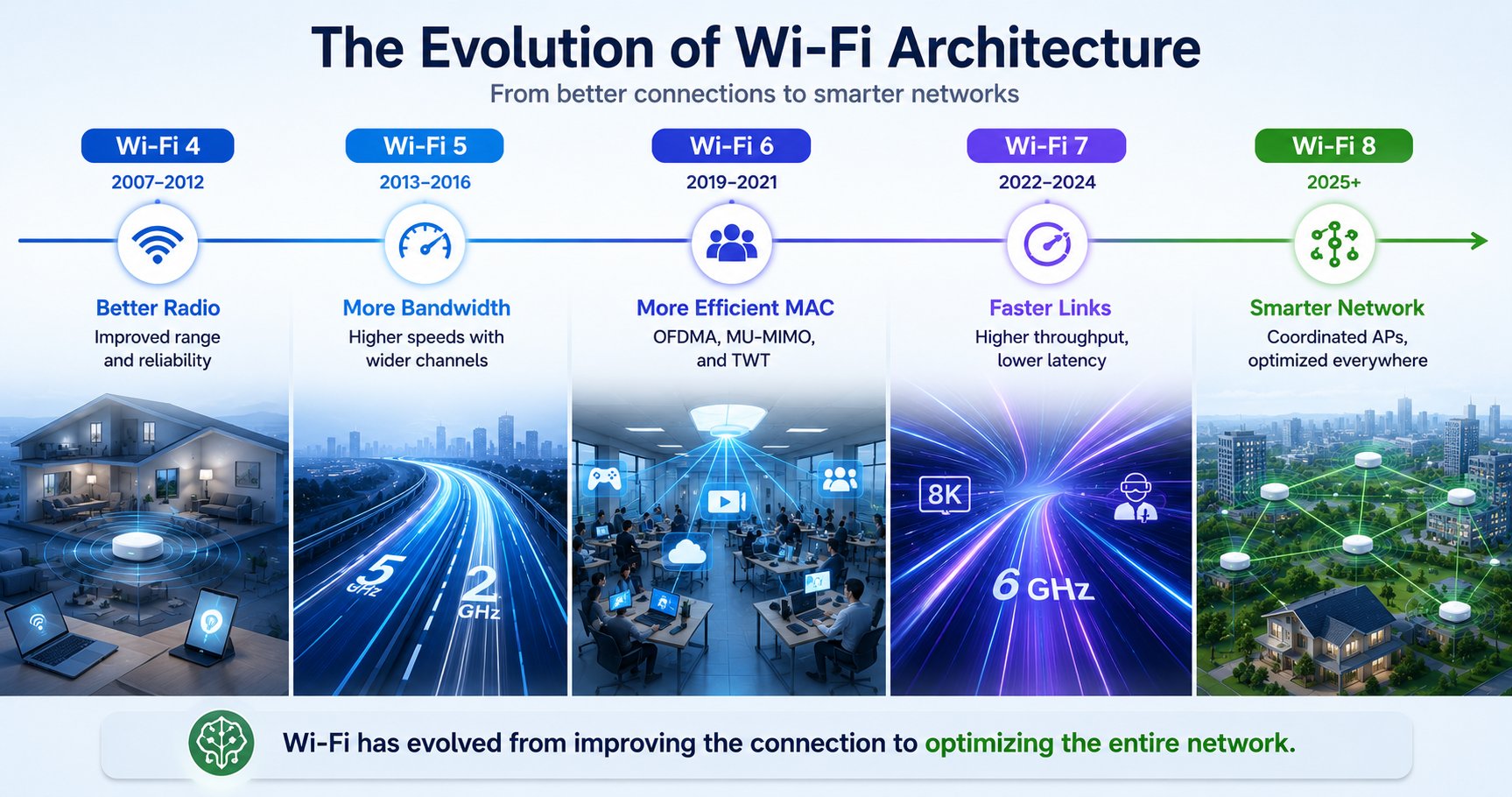
Multi-AP Coordination may ultimately become the defining innovation of Wi-Fi 8. Previous generations of Wi-Fi focused primarily on improving the performance of individual wireless links through wider channels, more advanced modulation, additional spatial streams and higher transmission rates. Wi-Fi 8 introduces a different way of thinking.
Rather than asking how an individual access point can transmit faster, IEEE 802.11bn increasingly asks how neighbouring access points can work together to improve the performance of the network as a whole. If broadly implemented, this architectural shift could prove to be one of the most significant developments in Wi-Fi since the introduction of OFDMA in Wi-Fi 6. It also points toward the future direction of wireless networking, where intelligence, coordination and cooperation become as important as advances in radio technology.
Key takeaways:
- Multi-AP Coordination is the central architectural concept behind many Wi-Fi 8 enhancements.
- The objective is to improve the behaviour of the wireless network rather than simply boosting the performance of individual links.
- Coordinated networking enables neighbouring access points to exchange information and cooperate more effectively.
- Multiple Wi-Fi 8 technologies contribute to this coordinated architecture, including spectrum management, mobility improvements and enhanced scheduling.
- The greatest benefits are expected in dense, interference-prone environments such as apartment buildings, enterprise campuses and large public venues.
- For service providers and enterprise operators, Multi-AP Coordination has the potential to improve quality of experience more significantly than another increase in peak throughput.
/Claus.