
WiFi NOW Resource Centre | Technology Guides | Bluetooth Series – Chapter 3 of 7
By Claus Hetting, WiFi NOW CEO & Chairman
Bluetooth Low Energy is preparing for its biggest increase in data rates since the introduction of the LE 2M PHY. The Bluetooth Special Interest Group is developing High Data Throughput (HDT), a new feature designed to raise Bluetooth LE speeds from today’s maximum of 2 Mbps to as much as 7.5 Mbps. The technology could enable lossless audio, faster device synchronisation, and a new generation of connected devices. But how does HDT work, and what will it mean for the wider wireless ecosystem?
1. Why Bluetooth needs more speed
Bluetooth has become one of the world’s most widely deployed wireless technologies largely because of its low power consumption, modest hardware requirements, and broad device compatibility. Bluetooth Low Energy (LE), in particular, has enabled an enormous ecosystem of wireless sensors, wearables, peripherals, and connected devices. But Bluetooth LE has never been particularly fast.
Today’s Bluetooth LE devices support a maximum physical layer (PHY) data rate of 2 Mbps, introduced with Bluetooth 5.0 in 2016. While sufficient for many applications, this limitation is becoming increasingly restrictive as connected devices grow more sophisticated.
Smartwatches collect increasingly detailed health and fitness information. Wireless audio products are moving towards higher-resolution formats. Smart glasses, medical devices, and industrial sensors are generating larger quantities of data. These applications require more than the occasional exchange of small data packets.
The Bluetooth Special Interest Group (SIG) is responding with Bluetooth High Data Throughput (HDT), a major enhancement to the Bluetooth LE radio architecture. According to the Bluetooth SIG, HDT is designed to support data rates of up to 7.5 Mbps, nearly four times the maximum rate available with today’s LE 2M PHY.
The objective is not simply to make Bluetooth faster. It is to increase the amount of information Bluetooth devices can exchange while retaining the energy efficiency that makes Bluetooth LE attractive in the first place.
2. Understanding Bluetooth LE’s current throughput limitations
Bluetooth LE currently supports several PHY configurations, each designed for a different balance of throughput, range, and reliability. The LE 1M PHY is mandatory, while LE 2M and LE Coded are optional. LE Coded uses forward error correction to improve communication at longer distances or under less favourable radio conditions, at the expense of data rate.
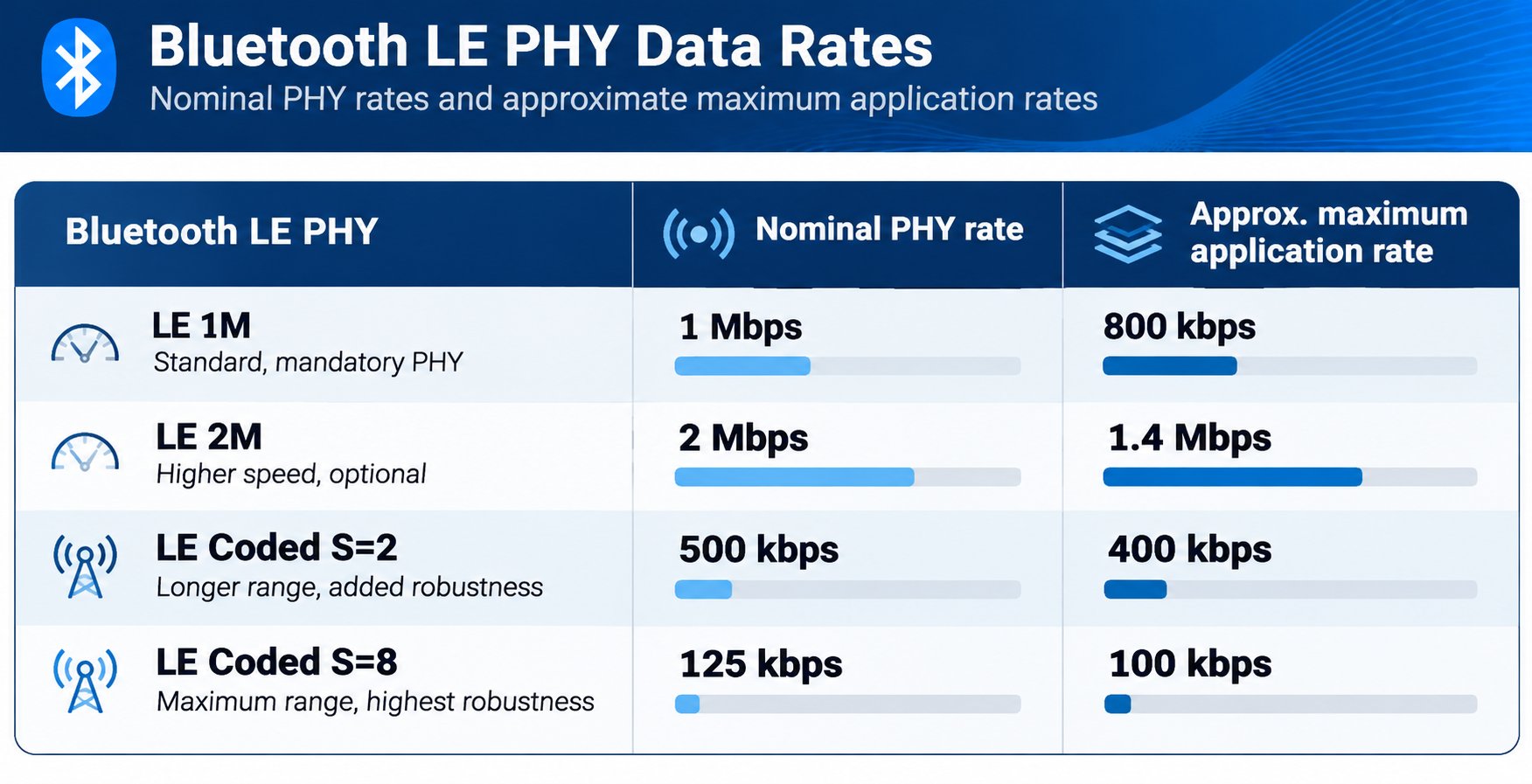
Source: Bluetooth SIG LE Primer. Application rates are approximate upper bounds, not guaranteed real-world performance.
It is important to distinguish between PHY data rate and application throughput. A 2 Mbps Bluetooth LE connection does not deliver 2 Mbps of usable application data. Packet headers, acknowledgements, protocol overhead, scheduling, and retransmissions all consume airtime. In practice, the maximum application throughput of LE 2M is approximately 1.4 Mbps under favourable conditions, according to the Bluetooth SIG.
For devices transferring small amounts of data, this is rarely a problem. For larger files, firmware updates, or continuous high-bandwidth streams, the throughput limitation becomes much more significant.
3. How Bluetooth High Data Throughput works
HDT represents a substantial change to the Bluetooth LE physical layer rather than a minor optimisation of existing protocols. The technology introduces new modulation methods, error correction, packet structures, and adaptive transmission capabilities.
Higher-order modulation
Conventional Bluetooth LE uses GFSK, a relatively simple modulation technique well suited to low-power radio implementations. HDT introduces more sophisticated modulation techniques, including forms of Quadrature Phase Shift Keying (QPSK) and Quadrature Amplitude Modulation (QAM).
These techniques allow more information to be encoded into each transmitted symbol. According to the Bluetooth SIG’s July 2026 technical overview, the proposed HDT PHY supports five data rates:
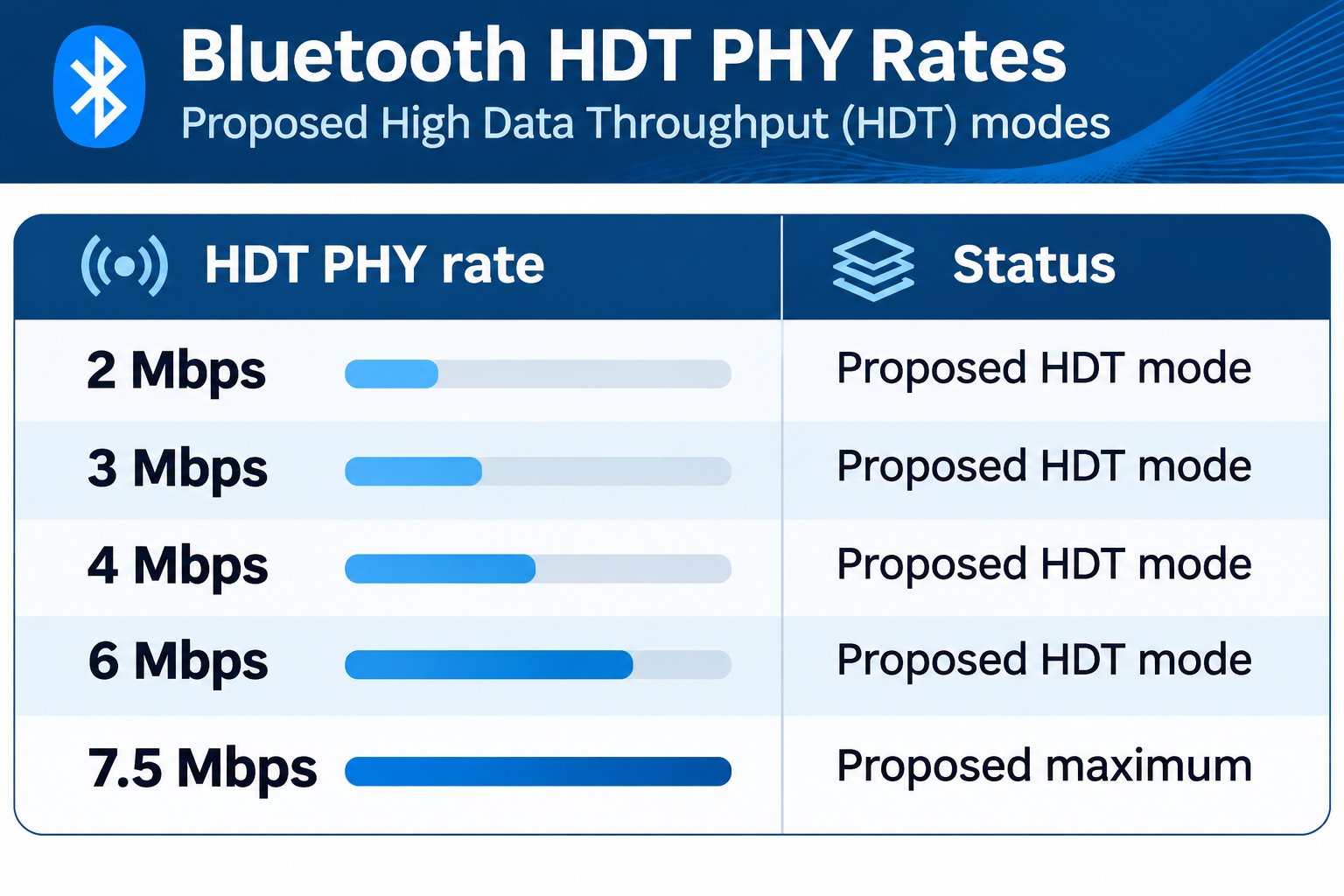
All five modes use a signalling rate of 2 megasymbols per second. Higher data rates are achieved through more sophisticated modulation and coding rather than simply increasing the symbol rate.
Forward error correction
Higher-order modulation can make radio links more sensitive to noise and interference. To address this, HDT incorporates forward error correction (FEC) across its supported data rates. FEC adds redundant information that allows a receiver to correct certain transmission errors without requesting that the original data be sent again. The result is potentially higher reliability and fewer retransmissions, both of which can improve effective throughput and energy efficiency.
Larger packets and selective retransmission
HDT also introduces a new packet architecture capable of supporting substantially larger payloads. Rather than treating an entire large packet as a single unit for error recovery, HDT can divide transmitted information into smaller blocks with individual integrity checks.
If one block is corrupted, the receiver can request retransmission of that block rather than the entire packet. This is particularly important when transferring larger files or continuous streams of information.
Adaptive data rates
HDT is designed to support dynamic changes in transmission speed according to radio conditions. Devices can switch between supported HDT rates from packet to packet, using lower rates when interference, distance, or signal quality make the highest rates unsuitable.
An optional link-quality feedback mechanism can provide additional information to help the transmitter select an appropriate data rate. The objective is to combine higher peak throughput with reliable operation across changing wireless environments.
4. What HDT means for Bluetooth power consumption
One of the most important questions surrounding HDT is whether higher throughput will compromise Bluetooth LE’s traditionally low power consumption.
The relationship between throughput and power consumption is not straightforward: A faster radio may require more sophisticated signal processing and therefore consume more power while actively transmitting or receiving. But faster transfers can also reduce the time the radio needs to remain active.
For example, a device transferring a fixed amount of data at four times the effective throughput could potentially complete the transfer in approximately one-quarter of the time, assuming comparable protocol efficiency. The radio can then return to a low-power state.
This means that higher throughput can improve energy efficiency when measured in energy consumed per bit transferred, even if instantaneous power consumption increases. HDT’s new packet architecture and error correction mechanisms could further improve efficiency by reducing unnecessary retransmissions.
However, actual battery-life improvements will depend on implementation, radio conditions, traffic patterns, and device architecture. The commercial challenge for silicon vendors will be to deliver these improvements without significantly increasing chipset cost, complexity, or power requirements.
5. New applications: From lossless audio to intelligent wearables
Higher throughput could expand the range of applications supported by Bluetooth LE, particularly where devices need to transfer larger quantities of data while remaining battery-powered.
High-resolution and lossless audio
One of the most promising HDT applications is higher-quality wireless audio. Existing Bluetooth LE Audio uses the efficient LC3 codec, but HDT could provide the additional bandwidth needed for higher-resolution and lossless audio formats. HDT is not itself an audio codec. It provides the underlying data capacity needed to support future audio specifications.
Smart glasses and advanced wearables
Smart glasses and wearable computing devices increasingly combine audio, sensing, and intelligent processing. HDT could enable faster exchanges of sensor information, synchronisation data, and other content between wearable devices and smartphones. Applications involving substantial video traffic would still generally require higher-capacity connectivity.
Industrial and medical devices
Industrial sensors, diagnostic equipment, and medical monitoring devices can generate substantial amounts of information. HDT could allow these devices to transfer larger datasets more efficiently, particularly where information is collected locally and periodically uploaded to a gateway or monitoring system.
Faster firmware updates and synchronisation
Over-the-air firmware updates are an increasingly important feature of connected products. Higher Bluetooth throughput could substantially reduce update times, improving user experience and reducing device downtime. This may become one of HDT’s most immediately useful commercial applications.
These use cases illustrate an important change in Bluetooth’s role.
Historically, Bluetooth LE has been particularly effective for transmitting relatively small quantities of information. HDT could make the technology more attractive for applications requiring occasional high-volume transfers or sustained medium-bandwidth communication. The Bluetooth SIG specifically identifies higher-quality audio, faster data transfers, and more capable connected devices among HDT’s principal opportunities.
6. Bluetooth HDT versus Wi-Fi: Competition or convergence?
Higher Bluetooth throughput raises an obvious question: Could Bluetooth HDT begin competing directly with Wi-Fi? In some applications, the answer may be yes. But the technologies will continue to occupy substantially different performance categories. Even at 7.5 Mbps, Bluetooth HDT remains far below the throughput available from modern Wi-Fi systems.
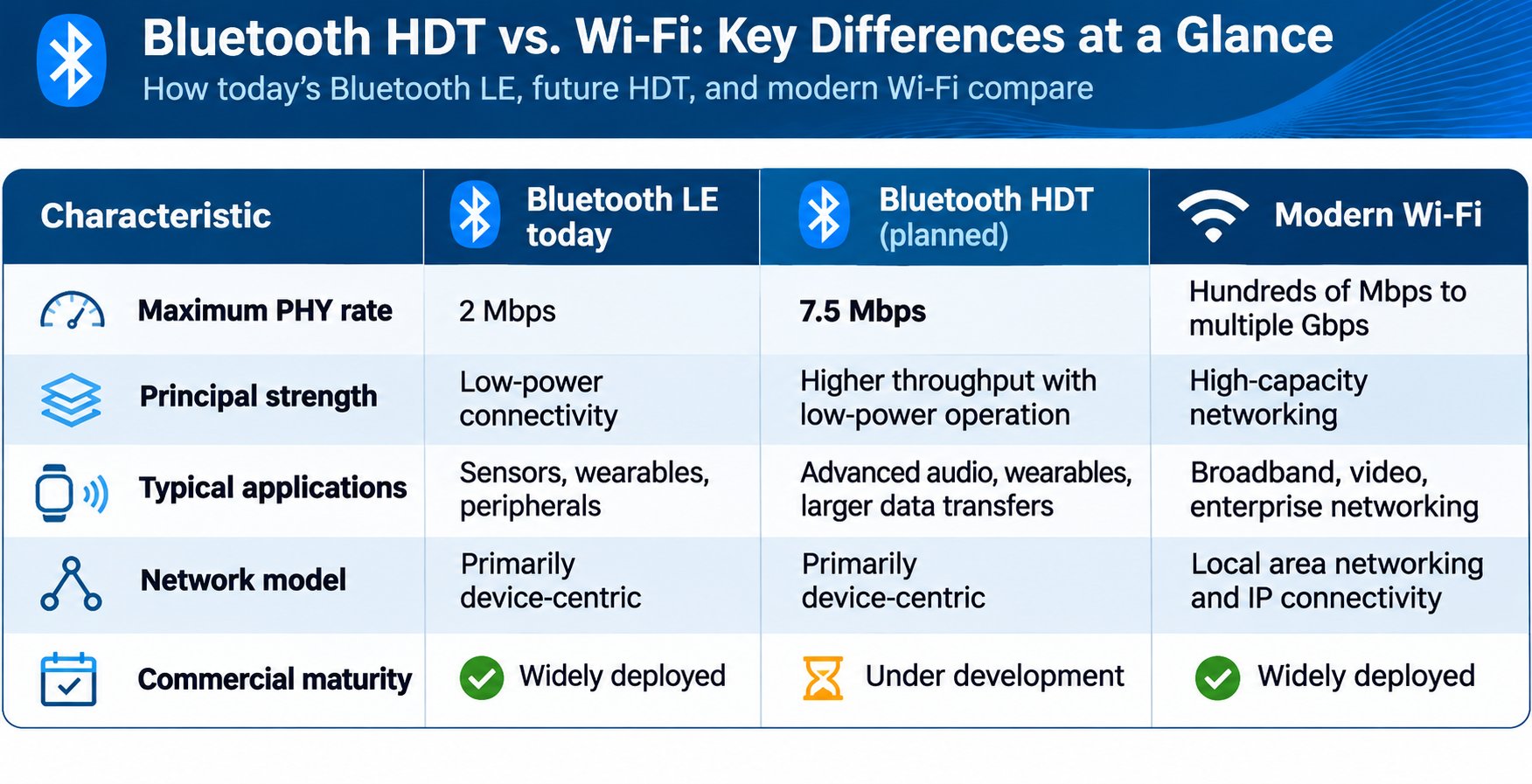
The more interesting development may be the growing overlap between Bluetooth and Wi-Fi in multifunction wireless devices. A smart wearable – for example – could use Bluetooth for discovery, control, audio, and moderate data transfers, while activating Wi-Fi when higher-bandwidth communication is required.
This approach is already familiar in devices combining multiple wireless interfaces: With HDT, Bluetooth could handle a larger proportion of these communications without requiring a transition to Wi-Fi. For battery-powered devices, avoiding unnecessary use of a higher-power radio could offer meaningful advantages.
However, the actual power and performance tradeoffs will depend on the application and the particular wireless implementations involved. Rather than replacing Wi-Fi, HDT could strengthen Bluetooth’s position as a complementary wireless technology.
7. Silicon requirements and commercial readiness
Delivering HDT will require more than a software update to existing Bluetooth devices. Higher-order modulation, coherent signal detection, and new error correction mechanisms introduce additional requirements for Bluetooth radio hardware and baseband processing. Chipset manufacturers will need to support the new PHY capabilities while maintaining the low cost and energy efficiency expected of Bluetooth products.
Companies such as Nordic Semiconductor, Silicon Labs, Qualcomm, NXP, and Infineon are among the established Bluetooth silicon suppliers whose future product roadmaps will be relevant to HDT adoption. This should not be interpreted as confirmation that each company has announced HDT silicon.
Nordic Semiconductor and Silicon Labs have publicly discussed the opportunities created by higher Bluetooth throughput, including higher-fidelity audio, larger media transfers, and more demanding wireless applications.
When will Bluetooth HDT become available?
As of October 2026, Bluetooth HDT remains a specification development project. In July 2026, the Bluetooth SIG indicated that adoption was anticipated in a Bluetooth Core Specification release towards the end of 2026. A draft HDT specification has also been made publicly available for technical review.
Specification adoption, however, is only the first step towards commercial availability. The subsequent process includes silicon development, interoperability testing, qualification, integration into operating systems and devices, and eventual mass-market deployment.
Early implementations may therefore appear before HDT becomes a widely supported feature across smartphones, wearables, and other Bluetooth products. Another important consideration is backward compatibility. HDT-capable devices will need to support existing Bluetooth LE communication methods when connecting to devices that do not support the new feature. The availability of HDT at both ends of a connection will ultimately determine whether the higher data rates can be used.
8. Outlook: A bigger role for Bluetooth in the wireless ecosystem
Bluetooth HDT is potentially one of the most consequential improvements to Bluetooth LE performance in years. The planned increase from 2 Mbps to 7.5 Mbps is significant, but the broader implications go beyond peak speed.
HDT combines higher-order modulation, error correction, larger packets, selective retransmission, and adaptive data rates to improve the efficiency and capacity of Bluetooth connections. If the technology delivers on its objectives, it could expand Bluetooth into applications that previously required other wireless interfaces.
Higher-quality audio is an obvious opportunity. Faster firmware updates, advanced wearables, and data-intensive sensing applications could also benefit. At the same time, HDT forms part of a broader Bluetooth technology roadmap that includes ultra-low latency, improved positioning, IP connectivity, and operation in additional frequency bands.
Together, these developments suggest that Bluetooth is evolving beyond its traditional role as a low-power peripheral connectivity technology. For the wireless industry, the central question is no longer simply how fast Bluetooth can become. It is how much more Bluetooth can do while preserving the simplicity, interoperability, and energy efficiency that made it successful.
And that could prove considerably more important than the increase in peak data rate alone.
Technical references:
Bluetooth SIG: Introducing Bluetooth High Data Throughput (July 2026)
Bluetooth SIG: The Bluetooth Low Energy Primer
Bluetooth SIG: Technology Roadmap
Bluetooth SIG: The Future of Bluetooth Technology (September 2026)
Bluetooth SIG: Industry Experts Discuss Bluetooth Trends for 2026
/Claus.