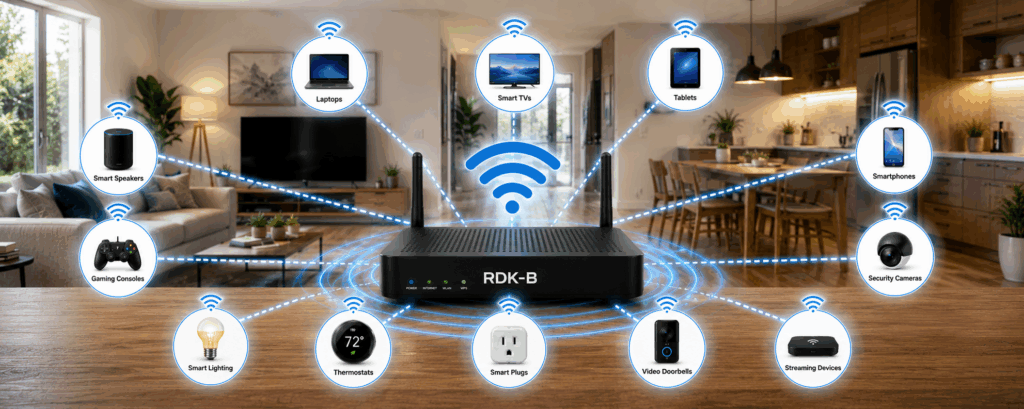

Today RDK-B has become one of the most important software platforms for residential broadband. WiFi NOW estimates (2026) that approximately 60–90 million active broadband gateways run on RDK-based software. This is based on publicly announced operator deployments, subscriber bases, and known RDK-B adoption patterns. Even though RDK-B was originally designed to support the cable industry, RDK-B is now also being used by fibre-based ISPs.
Why was RDK-B created?
Historically, every residential gateway shipped with vendor-specific software. This made introducing new features slow and expensive because software needed to be developed separately for each hardware platform. RDK-B addresses this challenge by separating hardware-specific components from higher-level software. Operators can standardise on a common software stack while selecting hardware from multiple suppliers.
This approach delivers:
- Reduced vendor lock-in
- Faster deployment of new services
- Consistent software across hardware generations
- Improved interoperability
- Lower long-term development costs
How RDK-B works
RDK-B provides a common software framework running on Linux. The platform includes:
- Device management
- Wi-Fi management
- Network services
- Security functions
- Diagnostics and telemetry
- Application framework
- Standardised APIs
Hardware abstraction layers isolate chipset-specific drivers from the rest of the software, allowing gateway manufacturers to support different SoCs without rewriting the complete software stack. Most deployments are remotely managed using cloud-based management systems together with protocols such as TR-369 (USP), although operators may integrate RDK-B with a variety of OSS/BSS platforms.
The RDK-B ecosystem
RDK-B has grown into a substantial ecosystem involving several categories of technology partners:
- Broadband service providers
- Gateway manufacturers
- Wi-Fi chipset vendors
- Software platform providers
- Cloud management vendors
- Wi-Fi optimisation companies
- Security software providers
- Diagnostics and customer experience platforms
Many commercial solutions—including home Wi-Fi optimisation, cybersecurity, parental controls, network analytics, and subscriber experience management—are available as applications integrated with RDK-B.
Benefits for broadband operators
Greater supplier flexibility
Operators can qualify multiple hardware suppliers while maintaining a common software environment.Faster innovation New capabilities can be deployed across an installed base without waiting for individual hardware vendors to develop proprietary firmware.
Lower operational costs
Using a shared software platform reduces duplicated engineering effort and simplifies long-term software maintenance.
Better subscriber experience
The platform supports advanced diagnostics, telemetry, cloud management, and AI-based optimisation solutions that help improve home Wi-Fi performance while reducing customer support costs.
Improved security
Operators retain greater control over security updates and software maintenance throughout the product lifecycle.
Operators with RDK-B deployments
- Comcast (tens of millions of broadband subscribers)
- Charter Communications
- Liberty Global
- Sky
- Cox Communications
- Rogers Communications
- Videotron
- Deutsche Telekom (publicly announced 1 million RDK-powered gateways)
However, not every gateway deployed by these operators runs RDK-B as some operators have mixed fleets, legacy gateways, or use RDK only on certain product lines.
RDK-B and Wi-Fi 7
RDK-B has evolved alongside successive Wi-Fi generations and now supports commercial Wi-Fi 7 gateway deployments. Several major chipset suppliers have announced RDK-B support for Wi-Fi 7 platforms, while broadband operators have begun deploying Wi-Fi 7 gateways based on the platform. As broadband networks become increasingly multi-gigabit, RDK-B provides a software foundation capable of supporting advanced features such as Multi-Link Operation (MLO), enhanced telemetry, AI-assisted optimisation, and cloud-managed subscriber services.
RDK-B versus proprietary gateway software
Compared with traditional vendor-specific gateway software, RDK-B offers operators considerably greater control over their broadband platforms. Rather than depending on a single equipment vendor for software updates and new features, operators can develop or integrate capabilities independently while maintaining a common software architecture across multiple device generations. The result is greater flexibility, improved negotiating leverage with suppliers, and a faster pace of innovation.
Looking ahead
As broadband services continue to evolve, RDK-B is expected to play an increasingly important role in enabling open, software-defined residential broadband networks. Industry trends such as cloud management, AI-driven operations, enhanced subscriber experience, and faster adoption of new Wi-Fi technologies all align well with the platform’s architecture. For broadband operators seeking greater control over their connected home platforms, RDK-B represents one of the industry’s most mature and widely adopted open-source software ecosystems.
WiFi NOW perspective: Open software platforms are becoming a strategic differentiator for broadband operators. RDK-B enables service providers to shift control of gateway software away from individual hardware vendors and towards their own engineering and operations teams. While commercial integration still requires significant expertise, the platform has matured into a robust ecosystem supported by leading operators, silicon suppliers, gateway manufacturers, and software vendors. As Wi-Fi 7 deployments accelerate and AI becomes increasingly integrated into broadband operations, RDK-B is well positioned to remain one of the industry’s most influential connected home software platforms. Support for RDK-B has also become critical for Wi-Fi SoC vendors such as Qualcomm, MediaTek, and Broadcom.
Editorial disclaimer: This content is based on publicly available information believed to be accurate at the time of publication, including official vendor and industry sources. While every effort has been made to verify the information, errors or omissions may occur. WiFi NOW welcomes corrections and updates from industry participants. For suggested updates or corrections, write to [email protected].
/Claus.