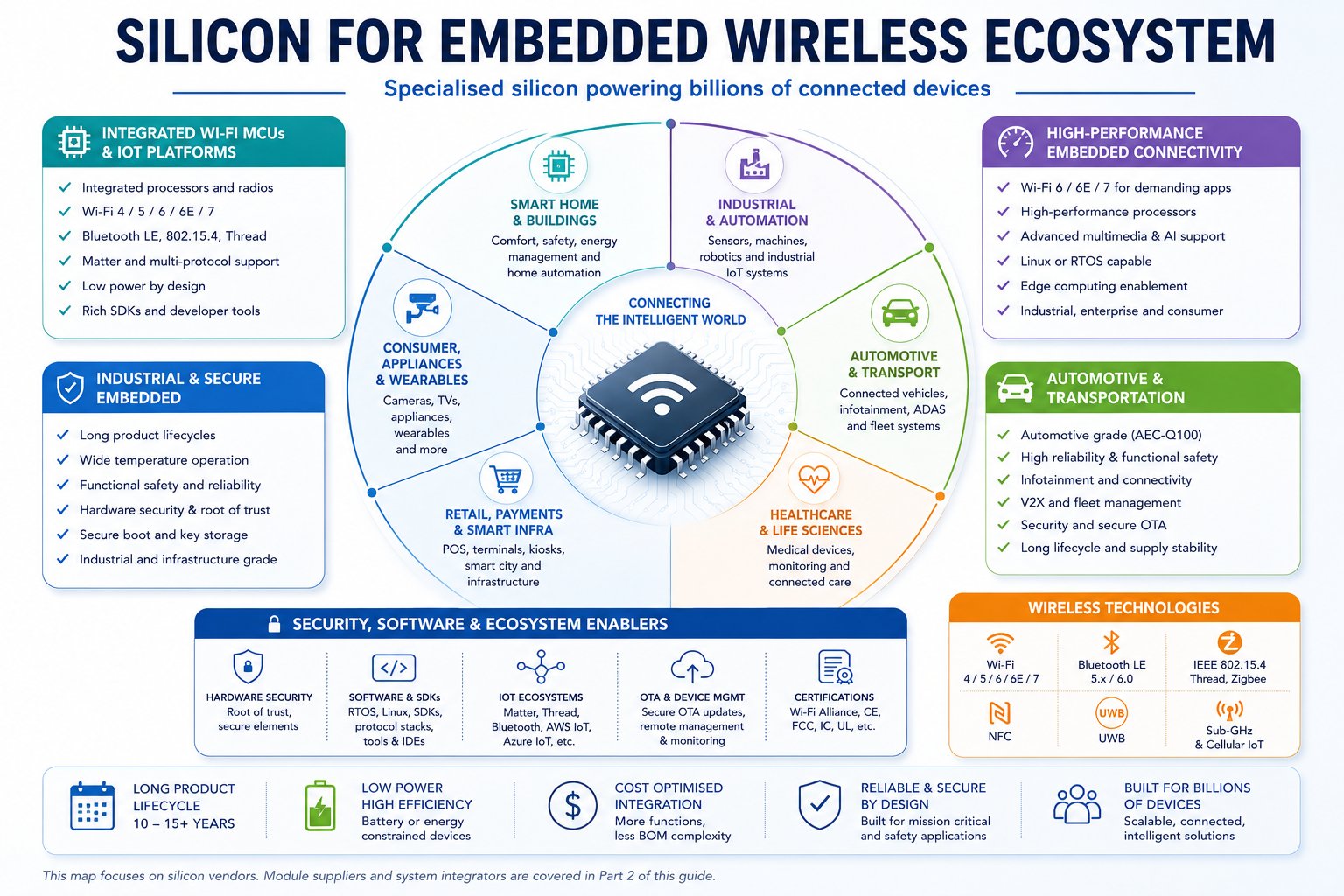

Why Embedded Wireless is Becoming the New Connectivity Frontier
For decades, wireless connectivity has been dominated by familiar product categories: smartphones, laptops, Wi-Fi routers, enterprise access points, and broadband gateways. These devices continue to drive innovation in wireless performance, pushing each new generation of Wi-Fi towards higher throughput and lower latency. But quietly, another wireless revolution is taking place.
Wireless connectivity is now being integrated into billions of products that are neither computers nor networking equipment. Smart appliances, industrial sensors, medical devices, robots, EV chargers, retail terminals, building automation systems, cameras, and countless other products are becoming connected – and each requires specialised silicon designed for very different priorities than a smartphone or PC.
This rapidly expanding market is what we refer to as embedded wireless. Although the individual devices are often small, inexpensive, and largely invisible to consumers, collectively they represent one of the fastest-growing and most strategically important segments of the wireless industry.
Embedded Means More Than “Small”
The term embedded does not simply describe the size of a device. Instead, it usually describes a computing system designed to perform one or a small number of dedicated functions within a larger product. Unlike a smartphone or laptop, an embedded device is usually expected to:
- Perform a single task extremely reliably
- Operate unattended for many years
- Consume very little power
- Require minimal maintenance
- Integrate tightly with sensors, actuators, or control systems
Wireless connectivity is simply one component of the overall system. For many embedded products, Wi-Fi is no longer the product – it is simply an enabling technology.
Different Priorities, Different Silicon
This distinction changes almost everything about semiconductor design. Designing wireless silicon for a smartphone is largely about delivering the highest possible performance while balancing battery life and cost. Embedded wireless designers often begin from a different starting point. Typical design questions include:
- Can the device operate for ten years?
- Will the silicon still be available a decade from now?
- Can the processor and wireless radio be integrated into one chip?
- Is security built into the hardware?
- Can firmware be updated remotely?
- Is certification already available?
- Can the product run from a small battery?
- Does the software ecosystem reduce development time?
Peak wireless throughput is often relatively low on the priority list. For many embedded applications, reliability, simplicity, integration, and longevity matter far more than gigabit performance.
More Than Just Wi-Fi
Although Wi-Fi is central to many embedded devices, today’s connected products rarely rely on a single wireless technology. Depending on the application, embedded systems may combine:
- Wi-Fi
- Bluetooth® Low Energy
- IEEE 802.15.4 (Thread and Zigbee)
- NFC
- Ultra-wideband (UWB)
- Cellular IoT
- Proprietary sub-GHz radios
Increasingly, a single silicon platform supports several of these technologies simultaneously, allowing products to communicate locally, join mesh networks, interact with smartphones, and connect directly to cloud services. Choosing the right combination of wireless technologies has become one of the most important architectural decisions in embedded product development.
Software Has Become Part of the Silicon
One of the biggest changes over the past decade is that developers no longer evaluate hardware alone. A modern embedded wireless platform includes:
- Development tools
- Software development kits (SDKs)
- Security frameworks
- Over-the-air update mechanisms
- Protocol stacks
- Certification support
- Cloud integration
- Documentation and developer communities
In many cases, these software components have become just as important as the hardware itself. For engineering teams under pressure to shorten development cycles, software maturity can be a decisive factor when selecting a wireless platform.
AI is Beginning to Reach the Edge
Artificial intelligence is also beginning to influence embedded wireless design. Instead of sending every piece of sensor data to the cloud, many devices are starting to process information locally. Edge AI enables products to:
- Detect anomalies
- Recognise events
- Reduce network traffic
- Improve privacy
- Respond more quickly
Although still an emerging trend, AI acceleration is increasingly being integrated into embedded processors and wireless platforms, opening new possibilities for industrial automation, healthcare, smart homes, and consumer electronics.
Why This Matters
Embedded wireless is becoming one of the defining technologies of the connected world. As connectivity spreads into every category of electronic product, wireless silicon is evolving beyond simple radio chips into complete computing platforms that integrate processing, security, software, and multiple communication technologies. Understanding these architectural principles is becoming essential for engineers, product managers, system designers, and technology decision-makers alike.
Next in This Series
In Part 2, we’ll examine the major architecture choices facing embedded system designers, including:
- Integrated wireless MCUs
- Companion wireless devices
- Hosted connectivity architectures
- Modules versus discrete silicon
- RTOS versus Linux platforms
Understanding these architectural approaches provides the foundation for evaluating individual silicon vendors and solutions, which we’ll explore in later chapters.
WiFi NOW’s take: Embedded wireless is no longer a niche technology. It is rapidly becoming the foundation of the connected world, enabling intelligence and connectivity to be built directly into products of every kind. While consumer Wi-Fi continues to drive performance innovation, embedded wireless is driving the far broader transformation of everyday devices into connected, intelligent systems. Understanding this shift is the first step towards understanding where the wireless industry is headed next.
Disclaimer: This guide provides a high-level introduction to the embedded wireless silicon market. It is not intended to be a complete vendor list or product comparison. Technologies, company activities, and market positions change frequently, and inclusion or omission does not constitute an endorsement or judgement of commercial importance. WiFi NOW will update and expand this guide as the market develops and additional information becomes available.