

Unlike many other low-power wireless technologies, Wi-Fi HaLow provides native IPv4 and IPv6 connectivity, allowing sensors, cameras, industrial equipment and other IoT devices to connect directly to standard IP networks without protocol gateways. It also benefits from the mature security framework and interoperability principles of the Wi-Fi ecosystem.
Today, Wi-Fi HaLow is being deployed across industrial automation, logistics, agriculture, utilities, healthcare, smart cities and campus environments—applications where conventional Wi-Fi often cannot provide the required combination of coverage, battery life and scalability.
IEEE 802.11ah: Extending Wi-Fi for IoT
Wi-Fi HaLow is based on the IEEE 802.11ah amendment to the IEEE 802.11 wireless LAN family. The standard was developed specifically for applications requiring:
- Long communication distances
- Low power consumption
- Support for large numbers of connected devices
- Reliable outdoor operation
- Native IP networking
Unlike broadband Wi-Fi technologies, IEEE 802.11ah was optimised from the outset for sensors, industrial equipment, battery-powered devices and machine-to-machine communications.
Why sub-1 GHz matters
The defining characteristic of Wi-Fi HaLow is its use of licence-exempt sub-1 GHz spectrum.
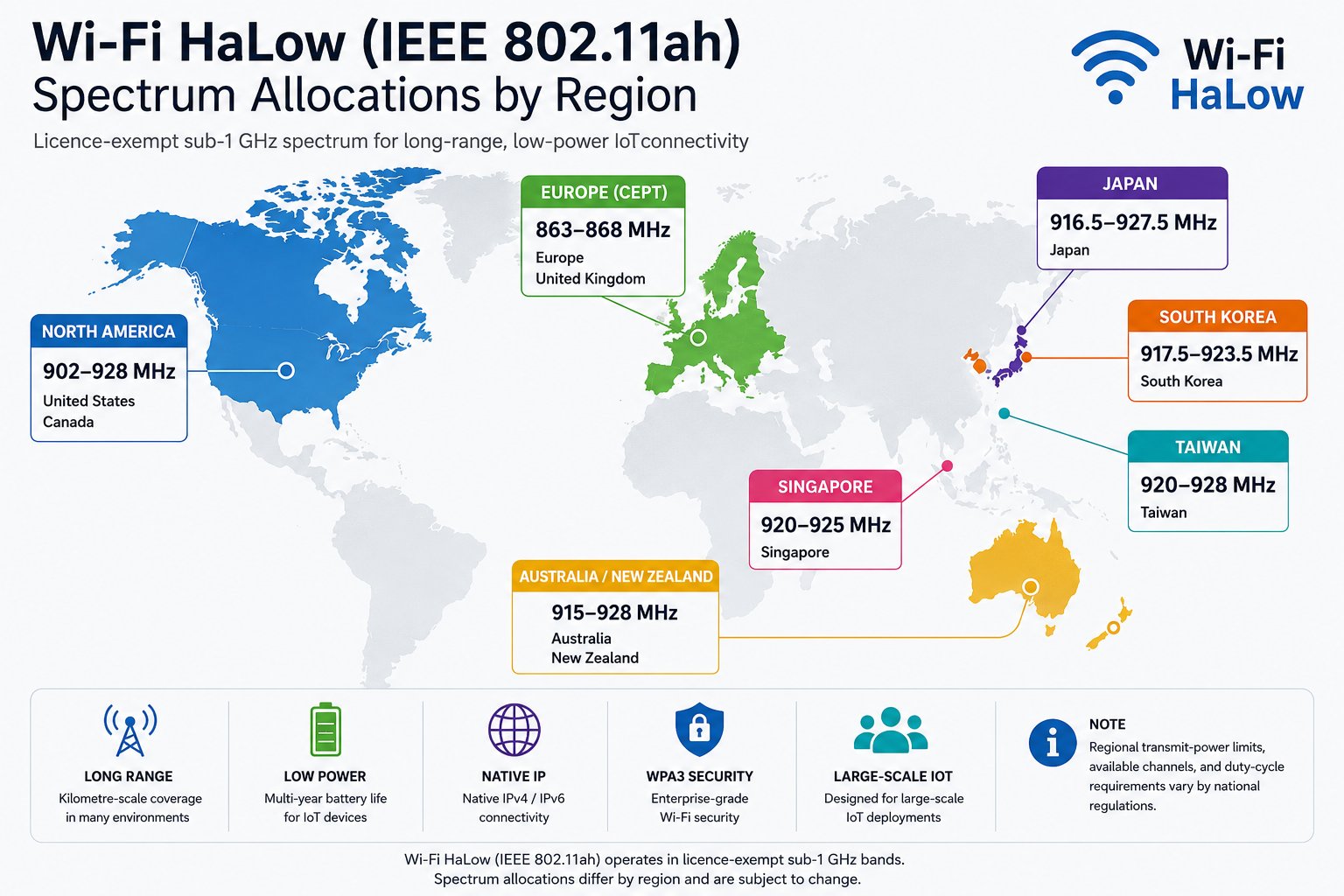
Note: Exact channel availability, transmit-power limits and duty-cycle requirements vary by national regulations. Manufacturers therefore supply region-specific firmware or hardware variants where required.
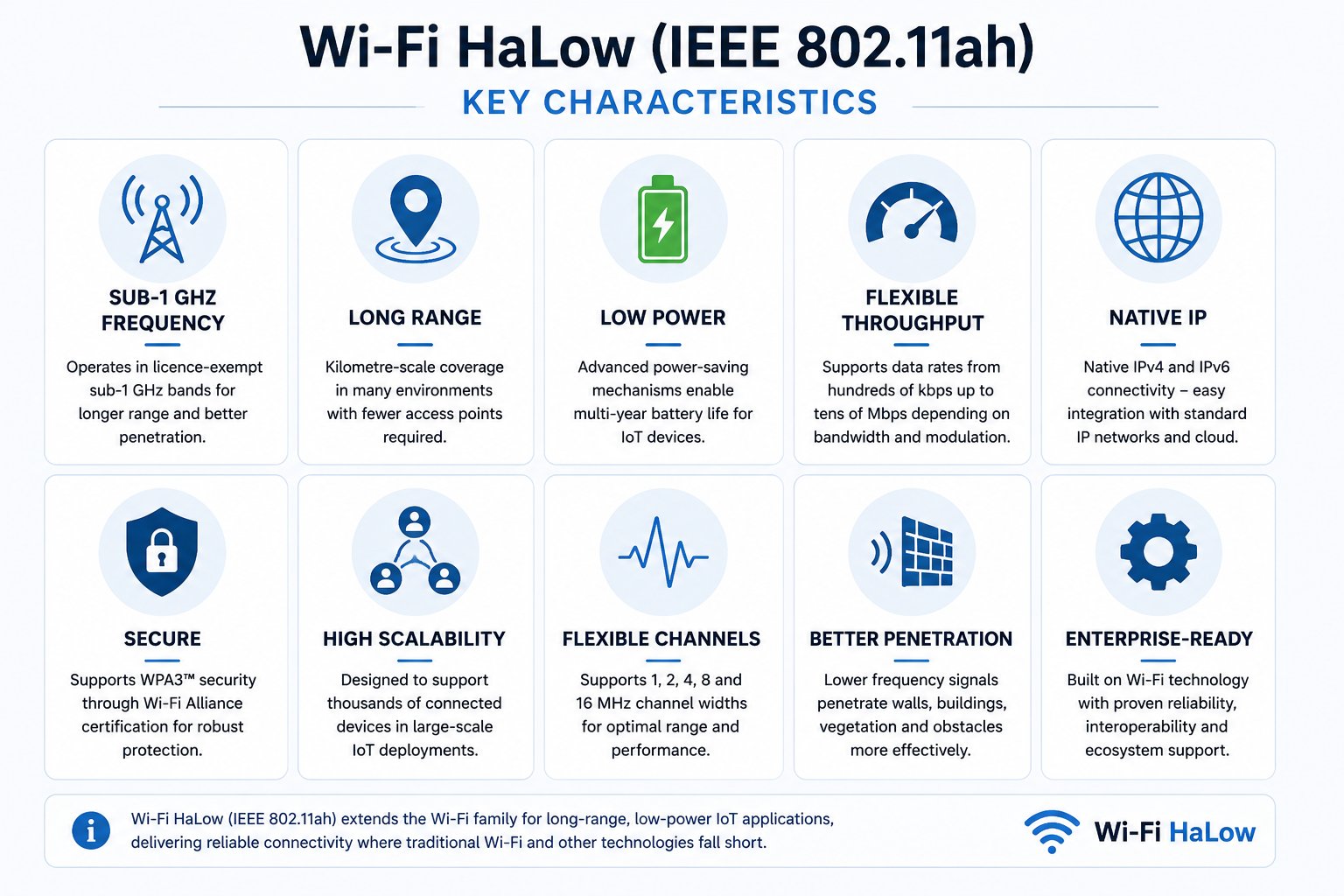
Lower-frequency radio waves experience less propagation loss than signals at 2.4 GHz, 5 GHz or 6 GHz. They also penetrate walls, vegetation, machinery and other obstacles more effectively. This physical advantage – not increased transmit power – is the principal reason Wi-Fi HaLow can provide substantially greater coverage than conventional Wi-Fi.
Key characteristics
Range and coverage
One of Wi-Fi HaLow’s defining advantages is its ability to provide significantly greater coverage than conventional Wi-Fi. The IEEE standard does not specify a maximum communication distance. Practical range depends on:
- Regional regulatory limits
- Antenna gain
- Channel bandwidth
- Modulation and coding scheme
- Receiver sensitivity
- Deployment environment
Commercial deployments commonly achieve coverage measured in kilometres under favourable conditions, while industrial and campus deployments often require significantly fewer access points than equivalent conventional Wi-Fi installations. Actual performance remains application dependent.
Power efficiency
IEEE 802.11ah incorporates advanced power-saving mechanisms that allow devices to remain asleep for extended periods and wake only when communication is required. Battery lifetime depends primarily on:
- Reporting interval
- Packet size
- Battery capacity
- Device design
- Environmental conditions
For low-duty-cycle sensing applications, multi-year battery operation has been demonstrated commercially. Battery life should therefore be regarded as an application characteristic rather than an intrinsic property of the standard.
Throughput
Wi-Fi HaLow occupies a position between traditional LPWAN technologies and broadband Wi-Fi. Depending on channel bandwidth and modulation, throughput ranges from hundreds of kilobits per second to tens of megabits per second. This makes Wi-Fi HaLow suitable for:
- Industrial monitoring
- Building automation
- Smart metering
- Environmental sensing
- Asset tracking
- Telemetry
- Low- and medium-bitrate video
Rather than replacing Wi-Fi 6 or Wi-Fi 7, Wi-Fi HaLow complements them by addressing applications where range, power efficiency and battery life are more important than maximum throughput.
Network scalability
Large IoT deployments require support for many connected devices. IEEE 802.11ah introduces several mechanisms—including hierarchical Association IDs (AIDs), Restricted Access Window (RAW) scheduling and advanced power management—to improve efficiency as device numbers increase. The architecture supports networks comprising thousands of associated stations. Actual deployment capacity depends upon traffic patterns, reporting intervals, packet sizes and access point implementation.
Typical applications
Wi-Fi HaLow is particularly well suited to environments requiring large coverage areas, low infrastructure costs and long battery life. Typical deployments include:
- Smart agriculture
- Industrial automation
- Warehouses
- Logistics yards
- Utility metering
- Building management
- Environmental monitoring
- Smart cities
- Security systems
- Healthcare monitoring
- University campuses
- Large residential communities
Wi-Fi HaLow compared with other IoT technologies
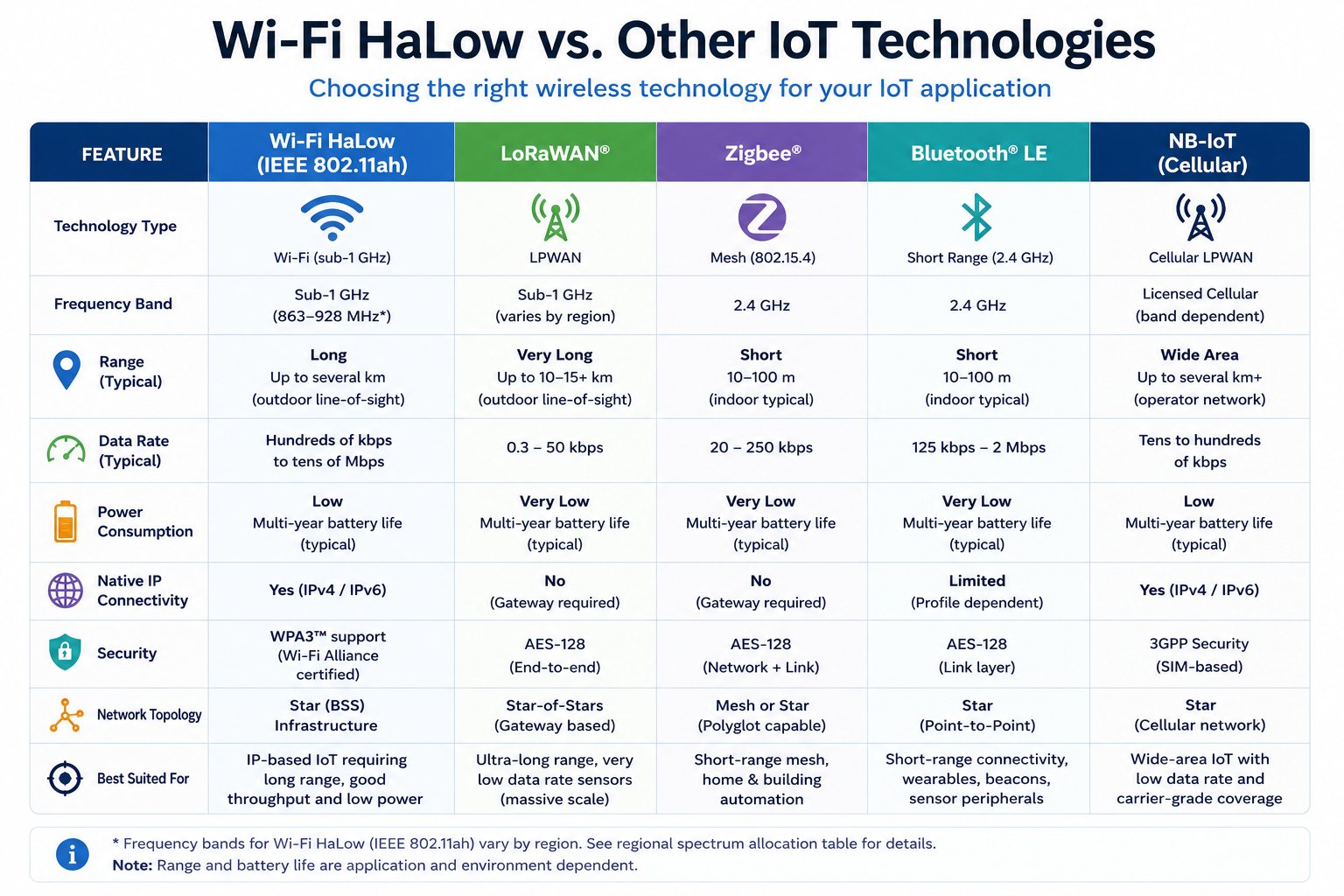
Each technology occupies a different design point. Wi-Fi HaLow’s principal differentiators are its combination of long-range operation, native IP networking, enterprise-grade security and interoperability within the Wi-Fi ecosystem.
The Wi-Fi HaLow ecosystem
The commercial Wi-Fi HaLow ecosystem has expanded rapidly and now encompasses silicon suppliers, module providers, infrastructure vendors, embedded computing platforms and system integrators.
Silicon suppliers:
- Morse Micro
- Newracom
Module providers:
These companies provide pre-certified radio modules that significantly simplify product development and regulatory approval for OEMs.
- AzureWave
- AsiaRF
- Quectel
- Gateworks (Ezurio)
- Heltec Automation
- Silex Technology
- Vantron
Infrastructure and access points:
- Edgecore Networks
- AsiaRF
- Ezurio (including the former Gateworks portfolio)
- Vantron
Among these companies, Edgecore has been an early adopter of integrating conventional Wi-Fi and Wi-Fi HaLow within a single managed networking platform. Other suppliers primarily focus on industrial gateways, bridges, routers and embedded infrastructure.
Ecosystem development
The ecosystem continues to mature through initiatives such as Morse Micro’s Approved Module Partner and Design Partner programmes, together with growing availability of development hardware and evaluation platforms through global distribution channels.
Current state of the market
The Wi-Fi HaLow ecosystem has now progressed well beyond the proof-of-concept stage.
Commercially available products include:
- Silicon chipsets
- Certified radio modules
- Industrial gateways
- Enterprise infrastructure
- Embedded computing platforms
- Development kits
- Commercial deployments across multiple industry sectors
Although the ecosystem remains smaller than that of mainstream Wi-Fi, the breadth of commercially available products has expanded significantly in recent years.
WiFi NOW perspective:
Ecosystem development: The ecosystem continues to mature through initiatives such as Morse Micro’s Approved Module Partner and Design Partner programmes, together with growing availability of development hardware and evaluation platforms through global distribution channels.
Wi-Fi HaLow fills an important gap within the wireless connectivity landscape. Rather than competing with broadband Wi-Fi, it extends the Wi-Fi family into applications where long range, low power consumption and native IP networking are more important than peak data rates. As industrial IoT, intelligent infrastructure and edge computing continue to expand, Wi-Fi HaLow is well positioned to become one of the principal wireless technologies for long-range IP-based IoT connectivity.
Sources and methodology: This guide is based on publicly available technical documentation and independently verifiable industry sources. Primary references:
- IEEE 802.11ah Standard
- Wi-Fi Alliance technical documentation and certification programme
- National spectrum regulator documentation
- Industry references
- Morse Micro
- Newracom
- Edgecore Networks
- AsiaRF
- Ezurio
- Heltec Automation
- Quectel
- AzureWave
- Vantron
- Silex Technology
Additional evidence
This guide incorporates technical information presented during the Wi-Fi HaLow Global Summit (April 2026). Technical claims have been cross-checked against IEEE specifications and other publicly available documentation wherever possible. Vendor presentations have been used to illustrate ecosystem developments but not as the sole source for technical claims.