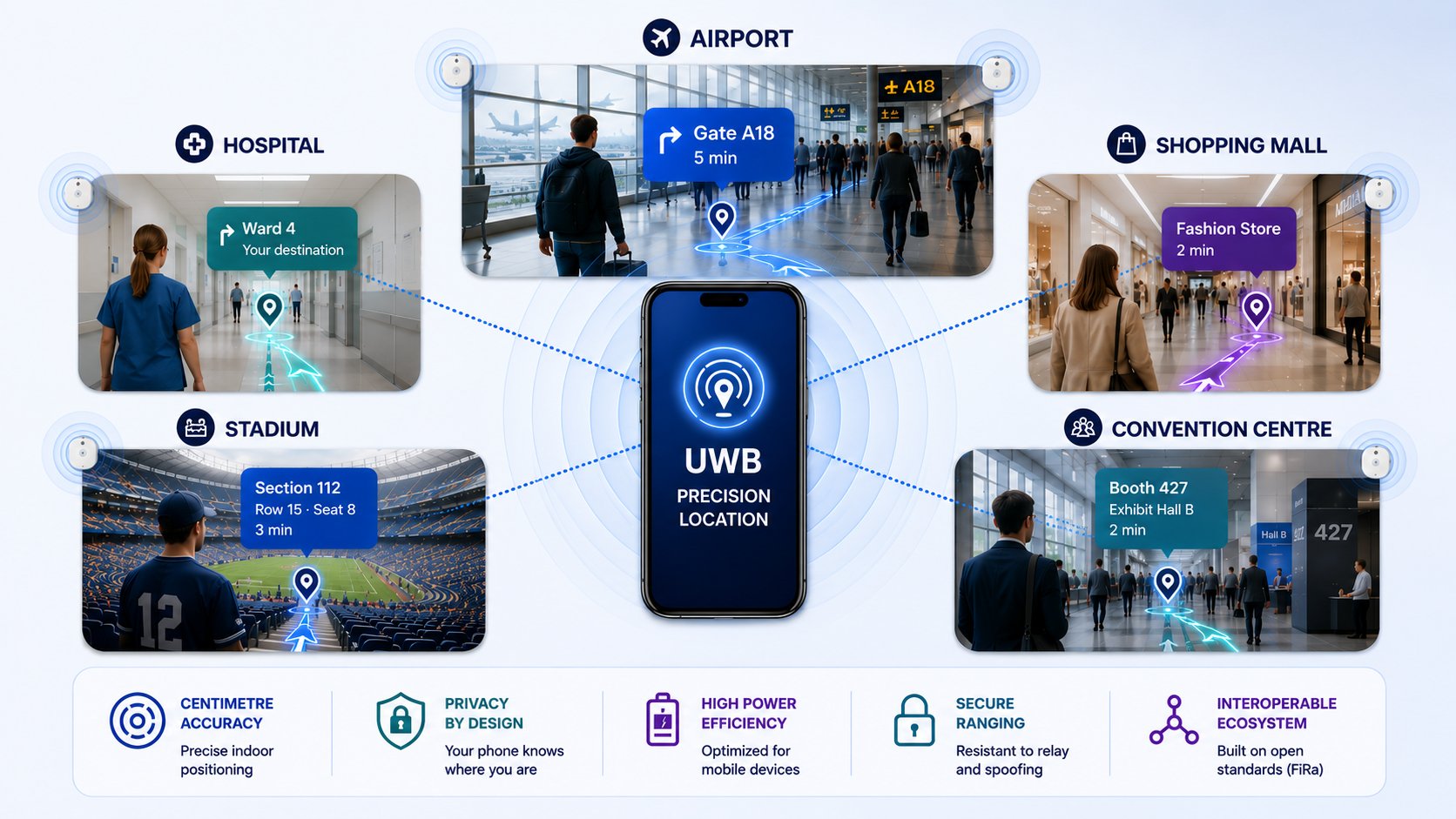

Outdoor navigation has become so effortless that most of us hardly think about it anymore. Whether we’re walking through a city, driving to a destination, or finding a nearby restaurant, GPS quietly calculates our position and guides us with remarkable reliability. Billions of smartphones perform this task every day.
Step inside a large airport, hospital, shopping centre, stadium, or convention centre, however, and that experience largely disappears. Satellite signals struggle to penetrate buildings, accuracy deteriorates, and navigation often becomes little more than following signs on the wall.
For decades, the wireless industry has tried to solve this problem. Today, Ultra-Wideband (UWB) is emerging as perhaps the strongest candidate yet for bringing GPS-like positioning indoors. More importantly, it may do so while preserving something that traditional indoor positioning systems often compromise: User privacy.
Why GPS stops at the front door
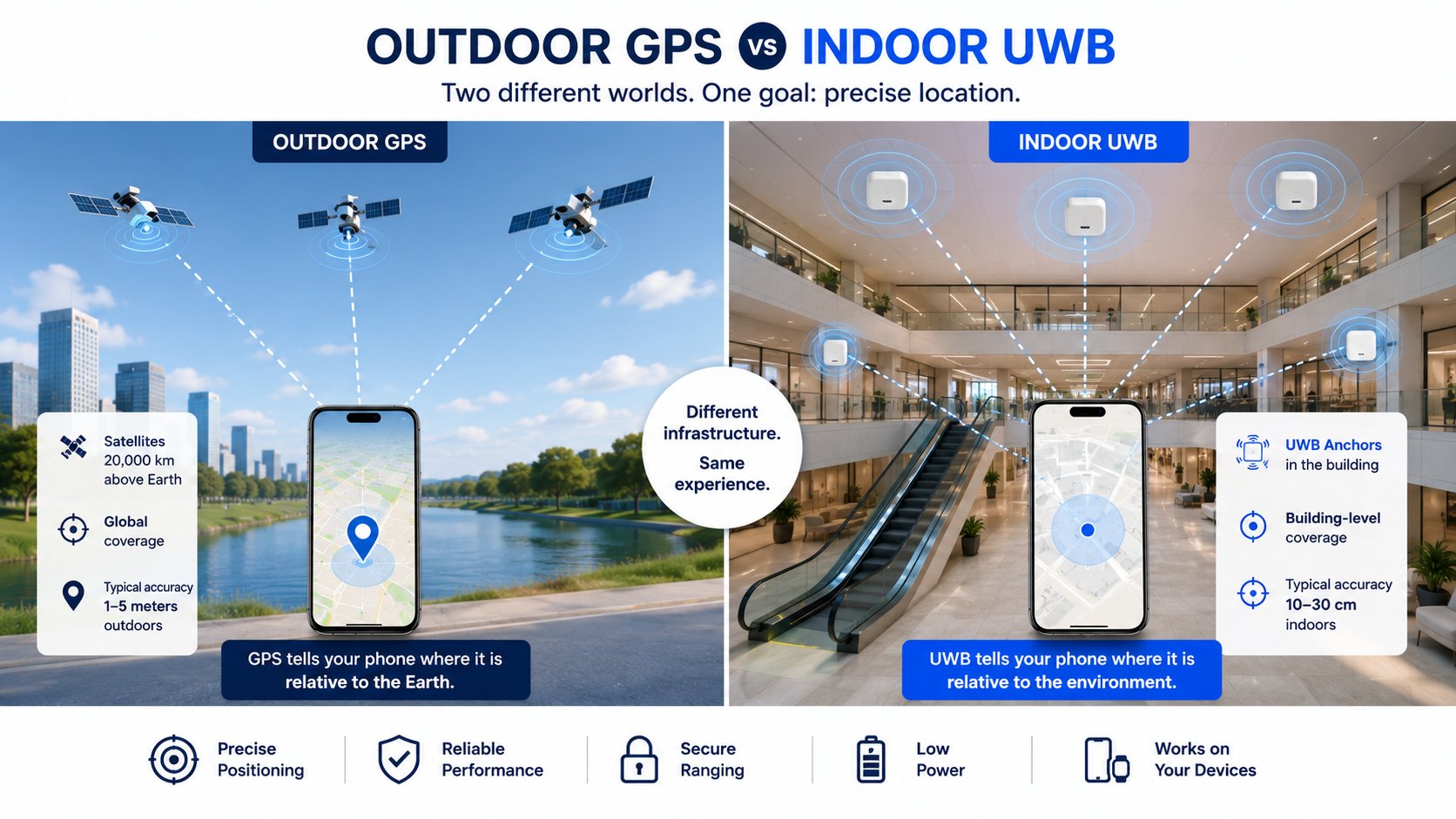
GPS is an extraordinary technology, but it was never designed for indoor environments. Satellites orbit roughly 20,000 kilometres above the Earth, and by the time their signals reach a smartphone they are already extremely weak. Walls, ceilings, steel structures, and even coated glass further attenuate those signals, making accurate positioning difficult or impossible.
This is why navigation apps can usually guide you to the entrance of a shopping mall—but not to the specific shop you’re looking for. The same applies to airports, hospitals, museums, university campuses, factories, warehouses, and office buildings. As our lives become increasingly digital, this “indoor location gap” has become one of the biggest remaining challenges in navigation.
Existing technologies have narrowed the gap
Ultra-Wideband is not the first wireless technology to address indoor positioning. Wi-Fi has made significant progress through Fine Timing Measurement (FTM), standardised in IEEE 802.11mc. By measuring the travel time of Wi-Fi signals, FTM enables positioning with typical accuracies of one to several metres, while taking advantage of existing Wi-Fi infrastructure.
Bluetooth has also advanced considerably. Recent developments such as Bluetooth Channel Sounding and High Accuracy Distance Tracking (HDT) improve distance estimation and direction finding, making Bluetooth increasingly suitable for proximity-based applications.
These technologies are already enabling valuable indoor location services. UWB, however, pushes precision to another level. Typical ranging accuracies of 10–30 centimetres, combined with directional awareness and secure ranging, enable experiences that simply are not practical with metre-level positioning. Rather than replacing Wi-Fi or Bluetooth, UWB complements them where the highest levels of precision are required.
From outdoor GPS to indoor GPS
Although the comparison is not technically accurate, UWB is often described as “indoor GPS.” The reason is simple. Instead of relying on satellites orbiting the Earth, UWB relies on precisely positioned reference points installed inside a building. These reference points exchange carefully timed radio signals with a smartphone.
Using those timing measurements, the phone can determine exactly where it is within the building—often with centimetre-level precision. The result is an experience that feels remarkably similar to GPS. Your phone simply knows where it is.
A fundamentally different approach to privacy
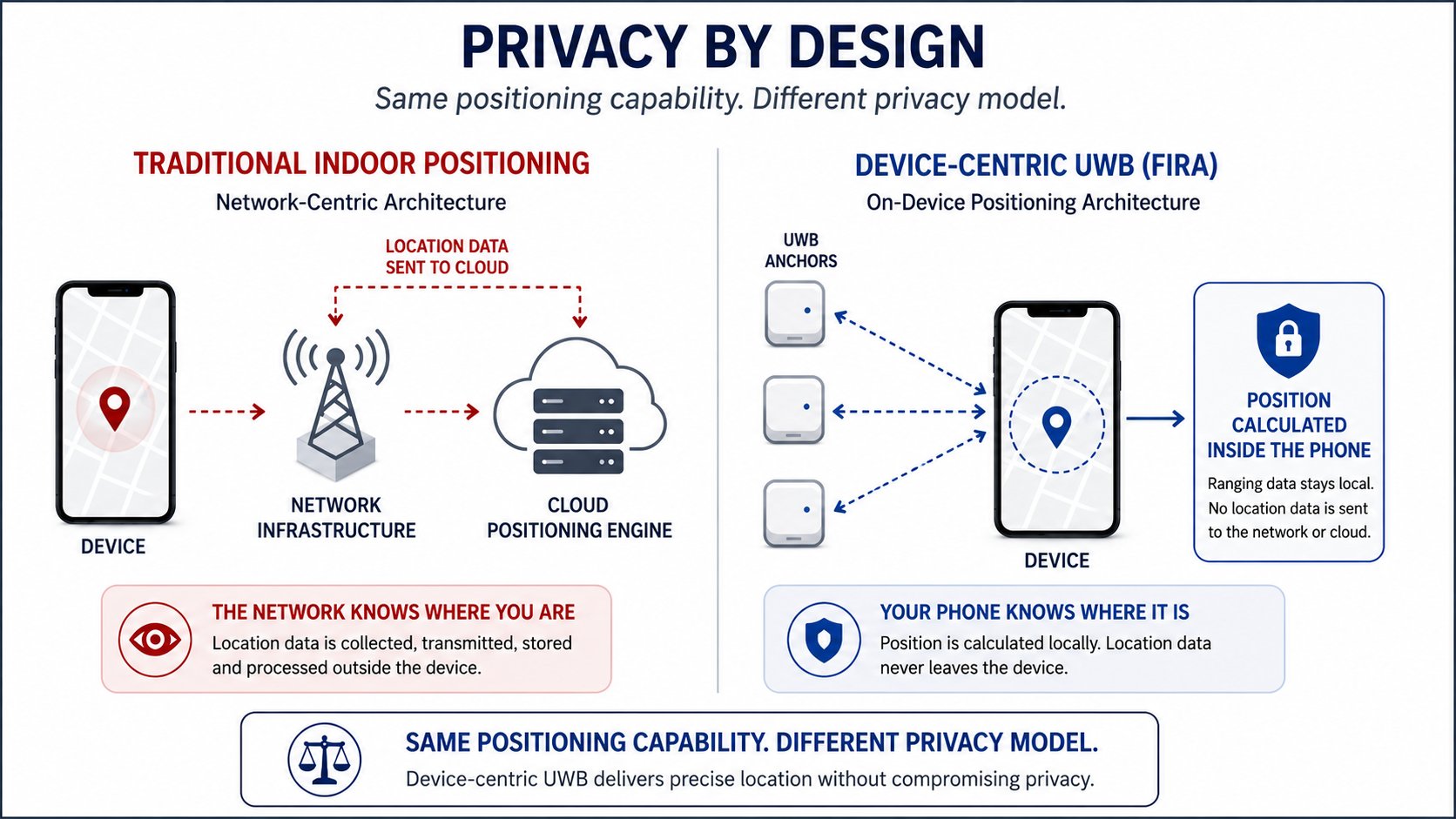
One of the least appreciated aspects of modern UWB systems is that the phone can calculate its own position. This represents a significant architectural difference compared with many traditional indoor positioning systems. Historically, indoor location systems often calculated device positions within the network infrastructure. Access points or servers determined where users were located, meaning the venue—or its cloud platform—potentially had visibility into people’s movements.
State-of-the-art consumer UWB systems can work differently. The infrastructure provides trusted ranging references. The smartphone performs the calculations. The result is simple: Your phone knows where it is, while he building doesn’t have to. This “device-centric” approach offers several important advantages:
- Improved privacy for users
- Reduced transmission of sensitive location data
- Less dependence on cloud-based positioning
- Better scalability as calculations are distributed across millions of devices instead of central servers
For consumers increasingly concerned about digital privacy, this may prove just as important as centimetre-level accuracy.
Pinpoint and the vision of indoor GPS
One company illustrating this vision particularly well is Germany-based UWB experts Pinpoint. Rather than building another enterprise asset-tracking system, Pinpoint has focused on enabling smartphones to determine their own location inside buildings. Its UWB infrastructure creates an indoor positioning environment that functions much like GPS does outdoors. Applications include:
- Airports
- Railway stations
- Convention centres
- Shopping centres
- Hospitals
- Museums
- Sports venues
The objective is not simply accurate positioning but rather to make indoor navigation feel as natural as outdoor navigation already does today.
Beyond navigation
Knowing precisely where a person is inside a building unlocks far more than turn-by-turn directions. Imagine arriving at an airport: Instead of searching for departure boards, your phone immediately guides you to the correct security checkpoint, recommends the fastest route to your gate, and alerts you if your departure changes.
In a hospital, visitors can navigate directly to a patient room without asking for directions. In a convention centre, attendees can locate exhibitors, meeting rooms, or colleagues with a single tap. Shopping centres can guide customers directly to specific stores or products.
Universities can help students navigate complex campuses. Hotels can offer seamless digital room access while guiding guests to restaurants, conference rooms, or fitness facilities. Location becomes another layer of digital intelligence.
The foundation for spatial computing
Perhaps the biggest opportunity lies beyond navigation. Future smartphones, augmented reality glasses, and wearable devices will increasingly combine:
- Precise location
- Direction
- Motion sensing
- Computer vision
- Artificial intelligence
Together, these technologies enable spatial computing—digital experiences that understand exactly where users are and what surrounds them. Instead of interacting only with screens, users will increasingly interact with physical spaces enhanced by digital information. Knowing where a device is becomes as fundamental as knowing where it is connected.
Challenges remain
Despite its promise, consumer UWB is still at an early stage. Wide-scale indoor navigation requires infrastructure deployments that do not yet exist in most buildings. Interoperability continues to evolve while costs must continue to fall and while application developers must create compelling consumer experiences. And building owners need clear business cases before investing.
The link to Wi-Fi infrastructure
One very important component of current and future UWB location solutions is UWB’s link to Wi-Fi infrastructure: UWB radios are increasingly being incorporated into enterprise Wi-Fi access points. This fact is a critical driver for the mass-market adoption of UWB: As UWB becomes a standard component of Wi-Fi infrastructure solutions – which are essentially deployed everywhere indoors – UWB-based indoor location services will be simple and low cost to implement.
WiFi NOW’s take: It is tempting to describe UWB simply as “indoor GPS.” The comparison is useful—but incomplete. GPS tells your phone where it is relative to the Earth while UWB tells your phone where it is relative to the surrounding environment—and, increasingly, it allows the phone to make that determination itself. That architectural difference matters.
It delivers greater precision, but it also enables a fundamentally more privacy-conscious approach to indoor location services. Rather than continuously reporting a user’s position to the network, modern UWB systems can keep the intelligence where it belongs: on the user’s own device. As indoor infrastructure becomes more widespread and spatial computing moves into the mainstream, this combination of precision, privacy, and intelligence could make UWB one of the defining wireless technologies of the next decade.