
By WiFi NOW Editorial Team
This report is based on our recent Tech Watch interview with Ookla’s Editorial Director, Sue Marek.
The transition to Wi-Fi 7 is underway, but Ookla’s latest global research shows that adoption remains highly uneven across the world. Drawing on millions of Speedtest measurements collected from Android devices, the company’s Global State of Wi-Fi report offers one of the clearest pictures yet of how broadband subscribers are actually connecting to Wi-Fi networks today – and why regulatory decisions on 6 GHz spectrum continue to influence deployment of next-generation Wi-Fi technologies.
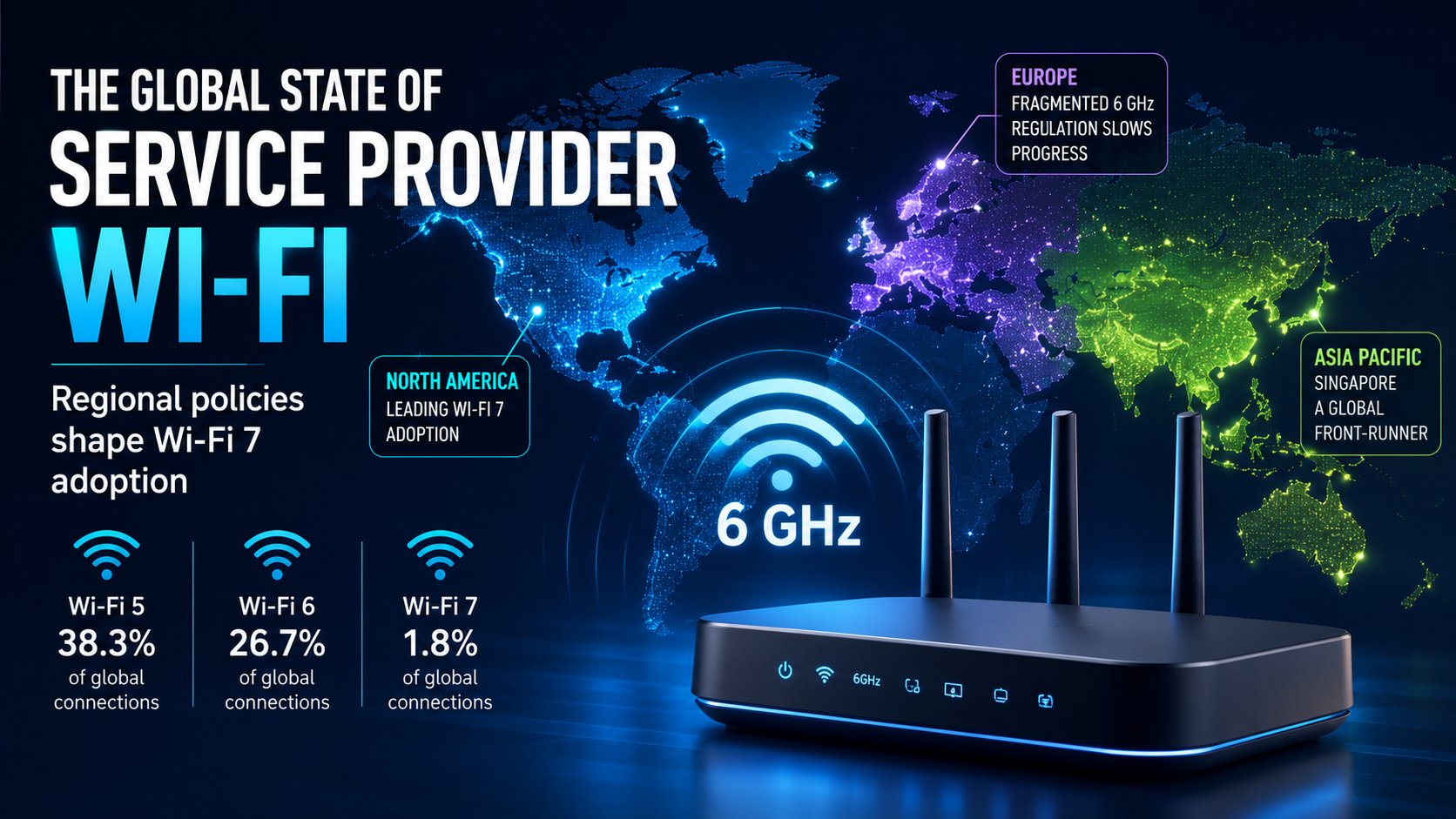
The study examines the installed base of residential Wi-Fi equipment by identifying the Wi-Fi generation used during Speedtest sessions. Rather than measuring equipment shipments, the data reflects technology that has already been deployed and is actively being used by consumers. According to Ookla, Wi-Fi 5 remains the largest installed technology globally, accounting for 38.3% of measured connections as of Q1 2026. Wi-Fi 6 has grown to 26.7%, while Wi-Fi 7 currently represents only 1.8% of global samples. Legacy Wi-Fi 4 still accounts for roughly one-third of global connections, although its prevalence varies significantly between regions.
One of the report’s central conclusions is that Wi-Fi 7 deployment is closely linked to access to the 6 GHz band. While Wi-Fi 7 can operate across 2.4 GHz, 5 GHz, and 6 GHz, the full performance advantages of the standard are realised when the complete 1,200 MHz of 6 GHz spectrum is available. Full-band operation enables multiple contiguous 320 MHz channels while avoiding interference from earlier generations of Wi-Fi devices that cannot access the new band. The report also distinguishes between Wi-Fi 6 and Wi-Fi 6E, noting that Wi-Fi 6E was specifically introduced to extend Wi-Fi 6 into the 6 GHz spectrum.
North America continues to lead global adoption of Wi-Fi 7 and 6 GHz. Ookla attributes this primarily to the early regulatory decision in the United States and Canada to allocate the full 6 GHz band for unlicensed use. That decision stimulated rapid ecosystem investment by chipset vendors, equipment manufacturers, and broadband operators. During the interview, Sue Marek also points to aggressive gateway replacement programmes by major service providers as an important driver of deployment, with many operators bundling Wi-Fi 6E and Wi-Fi 7 gateways into broadband subscriptions.
Europe presents a markedly different picture. The report finds that only 1.6% of measured Wi-Fi connections in Europe use the 6 GHz band, reflecting the fragmented regulatory landscape across the region. While countries such as France have embraced 6 GHz more aggressively, much of Europe continues to rely primarily on 5 GHz operation. As a result, Wi-Fi 7 adoption remains modest at approximately 2.5% of measured connections despite continued growth in Wi-Fi 6 deployments.
The Asia-Pacific region shows the greatest diversity. Overall 6 GHz utilisation remains very low across the region, largely because many markets have yet to make the spectrum widely available. However, Singapore stands out as a global leader in Wi-Fi 7 adoption. Ookla attributes this to a combination of supportive government policy, widespread availability of high-speed broadband services, and proactive deployment of next-generation gateways by local service providers. The interview notes that Singapore illustrates what can be achieved when regulatory policy, operator investment, and consumer demand develop in parallel.
The discussion also addresses an important question surrounding the dataset itself. Because the analysis is based on Speedtest measurements from Android devices, it reflects the Wi-Fi capabilities available to end users rather than simply the capabilities of the access point. Marek argues, however, that smartphones are generally not the limiting factor, as most current Android handsets already support the latest Wi-Fi technologies. Instead, the larger constraint remains the installed base of older residential gateways and customer premises equipment, which continue to delay migration to newer Wi-Fi generations.
WiFi NOW’s take: Ookla’s findings reinforce an increasingly clear trend across the broadband industry: Spectrum policy has become one of the strongest determinants of Wi-Fi technology adoption. Markets that allocated the full 6 GHz band early are now leading deployment of Wi-Fi 7, while regions with fragmented or delayed spectrum policies are seeing correspondingly slower migration. For broadband operators, equipment suppliers, and regulators alike, the data provides a useful benchmark for assessing the pace of next-generation Wi-Fi deployment around the world. And while Ookla paints a relatively bleak picture, other data sets (for example from large venue deployments by Cisco) a decidedly more optimistic regarding the adoption of – for example – 6 GHz devices.
Resources:
- Tech Watch interview with Sue Marek, Editorial Director, Ookla Research
- Sue Marek’s presentation: The Global State of Wi-Fi
- Ookla Global State of Wi-Fi report – find it here.