
Background: On August 13, 2026 covered the release of Celona’s Orion platform – read more here.
For years, the enterprise wireless industry has debated the relative merits of Wi-Fi and private 5G. The more important question may now be whether enterprises should be choosing between them at all. A new generation of converged networking platforms proposes that Wi-Fi, private 5G, public cellular, and even satellite should instead become complementary components of a common enterprise connectivity fabric.
The concept is not entirely new. Both HPE Aruba Networking and Cisco have for years argued that Wi-Fi and private 5G are complementary rather than competing technologies. HPE says enterprises do not want to operate private cellular and Wi-Fi as separate silos, while Cisco similarly describes the combination as a unified wireless fabric. What is changing is the scope of the convergence – and potentially the technology available to manage it (also not that the difference in this case is that HPE currently offers private 5G while Cisco does not).
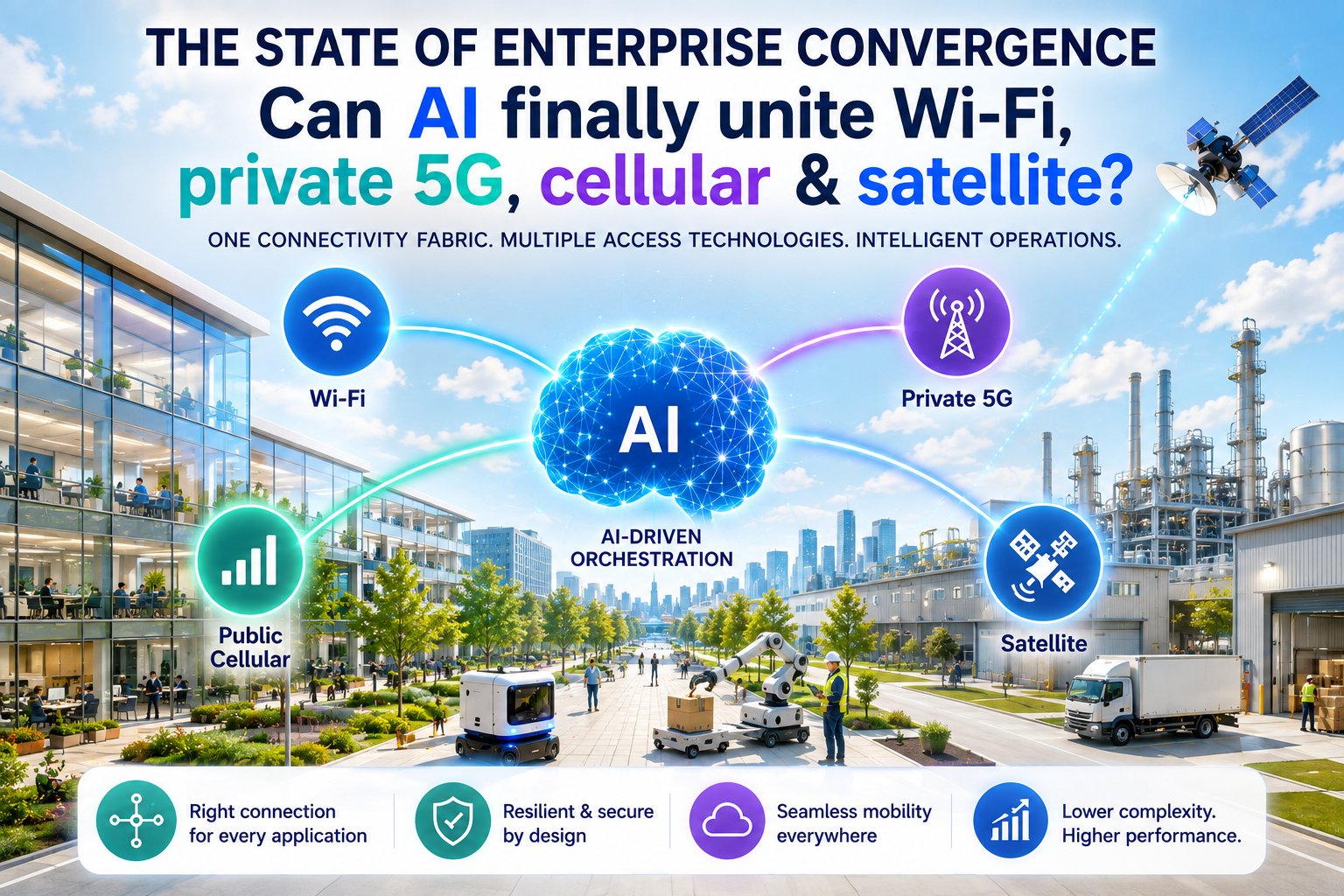
Celona’s newly launched Orion platform is perhaps the clearest expression yet of this broader vision: Orion brings private 5G and Wi-Fi into a common service fabric while adding management of public cellular and satellite connectivity. Celona is also introducing AI-based orchestration and an open-source endpoint agent intended to help devices navigate between multiple access technologies. The proposition raises a much bigger question than whether Celona’s particular solution succeeds: Could AI finally make heterogeneous enterprise wireless simple enough to deploy and operate at scale?
Private 5G’s problem was never the radio
Private 5G arrived with enormous expectations. The cellular industry predicted that enterprises would deploy dedicated mobile networks across factories, warehouses, ports, mines, utilities, campuses, healthcare facilities, and countless other environments.
The technology undoubtedly offers useful characteristics. Depending on spectrum and deployment, private cellular can provide large coverage areas, strong mobility, controlled access to radio resources, SIM-based identity, and predictable QoS. Wi-Fi, meanwhile, offers an enormous device ecosystem, comparatively simple deployment, very high capacity, and compelling economics, particularly indoors.
The two technologies are therefore fundamentally complementary. HPE Aruba Networking explicitly describes private 5G as complementing Wi-Fi, with private cellular providing wider-area coverage, mobility, and deterministic network access while Wi-Fi provides particularly high capacity in dense deployments. Cisco makes essentially the same argument in its own private 5G strategy. And yet private 5G adoption has developed considerably more slowly than many of the industry’s early expectations suggested. It has – in other words – been a disappointment especially for the cellular industry, from whence it came.
One reason may be remarkably simple: Enterprises don’t necessarily want another network. An enterprise may appreciate the technical properties of private 5G while being considerably less enthusiastic about deploying another set of radios, another management platform, another identity system, another device onboarding process, another troubleshooting domain, and another technology requiring specialist skills. The relevant question has therefore often not been whether private 5G works. It clearly does. The question has been whether its advantages justify the additional operational and economic complexity – and of course the additional CAPEX.
HPE itself has identified complexity as a factor holding back conventional private cellular deployments and has consequently focused on packaging core, servers, SIM/eSIM functionality, small cells, and management into an integrated enterprise offering. That is an important clue as to where the market may be heading.
The future may be Wi-Fi and private 5G
For much of the past decade, Wi-Fi and 5G have too often been positioned as competitors. That framing is becoming increasingly unhelpful.
Wi-Fi is exceptionally difficult to displace as the default enterprise wireless access technology. It is embedded in billions of devices, supported by essentially every enterprise networking vendor, operates in globally available unlicensed spectrum, and offers enormous capacity at attractive economics.
Private 5G solves a different set of problems. Industrial vehicles moving across large outdoor areas, autonomous mobile robots requiring controlled mobility, critical applications requiring tightly managed QoS, or devices operating in environments where Wi-Fi coverage would require a very large number of APs may represent excellent private cellular applications.
Public cellular extends connectivity beyond the enterprise campus. Satellite extends it beyond terrestrial network coverage. The emerging architecture could therefore look something like this:
- Wi-Fi: High-capacity enterprise access for employees, devices, applications, video, and general-purpose connectivity (mostly indoor)
- Private 5G: Controlled mobility, industrial connectivity, wide-area coverage (outdoor), and applications requiring predictable network characteristics.
- Public cellular: Wide-area mobility, off-campus connectivity, guest or contractor access, and backup connectivity.
- Satellite: Remote facilities, temporary sites, field operations, and locations beyond practical terrestrial coverage.
In such an architecture, asking whether Wi-Fi or private 5G is “better” becomes increasingly meaningless. The more useful question becomes: Which available access technology is best suited to this application, device, location, and moment? That is a radically different way of thinking about enterprise wireless.
AI could change the economics of heterogeneous networking
There is, however, an obvious problem. Four access technologies could easily mean four operational silos. And if convergence merely gives an enterprise four networks to operate instead of one, it is difficult to see why most IT organisations would embrace it. This is where AI potentially becomes significant.
The most interesting proposition behind AI-driven wireless orchestration is not simply that an AI assistant might help a network engineer configure an AP or diagnose an alarm. The potentially transformative proposition is that AI could reduce the operational penalty associated with heterogeneous infrastructure.
An AI-driven orchestration layer could potentially correlate telemetry across different access networks, identify dependencies that are invisible within individual management platforms, troubleshoot connectivity from application to endpoint, recommend configuration changes, automate repetitive operational processes, and ultimately translate application requirements into network policy.
The network engineer would no longer necessarily need to understand every underlying subsystem in detail. Instead, the engineer could increasingly define the required outcome while software agents determine how the available infrastructure should deliver it.
This is what makes Celona’s Orion proposition particularly interesting. Celona describes its Orchestrator AI, with Celona Brain at its core, as an agentic operating environment for converged wireless. The objective is not simply to place multiple dashboards behind a common login but eventually to have software agents reason across connectivity domains.
Whether today’s technology can fully deliver on that vision remains to be demonstrated. But the direction is significant. AI may make heterogeneous networking operationally viable in ways that conventional network management could not. If that happens, the economics of enterprise wireless could change with it.
Convergence doesn’t mean putting everything in one box
It is important to distinguish convergence from hardware integration. There is little technical reason why a Wi-Fi AP, private 5G small cell, public mobile network, and satellite terminal should become a single physical radio system. They operate in different spectrum, use different protocols, support different device ecosystems, and often have very different propagation and deployment requirements.
Celona itself makes this distinction. Its Wi-Fi APs and private cellular radios remain separate devices. The convergence instead happens higher in the architecture. We believe it is useful to think about enterprise wireless convergence as a series of layers:
- Radio infrastructure: Largely separate.
- Network management: Increasingly converged.
- Identity and onboarding: Increasingly capable of crossing network boundaries.
- Policy: Potentially converged.
- Telemetry and assurance: Increasingly converged.
- AI operations: Potentially access-independent.
- Endpoint connectivity: The next major challenge.
This distinction matters. A common dashboard is useful, but it does not in itself constitute profound convergence. The real transformation happens when applications and operational systems no longer need to care which underlying access network is being used.
The endpoint may be the hardest problem of all
Network-side convergence solves only half the problem. Consider an autonomous robot equipped with both private 5G and Wi-Fi. The robot may need highly predictable connectivity while moving through a production facility. At the same time, it may generate large quantities of machine-vision video, telemetry, diagnostic information, maps, and other data.
There is no obvious reason all of those applications need to use the same network. Private 5G might provide mobility and control connectivity while Wi-Fi handles high-capacity video upload, telemetry, software downloads, or AI model updates. Outside the private network, public cellular could become available. At a remote facility, satellite might provide the only practical WAN connection.
The difficult question is: Who makes those decisions?
Today’s devices and operating systems can already support multiple network interfaces, but truly intelligent application-aware selection and simultaneous use of heterogeneous enterprise networks remains considerably more difficult than simply installing two radios.
Celona is attempting to address this with AerConnect, an open-source software agent intended for integration into robotics and other AI-driven devices. Celona says AerConnect is not tied to Celona infrastructure, meaning that in principle it could operate across heterogeneous network environments.
This could prove strategically important. If endpoint software can abstract the underlying access technologies in the same way that network-side orchestration attempts to abstract infrastructure complexity, a new connectivity layer could emerge between applications and radios. Applications would specify what they require while the connectivity layer would determine how to deliver it.
Physical AI could accelerate the need for convergence
This becomes particularly relevant as enterprises begin deploying more robotics and other forms of physical AI. Traditional enterprise endpoints are relatively straightforward: A laptop or smartphone generally needs reliable connectivity and high throughput, and Wi-Fi satisfies those requirements extremely well.
Autonomous machines are different: A robot may simultaneously generate real-time control traffic, machine-vision video, telemetry, location data, sensor streams, operational logs, and AI inference traffic. It may also periodically download software and very large AI models. Those traffic types can have radically different connectivity requirements.
Some may prioritise latency, while others need reliability, and still others must have mobility or even raw capacity. Some may be critical while others can wait. A single radio technology can of course transport multiple traffic classes but increasingly sophisticated machines make it more plausible that enterprises will want to exploit different access technologies according to their particular strengths.
This creates an intriguing feedback loop. AI may simultaneously create the applications that require converged wireless and provide the operational intelligence needed to make converged wireless practical. That could become one of the strongest drivers of enterprise networking architecture over the coming years.
Celona is not alone – and the incumbents have enormous advantages
Celona’s Orion launch should not be interpreted as the beginning of Wi-Fi/private 5G convergence. The industry has been moving in this direction for several years. HPE’s 2023 acquisition of Athonet was explicitly intended to combine private cellular with Aruba’s enterprise networking portfolio. HPE said at the time that integration with Aruba Central would eventually allow network managers to administer Wi-Fi and private 5G through a common management environment with AI-powered insights and automation. HPE has also deployed integrated Wi-Fi and private 5G operationally, including at the Ryder Cup.
Cisco has similarly argued that private 5G should complement rather than replace Wi-Fi and markets private 5G as integrating into existing Wi-Fi and wired enterprise environments. Cisco has also explored the intersection between private 5G and non-terrestrial networks. Cisco’s current industrial wireless solution that – in some respects – competes with private 5G is called Ultra-reliable Wireless Backhaul or URWB (a proprietary unlicensed radio solution largely based on Wi-Fi infrastructure).
These companies have an enormous strategic advantage: They already own substantial parts of the enterprise network. But that advantage creates an interesting tension: An established Wi-Fi vendor has billions of dollars of installed infrastructure, customer relationships, channel expertise, and engineering investment centred on Wi-Fi. Private 5G is an additional technology that must justify its place alongside an already successful enterprise wireless architecture.
A private cellular specialist such as Celona approaches the problem from the opposite direction. It has no large incumbent Wi-Fi business to protect, which means that adding Wi-Fi potentially expands its addressable market rather than cannibalising an existing one. Which strategy ultimately proves more successful is not obvious. The incumbent enterprise vendors have enormous distribution and installed-base advantages. The challengers may have greater incentive to rethink the architecture from first principles.
The end of Wi-Fi versus 5G?
None of this means that every enterprise will suddenly deploy four wireless access technologies. Most probably won’t. For many organisations, Wi-Fi will continue to satisfy nearly every local connectivity requirement. Adding private cellular, public cellular integration, or satellite must still solve a real business problem and justify its cost. Nor should AI become an excuse to create unnecessary network complexity. But the underlying architectural direction is becoming clearer.
HPE says enterprises don’t want private 5G and Wi-Fi deployed as silos. Cisco argues that the two technologies are complementary. Celona is now extending the proposition beyond Wi-Fi and private 5G to public cellular and satellite while attempting to apply AI both to infrastructure operations and endpoint connectivity. The industry’s long-running argument over whether Wi-Fi or 5G will dominate enterprise wireless may therefore have been asking the wrong question. Neither technology needs to win.
Instead, the challenge is to make their differences sufficiently transparent to applications, devices, users, and network operations that enterprises can exploit whichever connectivity resource makes the most sense. If AI can substantially reduce the operational complexity – and if intelligent endpoint software can reduce the client-side complexity – enterprise wireless could evolve from a collection of independently operated radio networks into something much closer to a genuine connectivity fabric.
Celona’s Orion is one attempt to build that future. HPE, Cisco, and others are pursuing different versions of convergence. It is still too early to know which architecture will prevail but the destination is increasingly compelling: The future enterprise may not choose between Wi-Fi, private 5G, public cellular, and satellite. It may simply choose connectivity.
/Claus.