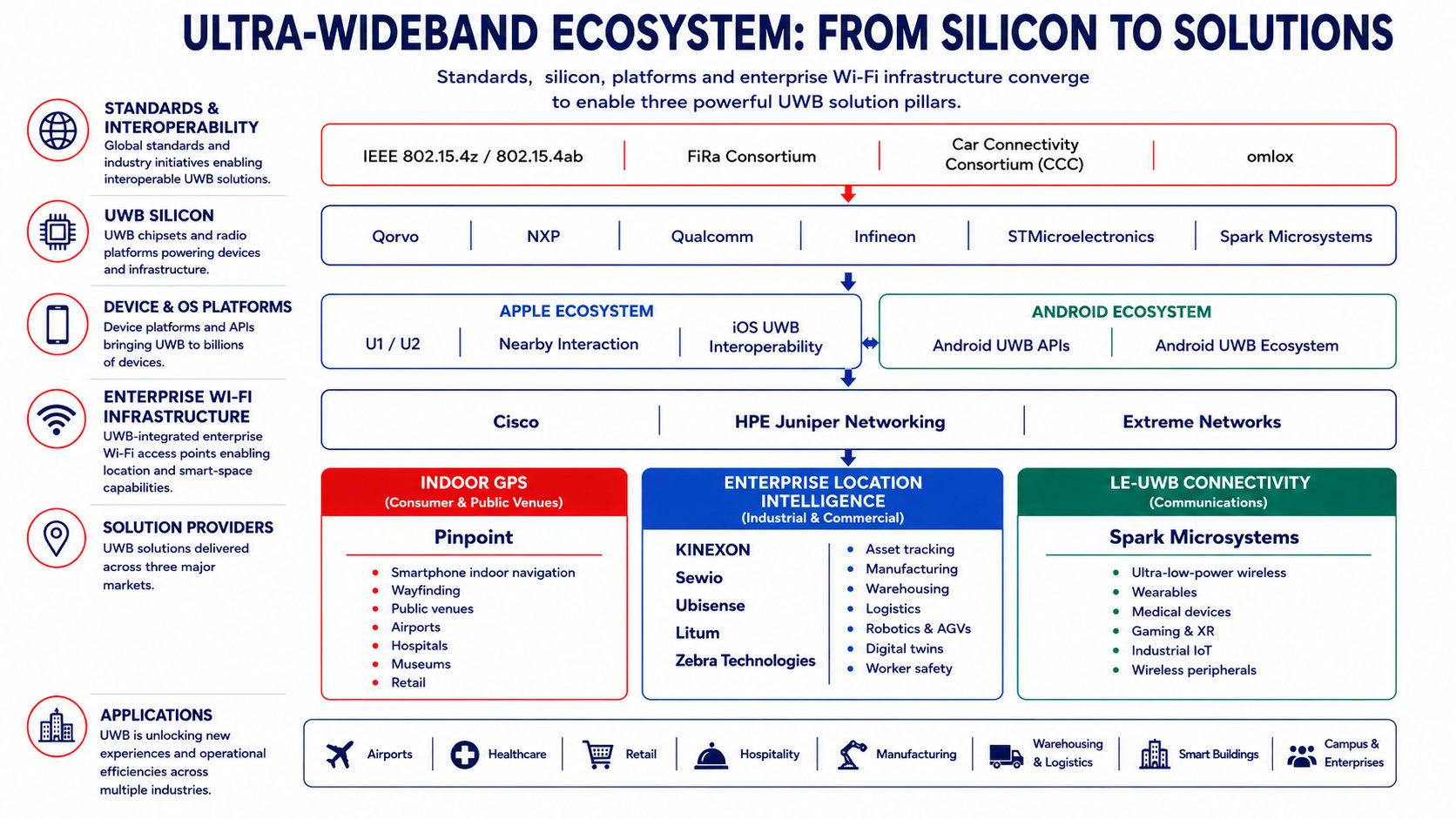

Ultra-wideband is evolving fast from a niche wireless technology into one of the industry’s most dynamic innovation platforms. Over the past few years, UWB has moved beyond smartphones and digital car keys to enable precise indoor positioning, enterprise automation, and a new generation of ultra-low-power wireless communications. Today, a growing ecosystem of standards bodies, silicon suppliers, device manufacturers, infrastructure vendors, and solution providers is shaping UWB’s commercial future.
In the previous four parts of this series, we’ve explored how UWB delivers centimetre-level indoor positioning, enables intelligent spaces, and is emerging as a compelling communications technology. In this final part, we step back and examine the broader ecosystem: Who is building it, how the pieces fit together, and why the convergence of these technologies matters.
Standards provide the foundation
Every successful wireless technology relies on open standards and industry collaboration. UWB is no exception. The IEEE 802.15.4z and 802.11.4ab standards define the physical and MAC layers used by modern UWB implementations, while the FiRa Consortium develops interoperability specifications that ensure devices from different manufacturers can communicate reliably.
The Car Connectivity Consortium (CCC) has driven widespread adoption of UWB for secure digital vehicle access through its Digital Key specifications, while omlox has established an open standard for interoperable industrial positioning systems. Together, these organisations are helping to transform UWB from a collection of proprietary implementations into a global, interoperable ecosystem.
Silicon is driving fast innovation
At the heart of every UWB device is a highly integrated radio chipset capable of transmitting and receiving extremely short radio pulses with exceptional timing precision. Companies including Qorvo, NXP, Qualcomm, Infineon, STMicroelectronics, and Spark Microsystems are investing heavily in UWB silicon, each targeting different market segments ranging from smartphones and automotive to industrial automation and ultra-low-power communications. As competition increases, chipset integration, power efficiency, and cost are expected to improve, accelerating adoption across both consumer and enterprise markets.
Apple and Android are bringing UWB to billions of devices
Perhaps the single biggest catalyst for UWB adoption has been its integration into mainstream mobile platforms. Apple introduced the U1 chip in 2019 and has steadily expanded UWB capabilities through Nearby Interaction and other platform services.
More recently, Apple has published an interoperability specification intended to help third-party infrastructure vendors build products that work seamlessly with future iOS devices. Android has followed a different path by exposing extensive UWB APIs to developers, allowing smartphone manufacturers and application developers greater control over location-aware applications. Together, Apple and Android are transforming UWB into a mainstream mobile platform rather than a niche technology.
Enterprise Wi-Fi infrastructure is becoming location-aware
One of the most significant developments in recent years has been the integration of UWB into enterprise Wi-Fi infrastructure. Rather than deploying dedicated positioning networks, organisations can increasingly combine wireless connectivity and precise indoor positioning through the same enterprise infrastructure.
Vendors including Cisco, HPE Juniper Networking, and Extreme Networks are incorporating UWB capabilities into enterprise access points, enabling organisations to build location-aware environments while leveraging their existing wireless investments. This convergence is likely to make precise location an increasingly standard capability of enterprise wireless networks.
Three solution pillars are emerging
The commercial UWB market can be viewed as three distinct but closely related solution areas.
- Indoor GPS
The first is Indoor GPS – bringing highly accurate positioning to places where satellite navigation cannot reach. UWB is enabling smartphone-based wayfinding, asset finding, and indoor navigation across airports, hospitals, campuses, museums, shopping centres, and other complex public venues. Companies such as Pinpoint are helping define this emerging market. - Enterprise Location Intelligence
The second pillar is Enterprise Location Intelligence, where precise location data becomes the foundation for operational intelligence. Industrial facilities increasingly use UWB to monitor assets, coordinate robots and automated guided vehicles, improve worker safety, and build digital twins of physical environments. Companies including KINEXON, Sewio, Ubisense, Litum, and Zebra Technologies are among those delivering commercial solutions in this rapidly growing segment. - UWB Connectivity
The third pillar is UWB Connectivity. While still at an early stage, companies such as Spark Microsystems are demonstrating that UWB can also deliver ultra-low-power, ultra-low-latency wireless communications suitable for wearables, medical devices, industrial IoT, gaming peripherals, and other demanding applications. This could eventually position UWB as an important complement—and in some applications, an alternative—to Bluetooth. The most promising UWB standard for connectivity is LE-UWB also known as 802.11.15.4ab, which is still under development.
The ecosystem is still in its early stages
Despite significant progress, UWB remains an emerging technology. The standards continue to evolve, more smartphones are becoming UWB-enabled, enterprise infrastructure vendors are expanding their offerings, and new applications continue to appear. Many of today’s most exciting commercial opportunities – from spatial computing to Physical AI – are only just beginning to take shape.
That also means the ecosystem will continue to evolve. New silicon vendors, infrastructure providers, software platforms, and solution specialists are likely to enter the market over the coming years.
WiFi NOW’s take: Ultra-Wideband is no longer simply a positioning technology. It is becoming a foundational wireless platform spanning consumer devices, enterprise infrastructure, industrial automation, and ultra-low-power communications.
Perhaps the most significant trend is the convergence of these previously separate markets. The same standards, silicon, operating platforms, and increasingly enterprise Wi-Fi infrastructure are supporting multiple classes of applications—from smartphone wayfinding to intelligent factories and next-generation wireless peripherals.
As the ecosystem matures, UWB is likely to become an increasingly important part of the broader wireless landscape. For network operators, enterprise IT teams, device manufacturers, and technology suppliers alike, understanding this ecosystem is becoming essential. And for that reason alone, Ultra-Wideband deserves a place alongside Wi-Fi and Bluetooth as one of the defining wireless technologies of the decade.
Disclaimer: This ecosystem map is intended as a high-level overview of the commercial Ultra-Wideband ecosystem based on publicly available information at the time of publication. It is illustrative rather than exhaustive, and inclusion or omission of companies should not be interpreted as an assessment of technical capability, market position, or commercial significance. The UWB ecosystem is evolving rapidly and will continue to be updated as new technologies, products, and participants emerge.