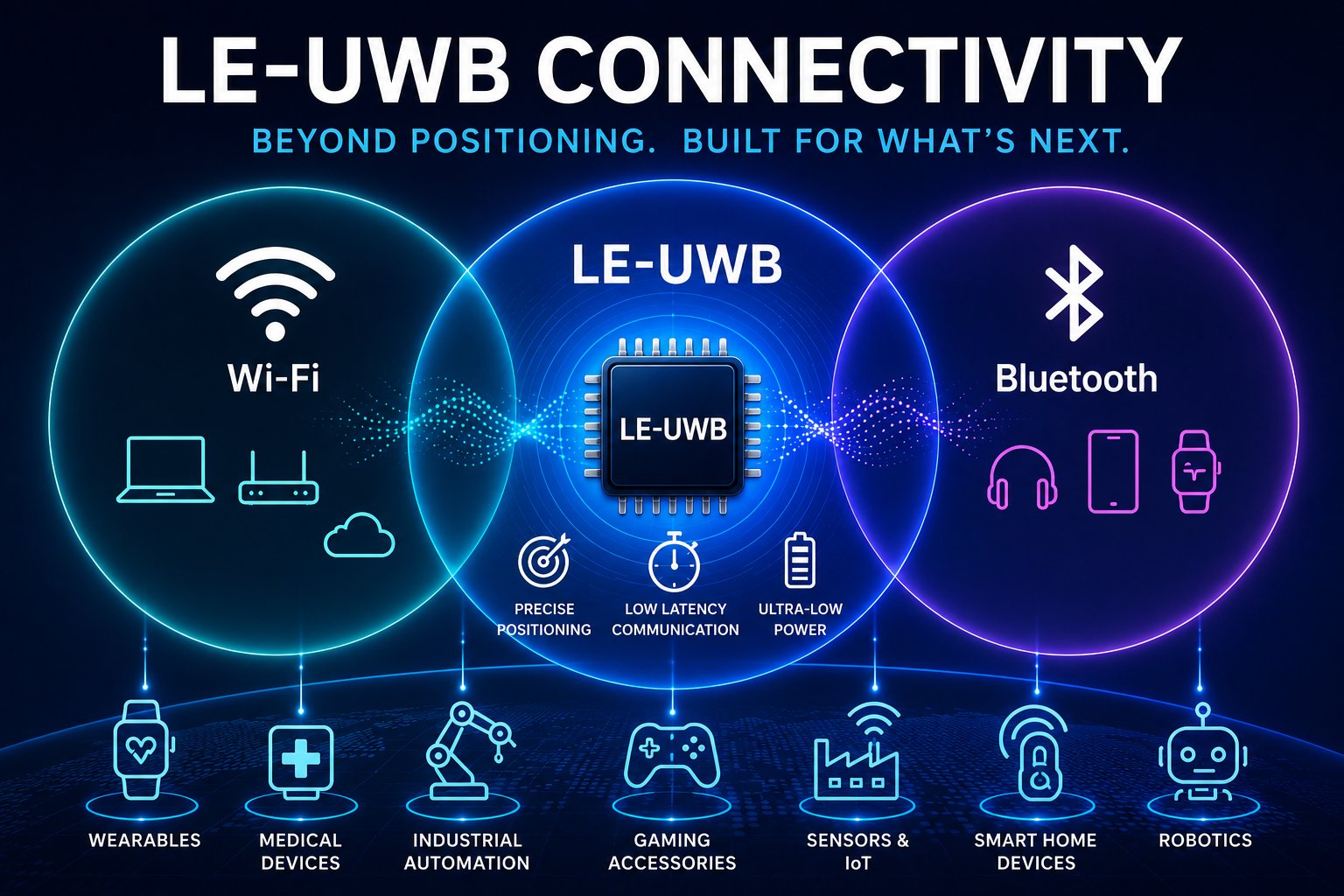

Ultra-wideband has become synonymous with precise indoor positioning. Today, UWB enables everything from finding misplaced devices and unlocking vehicles to navigating airports, tracking industrial assets, and powering increasingly intelligent enterprise environments. But positioning is only part of the story.
A second commercial market is now beginning to emerge – one that could significantly broaden UWB’s role in the wireless landscape. A new generation of UWB implementations called LE-UWB is demonstrating that the same technology used for centimetre-level ranging can also deliver ultra-low-power, ultra-low-latency wireless communications. While still at an early stage of development, LE-UWB connectivity has the potential to complement – and in selected applications compete with – established technologies such as Bluetooth. If this trend continues, Ultra-Wideband may evolve from a specialist positioning technology into a broader wireless platform supporting positioning, sensing, and data communications.
What is LE-UWB or IEEE 802.15.4ab? This is the next-generation Ultra-Wideband (UWB) standard under development by IEEE. Building on IEEE 802.15.4z, it introduces enhanced physical layer (PHY) capabilities for longer range, lower power, improved coexistence, higher device density, native sensing, and significantly higher data rates -extending UWB from secure ranging into low-latency wireless connectivity. 802.15.4ab explicitly broadens the scope of UWB to include communications, sensing, streaming, networking, and infrastructure operation. In other words: This is the first IEEE UWB amendment that clearly positions UWB as a general-purpose wireless platform, not predominantly a ranging technology.
UWB has always been a communications technology
One of the biggest misconceptions about UWB is that it is purely a positioning technology. In reality, UWB has always communicated. Every ranging measurement relies on devices exchanging precisely timed radio messages. Those messages already contain data – the industry has simply focused on using them to calculate distance rather than transport application traffic. Recent advances in UWB silicon are changing that perspective. Improvements in power efficiency, radio design, and protocol implementation with LE-UWB (the new 802.15.4ab standard under development) are making it increasingly practical to use UWB not only for ranging, but also for wireless connectivity.
Why LE-UWB is attracting interest for connectivity
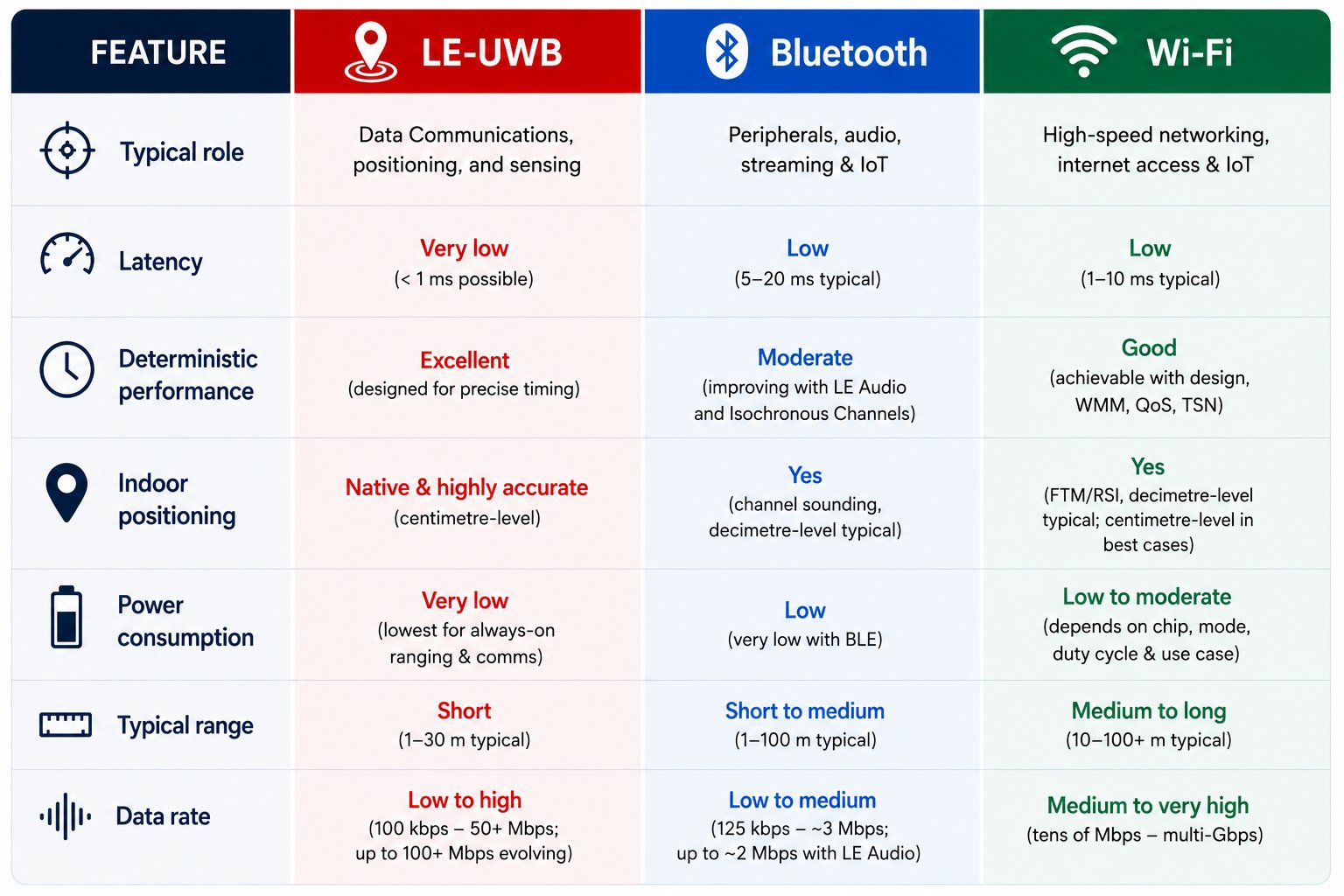
Several characteristics distinguish LE-UWB from other short-range wireless technologies:
- Extremely low latency
Because UWB transmits very short radio pulses with highly accurate timing, it can support communications with extremely low and predictable latency. This deterministic behaviour is particularly valuable for real-time control systems where reliable response times are more important than maximum throughput. - Low power operation
Recent UWB implementations have demonstrated that the technology can operate at remarkably low power levels. This creates opportunities for battery-powered devices such as wearables, medical sensors, industrial equipment, and other products where long battery life is essential. - Positioning and communications in one radio
Unlike conventional wireless technologies, UWB can combine precise positioning and wireless communications using the same radio technology. A device can determine where it is while simultaneously exchanging application data, simplifying system design and reducing the need for multiple wireless technologies.
Robust operation
UWB signals occupy a very wide bandwidth while transmitting at extremely low power spectral density. This enables efficient spectrum sharing with other wireless technologies and contributes to reliable operation in demanding RF environments.
A new class of wireless applications
Although commercial deployment remains at an early stage, LE-UWB connectivity is attracting interest across a growing range of applications. These include:
- Wearables
- Medical devices
- Gaming peripherals
- Industrial sensors
- Robotics
- Factory automation
- Human-machine interfaces
- Consumer electronics
- Smart home devices
- Low-power IoT
Many of these applications prioritise low latency, predictable performance, precise timing, and energy efficiency over high data rates.
SPARK Microsystems is demonstrating what’s possible
Among the companies pioneering this emerging market, SPARK Microsystems has attracted particular attention. The company has developed UWB technology specifically for ultra-low-power wireless communications rather than positioning alone. SPARK reports significant improvements in latency and power efficiency compared with conventional short-range wireless technologies in targeted applications, illustrating how LE-UWB can address use cases beyond location services. While the market is still in its infancy, SPARK demonstrates that LE-UWB connectivity is moving from research into commercial reality.
UWB, Bluetooth, and Wi-Fi are complementary technologies – for now
It is tempting to ask whether LE-UWB will replace Bluetooth. For now, that is probably the wrong question. Bluetooth has an enormous installed base, decades of ecosystem development, and remains the preferred solution for many consumer peripherals and audio products. Wi-Fi continues to dominate high-throughput networking across homes, enterprises, and public venues, and (in particular through the Matter ecosystem) is finding renewed support for smart home IoT devices and similar.
LE-UWB is emerging as a third option – one optimised for applications requiring deterministic communications, extremely low latency, precise timing, and, where needed, integrated positioning. Rather than replacing existing technologies, for now LE-UWB is expanding the wireless toolbox available to product designers. In time, LE-UWB could develop into a significant competitor to Bluetooth but this would also require – for example – and interoperability regime and standardisation.
A market just beginning to emerge
The commercial ecosystem for UWB connectivity is still in its early stages. Bluetooth benefits from billions of deployed devices and decades of software support. UWB, by comparison, is only beginning to develop a comparable ecosystem for communications. However, the foundations are already in place. Hundreds of millions of smartphones now include UWB hardware, major semiconductor companies continue to invest in the technology, and enterprise infrastructure vendors are increasingly integrating UWB alongside Wi-Fi. As new connectivity applications emerge, this installed base could accelerate commercial adoption.
WiFi NOW’s take: Ultra-wideband’s future is unlikely to be defined by positioning alone. The technology is evolving into a broader wireless platform capable of combining precise location, deterministic communications, and low-power operation within a single radio architecture. That combination could enable entirely new classes of wireless products across healthcare, industrial automation, robotics, wearables, intelligent buildings, and AI-enabled edge devices. Whether UWB ultimately becomes a major connectivity technology remains to be seen. But one thing is already clear: Ultra-Wideband is expanding beyond its original role as a positioning technology and deserves serious attention as one of the most promising emerging wireless platforms of the coming decade.