
WiFi NOW’s TAKE: Ultra-wideband is the one location technology that can pinpoint the location of an item right down to a few centimetres of accuracy – and that is a game changer for many use cases. Pinpoint is one of the few companies capable of delivering the full solution and is now leading the charge in deploying UWB location systems, particularly in Europe. We believe Pinpoint is positioned well for mass-market success as one of a handful early adopters.
For most of us, getting from A to B outdoors is effortless. We open a map app, follow the blue dot, and arrive at our destination. Indoors, however, the experience is often very different. Whether navigating a vast trade show, a busy train station, a hospital, or a retail store, finding the right location can still be surprisingly difficult.
According to Thomas Graichen of Pinpoint, that is about to change. In a recent WiFi NOW Tech Watch interview, Thomas Graichen outlined how Ultra-Wideband (UWB) technology is finally making precise indoor navigation practical – and potentially as transformative as GPS was for outdoor navigation.
The Missing Piece of Digital Navigation
GPS revolutionised the way people move through the world. Yet GPS signals do not work reliably inside buildings, leaving a major gap in the digital user experience. Thomas Graichen compares today’s indoor navigation experience to the early days of road travel before GPS. Visitors to large venues still rely on printed maps, signage, or simply asking for directions. Anyone who has attended major events such as CES or Mobile World Congress will recognize the problem immediately.
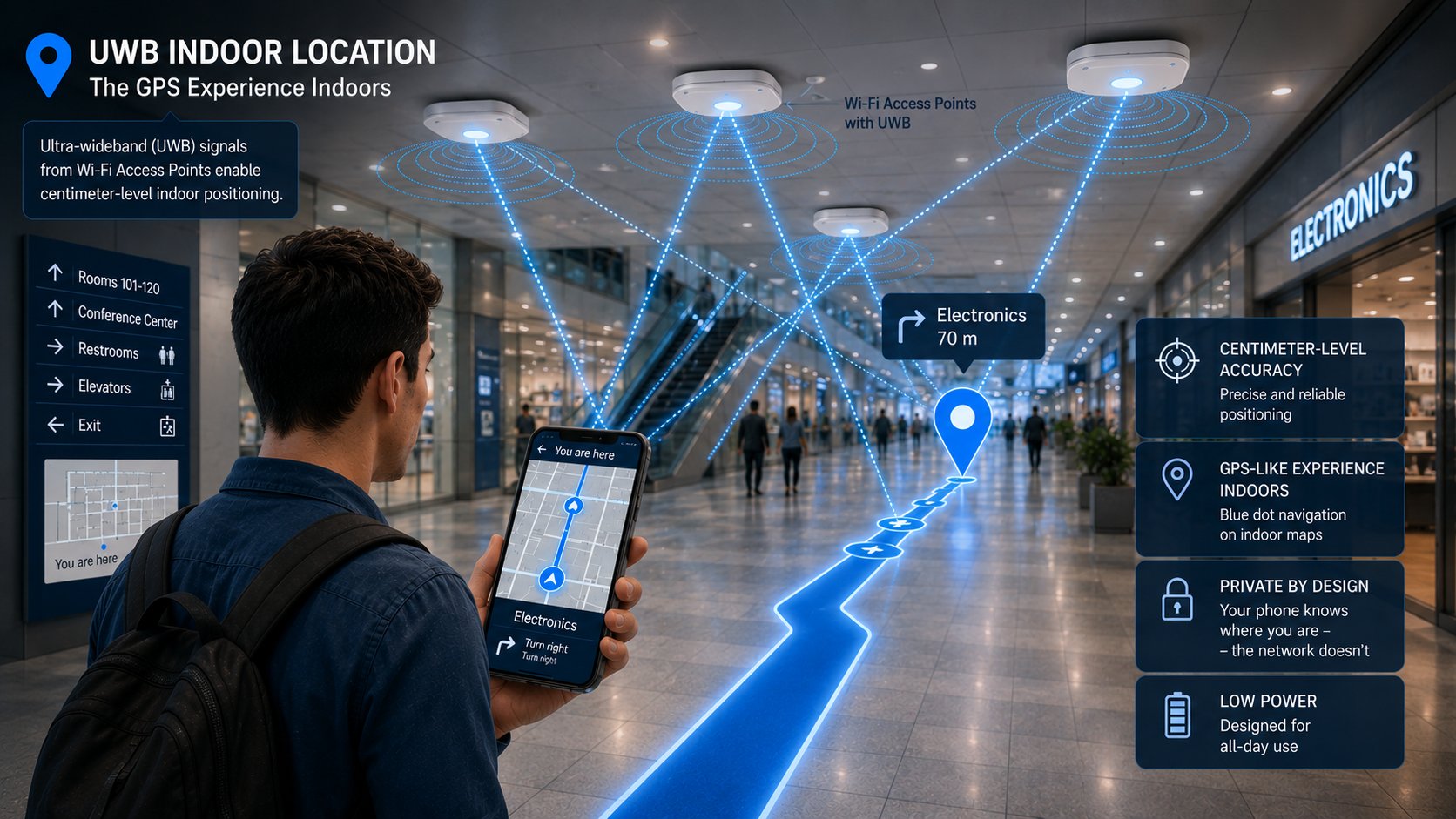
PinPoint’s vision is straightforward: bring the familiar “blue dot” experience indoors.
Why Ultra-Wideband Is Different
While Wi-Fi and Bluetooth can provide approximate location information, UWB is designed for highly precise ranging and positioning. Thomas Graichen says UWB can deliver centimetre-level accuracy, enabling applications where knowing exactly where a user is standing matters. This precision opens opportunities that are difficult or impossible with other wireless technologies:
- Turn-by-turn indoor navigation
- Product-level guidance in retail stores
- Navigation assistance in transport hubs
- Accessibility services for visually impaired users
- Context-aware location services
- Advanced venue experiences
Importantly, UWB is designed to coexist seamlessly with Wi-Fi networks, making it a complementary technology rather than a competitor.
A Growing Ecosystem Is Developing Fast
One reason indoor positioning has struggled historically is the lack of a complete ecosystem. That situation is rapidly changing. On the infrastructure side, major networking vendors including Cisco and HPE (Juniper/Mist) have begun integrating UWB capabilities into enterprise access points. On the device side, Apple has included UWB technology since the iPhone 11, while Google and Samsung are also expanding UWB support across their product portfolios.
Industry standards are also maturing:
- The FiRa Consortium is driving interoperability and positioning standards.
- Aliro is defining UWB-enabled smart access experiences.
- The Car Connectivity Consortium is advancing digital car key applications.
According to Thomas Graichen, the industry has now reached a tipping point where both infrastructure and end-user devices are widely available, creating the conditions for large-scale deployment.
PinPoint’s ‘Indoor Satellite Approach’
PinPoint describes its infrastructure devices as indoor “satellites” – compact UWB nodes installed throughout a building. Combined with deployment software and mobile SDKs, these devices enable smartphones to determine their position in real time. The company provides:
- UWB infrastructure devices
- Deployment and management software
- Android and iOS software development kits
- Location engines supporting FiRa interoperability
The goal is to allow venue operators, retailers, transportation providers, and event organizers to add precise positioning capabilities directly into their existing mobile applications.
Real-World Impact: Helping Visually Impaired Travellers
One of PinPoint’s most compelling projects involves a pilot deployment with German rail operator Deutsche Bahn. By installing UWB infrastructure within train stations, the system enables navigation assistance for visually impaired passengers.
The technology can guide users through complex transportation environments that are often challenging to navigate independently. This highlights an often-overlooked aspect of indoor positioning: accessibility. While many discussions focus on convenience, precise indoor navigation could significantly improve independence and mobility for millions of people.
Retail’s Next Frontier
Retail is another potentially powerful use case. Consumers frequently struggle to locate products in large stores. Retailers lose sales when shoppers abandon purchases simply because they cannot find what they need.
With centimeter-level positioning, retailers can guide customers directly to specific products or aisles through their existing mobile apps. Shopping lists could become navigational tools, leading users through stores with the same ease as GPS guides drivers on the road.
Privacy by Design
Perhaps one of the most interesting aspects of PinPoint’s approach is privacy. Unlike many location-tracking systems, UWB indoor positioning does not require the infrastructure to track users. Instead, smartphones determine their own location by listening to signals from the infrastructure.
The result is a fundamentally different privacy model: The network does not know where users are, but users know where they are. As concerns about digital privacy continue to grow, this architecture could become an important differentiator for indoor positioning systems.
The Beginning of the ‘Indoor GPS’ Era?
Indoor positioning has long been discussed as a future opportunity, but the combination of standardized UWB technology, enterprise infrastructure support, and smartphone adoption suggests the market may finally be ready. If GPS transformed how people move outdoors, UWB could do the same indoors. The challenge now is not the technology—it is identifying the applications that deliver enough value for venue operators, retailers, transportation providers, and consumers to embrace the new possibilities.
For companies like Pinpoint, that journey has already begun.
Don’t miss our full interview with Thomas Graichen from Pinpoint here.