
By Claus Hetting, WiFi NOW CEO & Chairman
If there was one clear conclusion from the Ultra-Wideband (UWB) Global Summit 2026, it was this: Ultra-Wideband has entered a new phase of maturity. The discussion has shifted away from whether UWB works and towards how rapidly it will become embedded into enterprise Wi-Fi infrastructure, smartphones, industrial automation, and intelligent AI systems.
Across presentations from Cisco, Qualcomm, Google, Qorvo, SPARK Microsystems, and independent analyst Shadi Hawawini, several consistent themes emerged.
UWB has reached critical mass
According to multiple speakers, UWB has quietly crossed an important milestone. Smartphone adoption has accelerated over the past five years, driven by Apple, Samsung, Google, Xiaomi and other vendors, with the technology now moving into mid-range devices through integrated connectivity chipsets.
Industry estimates presented during the summit suggest annual shipments are approaching – or have surpassed – one billion UWB-enabled devices. Unlike several years ago, standards fragmentation is no longer viewed as a major concern. The ecosystem is now built around:
- IEEE 802.15.4z
- The emerging IEEE 802.15.4ab standard
- FiRa Consortium certification
- Omlox industrial interoperability
- Car Connectivity Consortium (CCC)
- CSA Aliro secure access
This common standards foundation was repeatedly highlighted as one of the key reasons commercial deployments are now accelerating.
Wi-Fi infrastructure is becoming UWB infrastructure
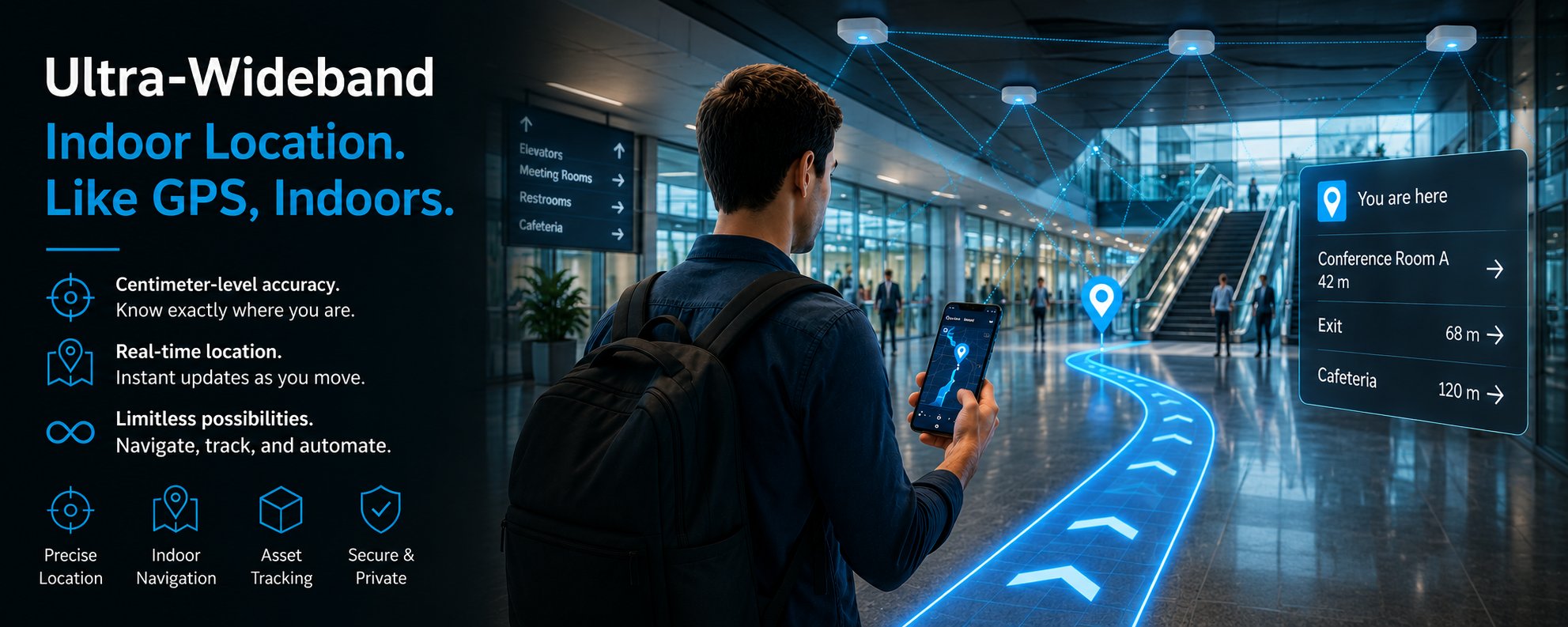
Perhaps the strongest message throughout the conference was the growing convergence between enterprise Wi-Fi and UWB. Qorvo argued that Wi-Fi access points are evolving into positioning and sensing platforms rather than simply wireless networking devices. Modern enterprise APs equipped with UWB can simultaneously provide:
- Wi-Fi connectivity
- Centimetre-level asset tracking
- Indoor navigation
- Location services
- Occupancy sensing
- Future radar capabilities
Rather than installing separate UWB anchor infrastructure, the Wi-Fi network increasingly becomes the positioning network. Qorvo also showed how UWB can simplify AP installation itself by enabling highly accurate AP-to-AP ranging during deployment, reducing installation cost and improving calibration accuracy.
Cisco sees standards enabling large-scale deployments
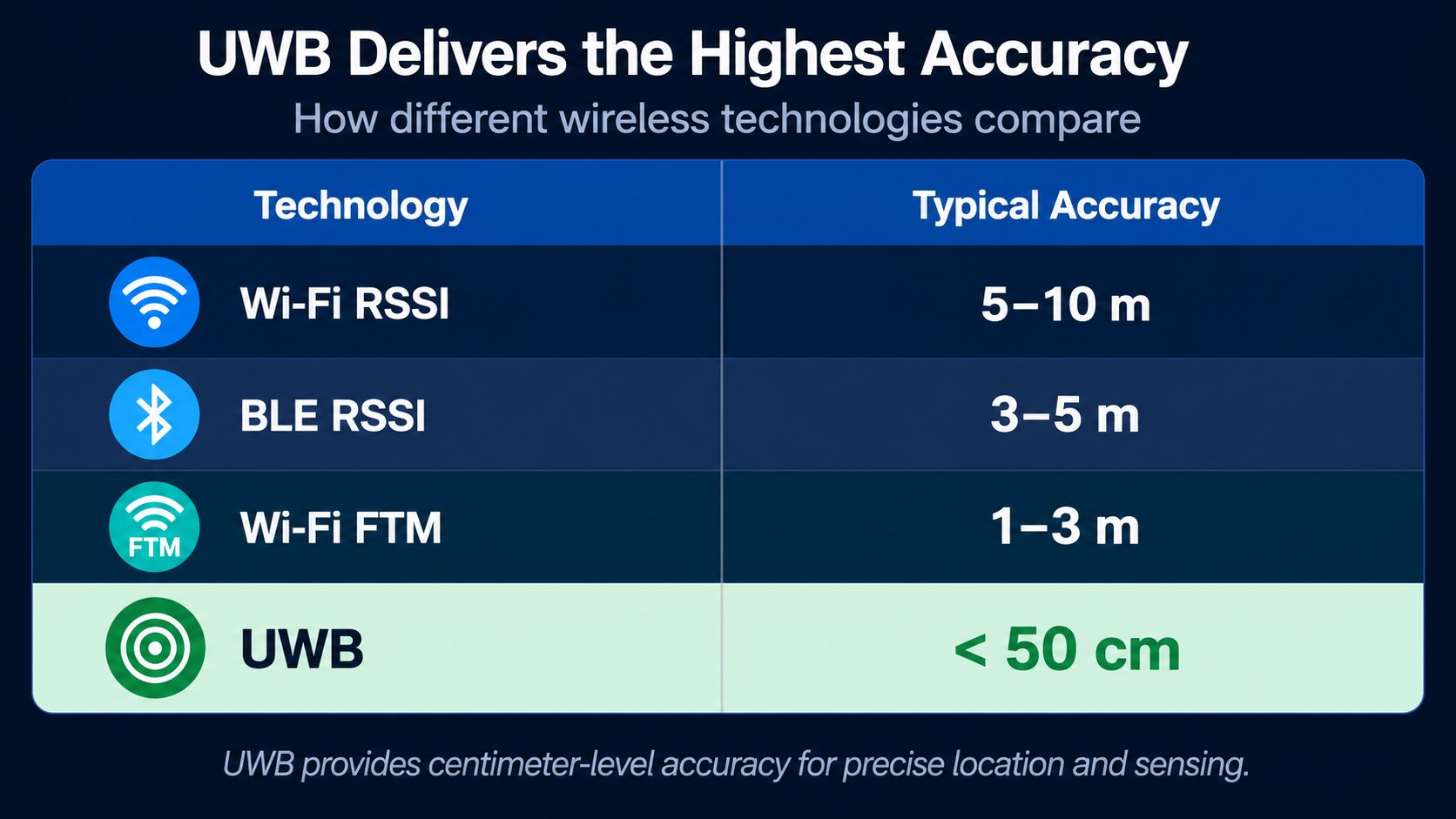
Cisco Distinguished Engineer Jerome Henry focused on why UWB accuracy is fundamentally different from Wi-Fi or Bluetooth. Because UWB transmits extremely short pulses across more than 500 MHz of spectrum, time-of-arrival measurements become dramatically more precise than conventional RSSI-based positioning.
He also emphasised that FiRa certification has increasingly shifted toward real user applications including:
- Public transport ticketing
- Tap-free payments
- Indoor navigation
- Asset tracking
– while new IEEE 802.15.4ab work is designed to extend range without increasing transmit power.
Android 17 makes UWB positioning much easier
One of the summit’s most important software announcements came from Google’s Roy Want and colleagues. Google presented the forthcoming Android 17 public APIs for Downlink Time Difference of Arrival (DL-TDoA), allowing Android applications to access infrastructure-based UWB positioning through standardized platform APIs. Instead of developers implementing complex ranging algorithms themselves, Android will expose:
- Public DL-TDoA APIs
- FiRa-compatible out-of-band configuration
- Integration with Android’s Fused Location Provider
- Future fusion with GPS, Wi-Fi RTT, cellular positioning and inertial sensors
Google demonstrated expected positioning accuracy around 25 cm (CDF90) using synchronised UWB infrastructure. This represents an important step toward making infrastructure-based indoor positioning widely accessible to Android developers.
Qualcomm: 802.15.4ab is the next major leap
Qualcomm focused heavily on the new IEEE 802.15.4ab standard, which extends today’s UWB capabilities. Among the improvements discussed:
- Narrow-Band Assisted Multi-Millisecond (NBA-MMS)
- Approximately three times longer ranging distance
- Significantly improved robustness when phones are in pockets or bags
- Improved link budget (12–18 dB)
- New sensing capabilities
- Higher data rates
Qualcomm also positioned UWB as one component within a broader connectivity platform combining:
- Wi-Fi 8
- Bluetooth
- Thread
- UWB
– rather than treating each wireless technology independently.
Perhaps most interestingly, Qualcomm presented UWB as supporting four major categories of smartphone applications: Find, Access, Track, and Detect including digital keys, indoor positioning, smart tags, asset tracking, gesture sensing and proximity AI.
UWB is becoming more than positioning
SPARK Microsystems challenged one of the industry’s long-standing assumptions.Their presentation argued that UWB has become overly associated with location, even though impulse-radio UWB was originally conceived as a high-performance communications technology. SPARK promoted its Low-Energy UWB (LE-UWB) architecture as suitable for applications requiring:
- Ultra-low latency
- Very low power
- Deterministic wireless performance
- High throughput
- Robust coexistence with Wi-Fi and Bluetooth
Potential applications included:
- AI wearables
- Robotics
- Gaming peripherals
- Wireless audio
- Industrial automation
- Physical AI systems
While these claims reflect SPARK’s own product positioning rather than broad industry consensus, the presentation illustrated that vendors increasingly view UWB as both a positioning technology and a real-time wireless communications platform.
Real deployments are now appearing
Unlike earlier UWB conferences that focused largely on future concepts, this summit featured several production deployments. Examples included:
- Cisco UWB-enabled access points deployed throughout Clair Global’s 250,000-square-foot headquarters for asset tracking and network management.
- Automotive manufacturing deployments using Qorvo UWB technology at Hyundai, Volkswagen and another European electric vehicle manufacturer for production tracking and industrial automation.
- Growing smartphone support across Apple, Samsung, Google, Xiaomi, Motorola and other vendors.
These examples reinforce that UWB has moved beyond pilots into operational deployments.
Remaining challenges
Despite the optimistic tone, speakers acknowledged that several hurdles remain. The largest challenges include:
- Enterprise infrastructure deployment still requires time as Wi-Fi 7 and future Wi-Fi 8 access points replace older equipment
- UWB still adds hardware cost, although integrated combo chips are reducing this premium
- Current transmit power regulations limit range in some regions
- Broader deployment depends on continued ecosystem growth and software support
Both Cisco and Qualcomm pointed to IEEE 802.15.4ab as addressing many of today’s practical limitations, particularly range and robustness.
WiFi NOW perspective: The most significant change compared to only two or three years ago is that UWB is no longer being discussed as a standalone technology. Throughout the summit, it was presented as a complementary layer within broader wireless platforms that include Wi-Fi, Bluetooth, Thread, and AI-enabled software. Equally important, UWB is becoming closely tied to the evolution of enterprise Wi-Fi infrastructure.
As Wi-Fi 7 and eventually Wi-Fi 8 access points increasingly integrate UWB radios, the installed base of enterprise networking equipment could also become the world’s largest indoor positioning infrastructure. If that trajectory continues, location-aware applications may become a standard capability of wireless networks rather than a specialised overlay.
From our perspective, that convergence—combining connectivity, precise positioning and sensing within the same infrastructure—is likely to be the defining theme of the UWB market over the next several years.