
Technology: Low Energy Ultra-Wideband (LE-UWB)
Company: SPARK Microsystems
Expert: Frederic Nabki, Co-founder & CTO, SPARK Microsystems
WiFi NOW Tech Watch, August 2026
Executive summary
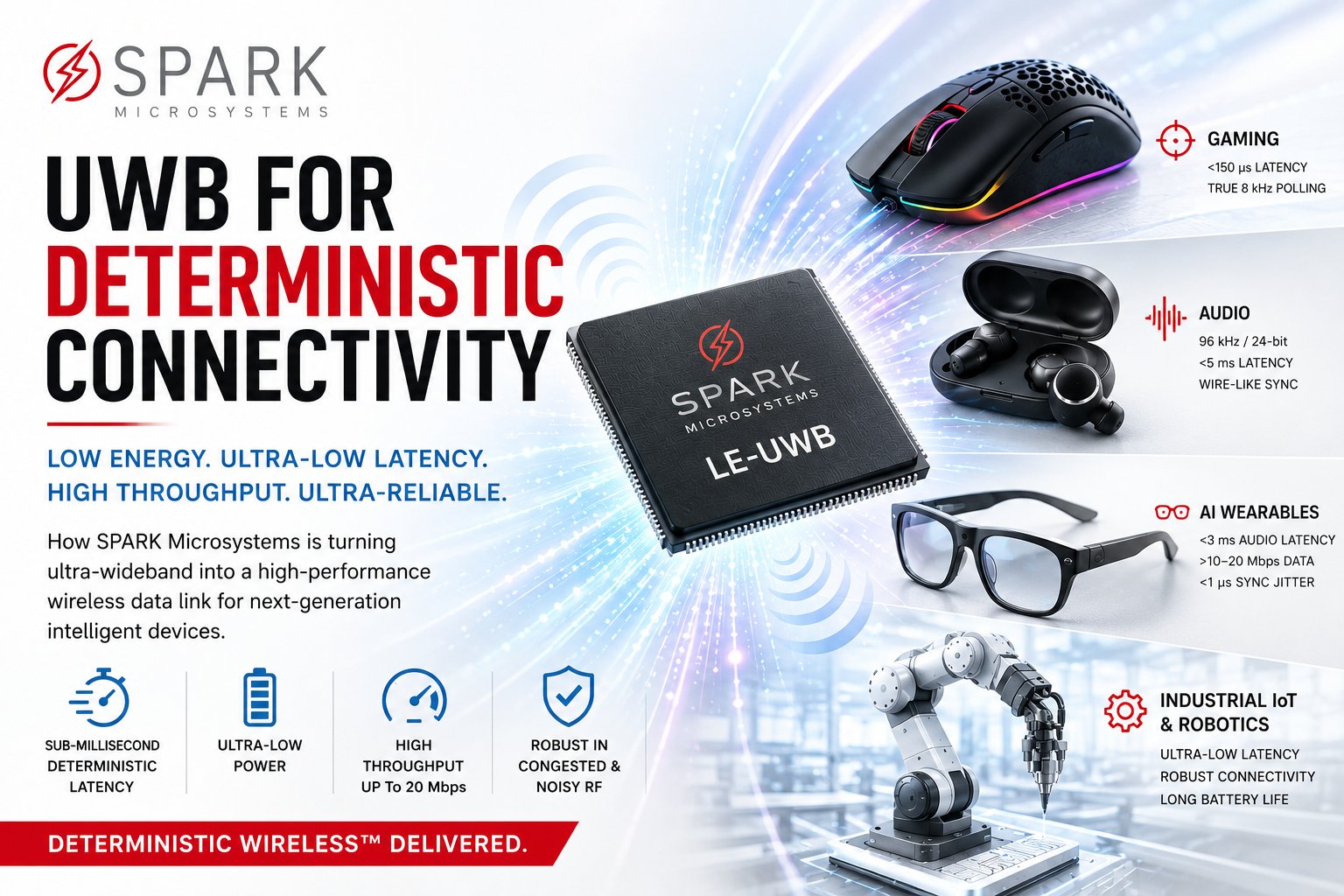
Ultra-wideband (UWB) is best known today for precise ranging and location applications such as digital car keys and tracking tags. SPARK Microsystems is pursuing a significantly different application: using impulse-radio UWB as a high-performance wireless data link. SPARK calls its approach Low Energy Ultra-Wideband (LE-UWB) and positions the technology as a foundation for what it calls Deterministic Wireless™: Short-range wireless connectivity designed to approach wired performance in latency, synchronisation, robustness, and predictability while consuming very little power.
The company is not proposing LE-UWB as a replacement for Wi-Fi or Bluetooth. Instead, SPARK sees it as a complementary wireless layer for applications where existing technologies force difficult trade-offs between latency, power consumption, throughput, and RF robustness.
In his Tech Watch interview with WiFi NOW, SPARK Microsystems Co-founder & CTO Frederic Nabki says this combination is becoming increasingly important as devices move beyond simple connectivity toward sensing, AI inference, high-quality audio, real-time control, and other applications in which wireless performance directly affects the user or system response. The initial opportunities identified by SPARK include gaming peripherals, high-quality wireless audio and hearables, specialized industrial and medical IoT, robotics, AI wearables, AR/VR devices, and mobile accessories.
Why another wireless technology?
Wi-Fi and Bluetooth have become extraordinarily successful because they solve broad connectivity problems. But SPARK argues that neither was architected specifically for the combination of extremely low latency, ultra-low power, predictable timing, robust short-range connectivity, and substantial data throughput now being demanded by emerging device categories.
According to Frederic Nabki, designers attempting to remove a cable frequently have to compromise somewhere else in the system: battery size, latency, wireless reliability, throughput, or some combination of these. That becomes particularly problematic for devices that need to sense, infer, communicate, and act in real time. SPARK’s presentation identifies four requirements that it believes need to be delivered simultaneously:
- Ultra-Low Latency: Sub-millisecond and deterministic packet delivery.
- Ultra-Low Power: Power characteristics suitable for battery-constrained and always-sensing devices.
- High Throughput: Enough capacity for substantial sensor and uncompressed data streams.
- Robust Connectivity: Stable operation in congested and interference-heavy RF environments.
The company’s proposition is that LE-UWB can provide this combination without taking over the roles already served effectively by Wi-Fi and Bluetooth.
The key difference: Impulse radio
The fundamental distinction is in the radio architecture. Conventional Wi-Fi, Bluetooth, and IEEE 802.15.4 technologies use narrowband or comparatively narrowband modulated carriers. SPARK’s LE-UWB architecture instead uses extremely short UWB impulses.
The diagram on page 3 of SPARK’s presentation (download available below) illustrates this difference: a conventional radio establishes and modulates a carrier, while the impulse-radio implementation transmits very short pulses measured on a microsecond-scale timeline. SPARK associates this architecture with fast startup, low transmit power, very low latency, strong time-of-flight ranging capability, and resilience to multipath and interference.
Frederic Nabki says SPARK began architecting its radio around these impulse characteristics more than a decade ago rather than adapting a conventional radio architecture to UWB. An important consequence, he says, is that the relationship between data rate and power consumption can be comparatively linear: transmitting more data means transmitting more impulses.
For very light traffic such as wake-up or keep-alive packets, Nabki says the radio can operate at microwatt-level power consumption. For high-rate traffic such as video, consumption can rise into the milliwatt range—but using the same underlying radio architecture. This ability to scale power consumption with the actual workload is potentially significant for devices that spend much of their time transmitting little data but occasionally require much higher throughput.
What does “deterministic wireless” mean?
SPARK uses the term Deterministic Wireless™ to describe wireless behaviour approaching what designers expect from a cable. As Frederic Nabki explains:
“We mean wireless that’s as close to what a wire would provide as possible.” The relevant characteristics include latency, throughput, power consumption, synchronisation, and robustness.
The emphasis on determinism is important. Peak throughput alone does not define the quality of a real-time wireless link. Applications such as interactive gaming, audio synchronisation, robotics, sensor fusion, and AI wearables may care as much—or more—about when a packet arrives and how predictable that arrival time is.
SPARK says its current technology delivers payload throughput of up to 20 Mbps, while gaming mice using the technology can achieve click-to-PC latency on the order of 125 microseconds. He also describes sub-microsecond synchronisation between wireless data streams as achievable with the technology. These characteristics open applications that sit between the traditional strengths of Bluetooth and Wi-Fi.
LE-UWB is designed to complement Wi-Fi and Bluetooth
A central point in SPARK’s strategy is that LE-UWB is not intended to replace Wi-Fi or Bluetooth. Wi-Fi remains the obvious choice when very high throughput, network connectivity, and longer-range broadband access are required. Bluetooth benefits from an enormous installed base and ecosystem and remains highly effective for many low-power peripheral and device applications.
LE-UWB instead targets situations where a separate short-range link can provide characteristics that are difficult to obtain from those technologies. Frederic Nabki says many SPARK customers use LE-UWB alongside Bluetooth, Wi-Fi, or both.
“The goal is not to replace, it’s to complement with stuff that these radios can’t deliver.” This is reflected in the presentation’s positioning of LE-UWB alongside BLE, Wi-Fi, and conventional IEEE 802.15.4z UWB rather than as a universal substitute for them.
LE-UWB versus Bluetooth
SPARK sees one of its clearest opportunities in applications that require more performance than conventional Bluetooth links can efficiently provide. The company’s presentation lists target figures of 25× lower power consumption, 60× lower latency, and 40× higher maximum data rate compared with BLE, together with better interference robustness. SPARK explicitly notes that these figures represent target performance under typical system conditions, so they should be treated as vendor performance targets rather than universal protocol-level comparisons.
SPARK provides additional context: Frederic Nabki says SPARK’s current product supports up to 20 Mbps payload throughput while offering approximately 100-microsecond-class latency for certain applications. The practical system objective is longer battery life combined with faster transfer and real-time responsiveness.
LE-UWB versus Wi-Fi
The comparison with Wi-Fi is different because Wi-Fi’s principal strength is throughput. Frederic Nabki describes Wi-Fi as the “throughput king”, and SPARK does not attempt to position LE-UWB as an alternative for conventional high-throughput WLAN connectivity. Instead, the opportunity is in devices where Wi-Fi’s throughput may be more than adequate but its power profile or latency characteristics are not appropriate.
SPARK’s presentation claims target performance of 100× lower power consumption and 5× lower and more predictable latency than Wi-Fi under typical system conditions. Again, these are vendor target figures and will depend heavily on the implementation and workload. The more interesting distinction may therefore be predictability rather than raw speed.
Frederic Nabki gives synchronised wireless audio as an example. A system may need only moderate throughput but require audio latency of a few milliseconds combined with synchronization between streams measured in microseconds. That is a fundamentally different optimization problem from maximizing network throughput.
LE-UWB versus conventional UWB
SPARK’s use of UWB should also not be confused with the UWB technology already incorporated into smartphones, vehicles, and tracking devices. Existing UWB based on IEEE 802.15.4z has largely been optimized around precise ranging and secure distance measurement.
SPARK’s LE-UWB is optimized primarily for data communications, while retaining the ability to perform low-power time-of-flight ranging. According to SPARK’s presentation, its target characteristics compared with legacy UWB include substantially lower power consumption, lower implementation cost, low-latency optimization, and a combination of data communications and ranging.
Frederic Nabki says conventional UWB ranging radios are not optimized for the combination of throughput, power consumption, latency, and robust data communications that SPARK is targeting. This distinction is crucial: SPARK is effectively expanding UWB from a positioning technology into a connectivity technology.
Application #1: Gaming peripherals
Gaming is one of the most immediate applications because the market already values extremely low latency and high polling rates. SPARK identifies requirements including:
- <150 µs click latency
- True 8 kHz polling
- Robust connectivity
- Ultra-low power
- 10–20 Mbps data rate
Nabki says gaming mice using SPARK technology are already achieving latency on the order of 125 microseconds from click to registration on the computer. Gaming therefore provides an effective proving ground for deterministic wireless as improvements in latency have direct product value.
Application #2: High-quality wireless audio
Wireless audio illustrates why throughput alone is not enough. SPARK targets applications requiring 96 kHz/24-bit uncompressed audio, less than 5 ms latency, wire-like synchronisation, and ultra-low power. Frederic Nabki argues that existing wireless approaches force compromises between uncompressed high-quality audio, latency, synchronisation, and power consumption. LE-UWB potentially changes that equation by supporting substantial data rates while maintaining very low latency.
Synchronisation could be particularly valuable for microphone arrays, where multiple wireless streams must remain precisely aligned for techniques such as beamforming. Frederic Nabki says SPARK can provide sub-microsecond synchronisation between streams.
Application #3: Industrial IoT and robotics
Industrial systems and robotics represent another natural fit because communications may form part of a real-time control loop. SPARK highlights requirements including ultra-low latency, robust connectivity, accurate location, and potentially more than ten years of battery life for specialized IoT devices. The combination of communications and time-of-flight ranging could be particularly useful here. A single radio architecture could potentially support both data exchange and location-related functions. Frederic Nabki says SPARK is already seeing significant customer engagement in medical, robotics, and industrial applications.
Application #4: AI wearables and smart glasses
Perhaps the most strategically important opportunity is the emerging generation of AI wearables.
Today’s smartphone concentrates processing, connectivity, display, audio, sensing, and battery capacity into one relatively large device. Smart glasses and other body-worn devices distribute those functions across much smaller form factors with dramatically smaller batteries. At the same time, AI interfaces may require devices to continuously capture, transfer, and process audio, video, sensor, and contextual data. SPARK’s presentation identifies potential requirements for AI wearables including:
- <3 ms audio latency
- <1 µs synchronization jitter
- >10–20 Mbps data rate
- Robust connectivity
- Ultra-low power
Future glasses will need to stream video while still achieving perhaps 12–18 hours of battery life. SPARK’s says the combination of bidirectional megabit-class data, deterministic latency, tight synchronisation, and very low power could make LE-UWB an important complementary radio for such products.
Spectrum and interference
Another potential advantage comes from where UWB operates. Bluetooth and much existing IoT connectivity share the crowded 2.4 GHz band. Wi-Fi has expanded significantly into 6 GHz, but congestion remains a fundamental issue as the number and density of wireless devices increase. Frederic Nabki argues that SPARK’s UWB implementation benefits both from impulse-radio propagation characteristics and from having substantial spectrum available, allowing the radio to be agile in avoiding or surviving interference.
This does not eliminate interference, but it provides another design dimension for short-range connectivity – particularly in environments where predictable RF behaviour matters more than maximum range.
Security: Useful physical properties, but not a replacement for cryptography
UWB is already associated with secure ranging because accurate time-of-flight measurements can help protect against certain relay attacks. Nabki also notes that SPARK’s extremely short impulses can be more difficult to detect electromagnetically at distance than a conventional continuously transmitted high-power carrier. But he is careful not to describe this as a replacement for conventional wireless security.
Encryption, secure elements, protected firmware, trusted execution environments, and other established security mechanisms remain necessary. The physical characteristics of UWB should therefore be viewed as a potentially useful additional property—not as the security architecture itself.
Standardization: IEEE 802.15.4ab
One of the most important developments for LE-UWB is its relationship with IEEE standardisation. Frederic Nabki says SPARK is participating in IEEE 802.15.4ab, with its physical-layer approach defined within the work. Standardization could ultimately enable the technology to develop beyond a single-vendor implementation and move toward interoperability and a broader ecosystem.
Frederic Nabki explicitly says SPARK does not want to remain the only supplier indefinitely. For the technology to become ubiquitous, he believes multiple sources and widespread adoption will ultimately be required. The longer-term ambition includes interoperability with smartphones. He also says that SPARK’s next-generation product is expected to support communication with legacy UWB implementations, although without the full performance available when both sides support the LE-UWB approach. Full adoption by smartphone vendors would be a much longer-term ecosystem development.
Commercial status
SPARK’s technology is no longer solely an R&D project. SPARK says the company is currently shipping its second-generation product in mass production, with a third generation planned for the coming years. He says the technology is already deployed in high-end products, including human-interface devices and high-quality audio applications.
This matters because emerging wireless technologies frequently face a difficult transition from impressive laboratory performance to commercially manufacturable silicon, deployed products, and ultimately an ecosystem. SPARK appears to be pursuing the familiar semiconductor adoption path of entering performance-sensitive premium products first and expanding into broader markets as the technology and ecosystem mature.
WiFi NOW assessment:
SPARK’s LE-UWB proposition is interesting precisely because it does not attempt to compete with Wi-Fi on Wi-Fi’s strongest metric. It is not another technology promising more gigabits per second. Instead, it targets a different engineering problem: How do you make a short-range wireless link behave more like a wire without consuming the power normally associated with high-performance wireless?
That question is becoming increasingly relevant. Gaming devices need microsecond-class responsiveness. Wireless audio needs tightly synchronised streams, while robots and industrial systems need predictable communications. AI glasses and wearables need substantial data transfer while operating from tiny batteries. And all of these devices will operate in increasingly crowded RF environments. If SPARK can consistently deliver its target combination of low power, deterministic latency, useful throughput, synchronisation, and robustness in commercial products, LE-UWB could establish an important new role for UWB alongside its already successful ranging applications.
The most important point may therefore be the one SPARK repeatedly emphasises: This is not necessarily Wi-Fi versus UWB, or Bluetooth versus UWB. The emerging architecture could increasingly be Wi-Fi + Bluetooth + LE-UWB, with each radio handling the traffic and applications it is best suited to serve. But there will also be cases where UWB will compete fiercely with Bluetooth.
For Wi-Fi, that means LE-UWB should be viewed less as a competitive threat and more as a potential companion technology – one that handles highly time-sensitive, power-constrained short-range links while Wi-Fi continues to provide high-throughput WLAN and Internet connectivity. That complementary architecture could become particularly compelling as AI moves from cloud-based interaction into wearables, peripherals, robots, sensors, and other real-time physical systems.
Download Frederic Nabki’s presentation here.