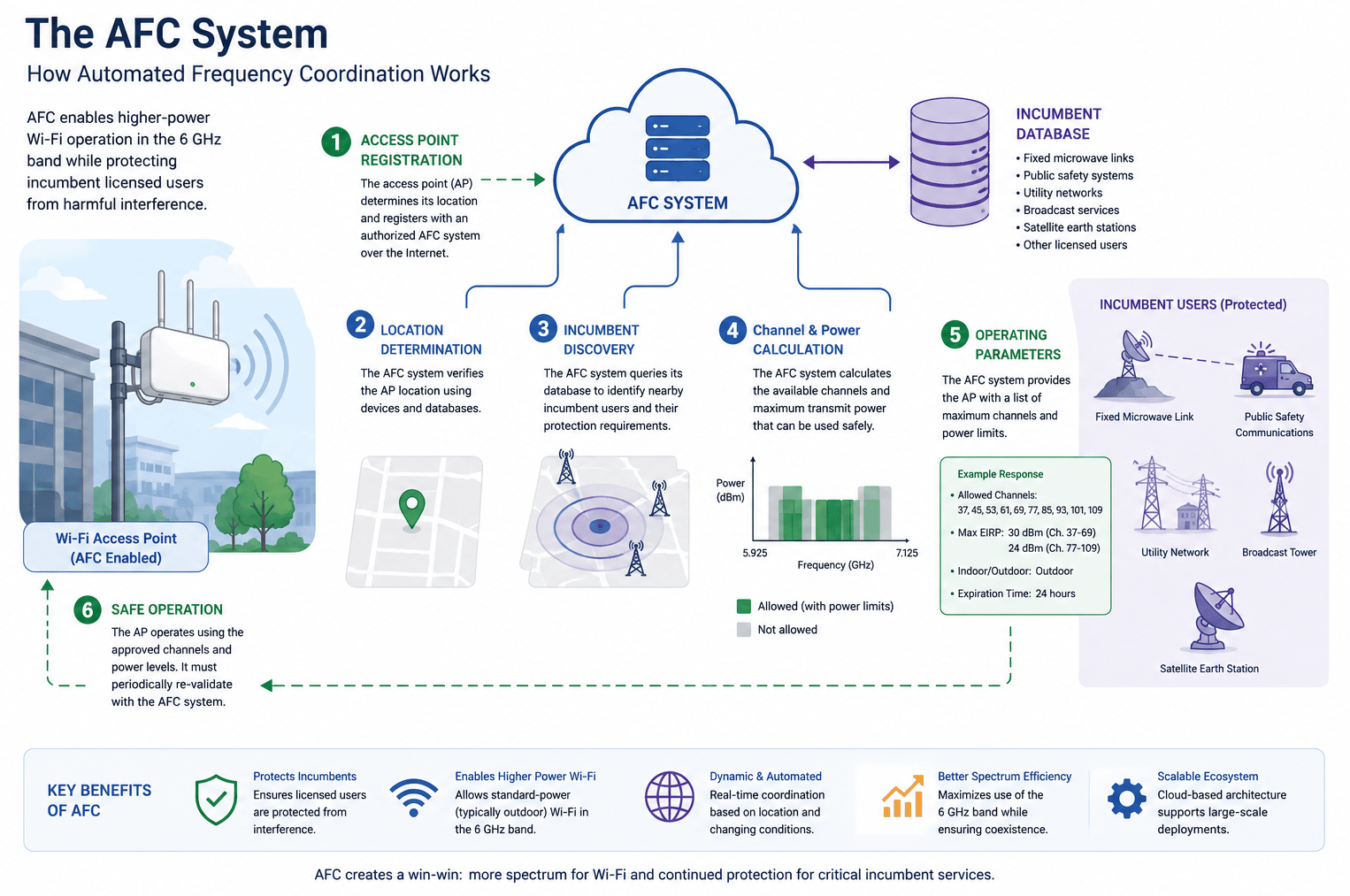

WiFi NOW’s TAKE: AFC is arguably the most successful dynamic spectrum allocation system ever designed. The solution came about as a cooperation between industry experts and the FCC ahead of the 6 GHz spectrum allocation decision in 2020. While TV White Space and CBRS also in principle can allocate spectrum dynamically, AFC is – we believe – the first solution that has implemented this at scale. Standard power deployments using AFC – including for example for stadiums – are on the rise.
Automated Frequency Coordination (AFC) is a spectrum management system designed to enable higher-power operation of Wi-Fi devices in the 6 GHz band while protecting incumbent licensed users from harmful interference AFC is one of the most important innovations associated with Wi-Fi 6E and Wi-Fi 7 because it allows both outdoor and indoor Wi-Fi deployments to make use of valuable 6 GHz spectrum without compromising existing services. In simple terms, AFC acts as a cloud-based coordination system that tells Wi-Fi access points which frequencies and power levels they can safely use at a given location. AFC is only used to authorise standard power Wi-Fi in (parts of) the 6 GHz band both indoors and out (it is never used for lower power indoor 6 GHz Wi-Fi).
Why AFC Is Needed
The 6 GHz band offers a large amount of new spectrum for Wi-Fi, making it possible to support higher capacity, lower latency, and improved performance for demanding applications. However, portions of the 6 GHz band are already used by incumbent services, including fixed microwave links, public utility communications, public safety networks, broadcast auxiliary services, and other licensed users. These incumbent systems must be protected from interference. Rather than prohibiting higher-power Wi-Fi operation altogether, regulators developed AFC as a way to allow Wi-Fi devices and incumbent users to coexist.
How AFC Works
An AFC system maintains a database of protected incumbent operations (meaning what 6 GHz spectrum is used in a particular location by incumbent users). When an AFC-enabled access point is installed, it determines its location and communicates with an authorised AFC service over the Internet. The AFC system then determines the device’s location, identifies nearby incumbent systems, calculates which frequencies can be used safely, establishes permitted transmit power levels, provides an operating channel list to the access point. The Wi-Fi device can then begin operating within those approved parameters. This process is automated and not apparent to end users.
WiFi NOW PERSPECTIVE: AFC is not a fixed system in that industry leaders often request that the rules and methods applied by the AFC be modified so as to improve Wi-Fi performance and value even further. For example: A group of vendors have recently asked the FCC to incorporate building entry loss (BEL) into AFC calculations for the purposes of increasing the permissible power levels for indoor AFC. Read more here.
Standard-Power Wi-Fi
AFC is primarily associated with Standard Power operation in the 6 GHz band. Standard Power access points can transmit at significantly higher power levels than indoor-only devices, providing: Greater coverage, improved outdoor performance, better support for enterprise deployments, enhanced fixed wireless access (FWA) applications, expanded public venue coverage. Without AFC, these higher power levels would create an unacceptable risk of interference to incumbent systems.
AFC and Wi-Fi 7
Although AFC was introduced alongside Wi-Fi 6E, it is expected to become increasingly important for Wi-Fi 7 deployments. Wi-Fi 7’s advanced features—including Multi-Link Operation (MLO), wider channels, and higher throughput—benefit significantly from access to clean 6 GHz spectrum. As enterprises, service providers, municipalities, and venue operators deploy outdoor and large-area Wi-Fi networks, AFC is expected to play a critical role in unlocking the full value of the 6 GHz band.
Global AFC Adoption
Regulatory approaches to 6 GHz Wi-Fi vary by region. The United States and Canada were among the first countries to authorise AFC-based Standard Power operation in the 6 GHz band. Other countries and regions are evaluating or implementing similar approaches, although regulatory frameworks continue to evolve. In many countries and regions, the upper 6 GHz band has not yet been allocated to Wi-Fi or other technologies (IMT). Ofcom of the UK is a good example of an innovative regulator looking for solutions to accommodate both mobile (IMT) and Wi-Fi needs. For more about this also see this webinar.
AFC Ecosystem
AFC requires collaboration among multiple stakeholders, including:
- Regulators
- Database providers
- AFC service operators
- Wi-Fi chipset vendors
- Access point manufacturers
- Service providers
- Enterprise network operators
Several organisations are actively developing AFC platforms and supporting technologies to enable large-scale deployment.
Benefits of AFC
Key benefits of AFC include:
- Expanded coverage for Wi-Fi networks
- More efficient spectrum utilisation
- Protection of incumbent licensed services
- Improved support for indoor and outdoor deployments
- Enhanced opportunities for fixed wireless access
- Greater value from 6 GHz spectrum investments
By enabling higher-power operation while maintaining incumbent protection, AFC helps maximise the usefulness of the 6 GHz band for both existing users and next-generation Wi-Fi networks.
Key Takeaway
Automated Frequency Coordination (AFC) is a cloud-based spectrum management system that enables higher-power Wi-Fi operation in the 6 GHz band while protecting incumbent licensed users from interference. AFC is becoming a foundational technology for large-scale Wi-Fi 6E and Wi-Fi 7 deployments, particularly in outdoor, enterprise, service provider, and fixed wireless access environments.