
OpenWiFi is an open-source enterprise Wi-Fi platform developed under the umbrella of the Telecom Infra Project (TIP). Today it forms the wireless access component of the broader OpenLAN initiative, whose goal is to create an open, disaggregated networking stack spanning Wi-Fi access points, Ethernet switches, cloud management software, and white-box hardware.
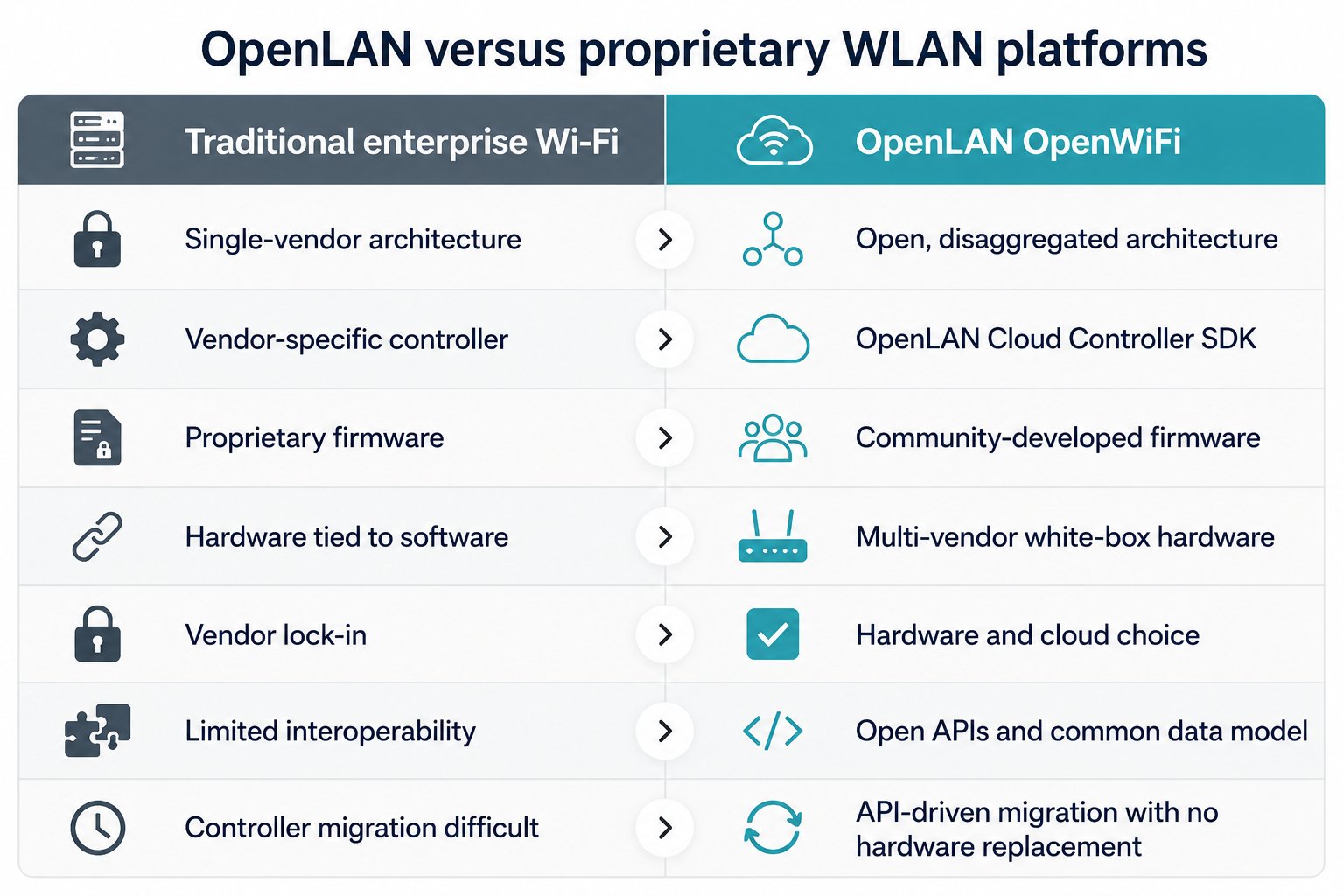
Unlike traditional enterprise WLAN solutions, where a single vendor supplies the hardware, controller, and management software, OpenLAN separates these components into open, interoperable layers. This allows operators and enterprises to combine hardware and software from multiple suppliers into a bespoke enterprise networking solution while avoiding long-term vendor lock-in.
Why was OpenWiFi created?
Enterprise Wi-Fi has historically been dominated by vertically integrated platforms. While these solutions are feature-rich, they often require customers to purchase access points, controllers, cloud services, and software from the same supplier. TIP created OpenWiFi to change this model by providing a community-developed software platform that enables:
- Multi-vendor hardware support
- Cloud-native network management
- Open APIs
- Hardware independence
- Lower deployment costs
- Faster innovation through open-source collaboration
The project targets service providers, managed service providers (MSPs), hospitality providers, enterprises, and public Wi-Fi operators. OpenWiFi today also includes integration options for OpenRoaming.
From OpenWiFi to OpenLAN
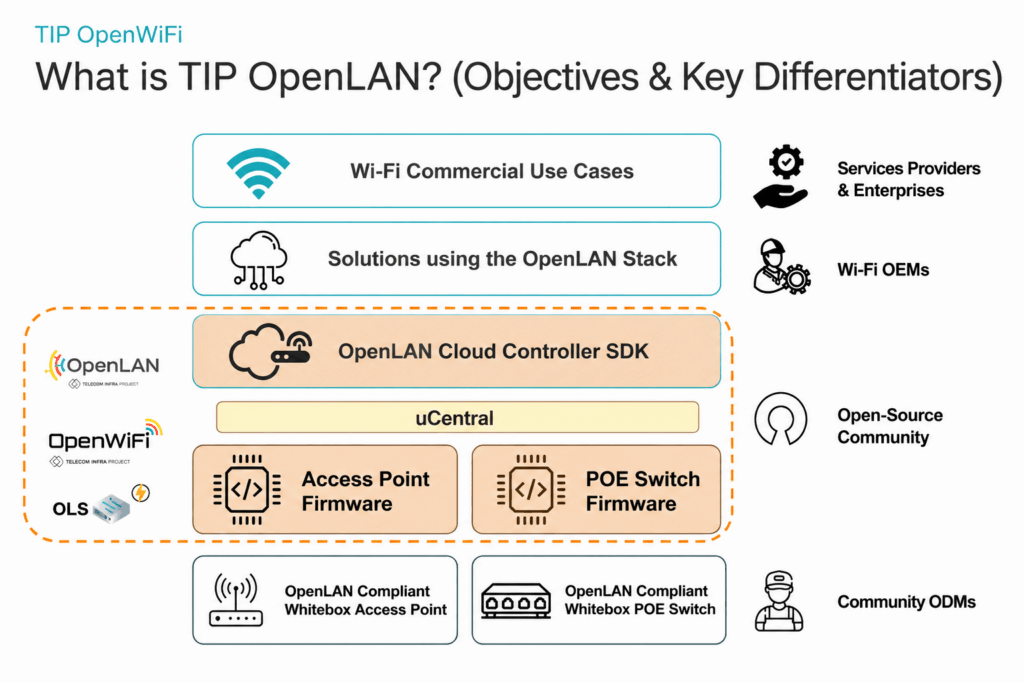
One of the most important developments since OpenWiFi launched in 2021 is the evolution into OpenLAN. OpenLAN expands beyond Wi-Fi by integrating several previously separate components into a single validated software platform. According to the TIP architecture, OpenLAN includes:
- Enterprise-grade Wi-Fi access point firmware
- Enterprise-grade PoE switch firmware
- The OpenLAN Cloud Controller SDK
- uCentral device management
- OpenLAN-compliant white-box access points
- OpenLAN-compliant white-box Ethernet switches
The objective is to provide a complete open networking platform rather than simply an open-source Cloud-based WLAN controller SDK and an open operating system for APs.
How the architecture works (see top diagram)
The OpenLAN software stack can be viewed as five layers: Commercial Wi-Fi Applications, solutions built using the OpenLAN stack, OpenLAN Cloud Controller SDK (uCentral), OpenLAN Firmware (Access Point Firmware and PoE Switch Firmware), white-box Hardware (Access Points & Ethernet Switches). Because all components follow common APIs and data models, operators can combine products from different hardware manufacturers while using the same cloud management platform.
Hardware independence
Perhaps OpenLAN’s most significant differentiator is that the same software image can operate across multiple hardware platforms. This enables:
- Mixed-vendor access point deployments
- Common telemetry across all devices
- Common configuration model
- Shared RF optimisation capabilities
- API-driven migration between cloud controllers
- Zero-touch provisioning (ZTP)
- No truck rolls when changing cloud providers
- No hardware replacement when changing controller platforms
As of April 2026 OpenLAN/OpenWiFi includes support for more than 75 white-box hardware SKUs, including indoor, outdoor, wall-plate, desktop, and pole-mounted designs in Wi-Fi 6 and Wi-Fi 6E variants.
Key capabilities
OpenLAN provides a carrier-grade software platform that includes:
- Cloud-native WLAN management
- Zero-touch provisioning
- Enterprise AP firmware
- Enterprise PoE switch firmware
- Common telemetry
- Common data model
- REST APIs
- Multi-vendor hardware support
- Remote firmware upgrades
- RF optimisation
- Mesh networking
- WPA2/WPA3 Enterprise
- Open interfaces for third-party applications
Commercial vendors can then build additional capabilities—such as AI-driven optimisation, QoE analytics, captive portals, security, or OpenRoaming integration—on top of the platform.
Commercial deployments
See our deployment database here.
WiFi NOW perspective: OpenWiFi has evolved considerably since its launch in 2021. Rather than remaining an open-source Cloud-based WLAN controller interface and operating system for APs, it has matured into the broader OpenLAN architecture, encompassing cloud software, access point firmware, Ethernet switch firmware, and validated white-box hardware. This makes OpenLAN one of the industry’s most comprehensive open-source networking initiatives.
One of the project’s greatest strength lies in its commitment to hardware independence. Operators can deploy standards-based white-box hardware, choose among compatible cloud management platforms, and migrate between controllers without replacing installed equipment – an important departure from the proprietary WLAN model.
Commercial momentum has also improved. While the ecosystem is still much smaller than those of established enterprise and proprietary WLAN vendors, deployments by organisations such as WorldVue, Boingo, Single Digits, and YTL demonstrate that OpenLAN has moved beyond proof-of-concept into production networks. For managed service providers, hospitality operators, and service providers seeking greater supplier choice and lower long-term infrastructure costs, OpenLAN is now a credible and increasingly mature alternative to proprietary enterprise Wi-Fi platforms.
Editorial disclaimer: This content is based on publicly available information believed to be accurate at the time of publication, including official vendor and industry sources. While every effort has been made to verify the information, errors or omissions may occur. WiFi NOW welcomes corrections and updates from industry participants. For suggested updates or corrections, write to [email protected].