
Every wireless technology solves a different problem. Wi-Fi moves large amounts of data over medium and long distances. Bluetooth mostly connects nearby devices using very little power, while GPS tells us where we are – usually outdoors. Ultra-Wideband (UWB) is something entirely different. It answers two questions that have become increasingly important in the connected world:
- Where exactly is something (including for example a phone) located? – and
- How can I communicate with it reliably over short distances using very little power?’
Those capabilities have made UWB one of the fastest-growing wireless technologies of the past decade – although UWB still lives a life a little under the radar and is little known even among wireless professionals. Today, UWB is built into hundreds of millions of smartphones, powers secure digital car keys, enables centimetre-level asset tracking in factories and hospitals, and is beginning to emerge as a compelling alternative to Bluetooth for ultra-low-power wireless connectivity.
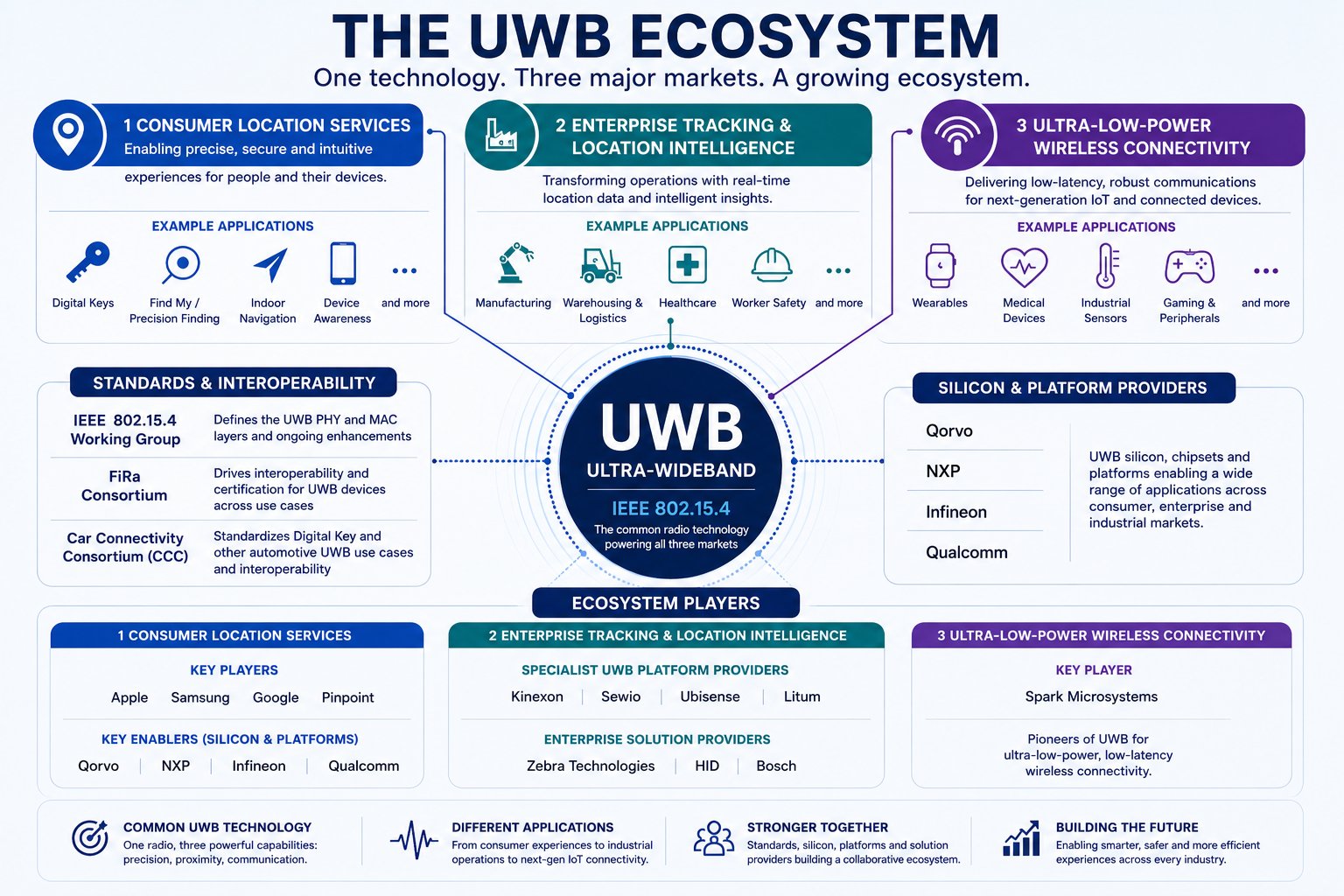
UWB is often described simply as a positioning technology. In reality, UWB has evolved into three distinct commercial markets:
- Consumer Location Services
- Enterprise Tracking & Location Intelligence
- Ultra-Low-Power Wireless Connectivity
Understanding these three markets is the key to understanding why UWB matters.
Why is UWB taking off now?
UWB isn’t new as the underlying radio technology has existed for decades and has long been recognised for its ability to measure distance with exceptional precision. But until recently, commercial adoption remained limited. That has changed because several industry trends have converged.
First, smartphones created enormous shipment volumes. Apple’s introduction of the U1 chip in the iPhone 11 in 2019 was followed by UWB adoption in many premium Android devices. Second, industry organisations such as the FiRa Consortium and the Car Connectivity Consortium (CCC) established interoperability and application frameworks that allowed products from different manufacturers to work together. Third, enterprise demand for real-time location data has grown rapidly as manufacturers, logistics companies, hospitals, and warehouses embrace automation, robotics, and AI-driven operations.
Finally, semiconductor integration has reduced cost, size, and power consumption, making UWB practical for a much wider range of products. The result is a technology that has moved from niche deployments to mainstream adoption.
Three markets, one radio technology
Although all UWB systems are built on the same underlying radio technology, the commercial ecosystem has evolved into (at least) three distinct application domains.
Consumer Location Services
This is the market most consumers already experience – even if they don’t realise they are using UWB. The objective is to enable precise, secure interactions between personal devices. Applications include:
- Precision Finding
- Locating keys, wallets, and other personal belongings (with tags)
- Digital car keys
- Indoor navigation and wayfinding
- Device-to-device awareness
- Future augmented and spatial computing experiences
Representative companies include:
- Apple
- Samsung
- Pinpoint
- Qorvo
- NXP
- Infineon
- Qualcomm
- ST Microelectronics
Industry interoperability is driven primarily by the FiRa Consortium, while automotive applications are standardised through the Car Connectivity Consortium. The value proposition is convenience, security, and intuitive user experiences.
Enterprise Tracking & Location Intelligence
The second market uses the same radio technology to solve a very different problem: Rather than locating a smartphone or car key, organisations need to know where thousands or even millions of assets, vehicles, tools, robots, or personnel are located in real time. Applications include:
- Manufacturing
- Hospitals
- Warehouses
- Airports
- Logistics centres
- Construction
- Mining
- Worker safety
But enterprise deployments are rapidly moving beyond simple tracking. Traditional Real-Time Location Systems (RTLS) answer the question, “Where is this asset?” while Enterprise Location Intelligence goes much further: It combines precise location data with analytics, automation, AI, robotics, and digital twins to optimise workflows, improve safety, and support operational decision-making. Representative companies include:
Specialist UWB platform providers
- Kinexon
- Sewio
- Ubisense
- Litum
Enterprise solution providers
- Zebra Technologies
- HID
- Bosch
For these organisations, location is no longer simply information – it becomes an operational input that drives automation and productivity.
Ultra-Low-Power Wireless Connectivity
The newest commercial direction for UWB has little to do with positioning. Instead, companies are using UWB as a next-generation wireless communications technology. One of the pioneers in this field is Spark Microsystems, whose technology demonstrates how UWB can deliver:
- Ultra-low latency
- Extremely low power consumption
- Deterministic communications
- Robust operation in congested radio environments
Potential applications include:
- Medical devices
- Industrial sensors
- Wearables
- Gaming peripherals
- Consumer electronics
- Battery-powered IoT devices
Although still an emerging market, interest in UWB connectivity is growing as device manufacturers look beyond Bluetooth for applications where latency, energy efficiency, or reliability are critical. The cost of UWB connectivity is at the time of writing similar to the cost of Bluetooth chips.
How does UWB work?
Unlike Wi-Fi and Bluetooth, which transmit relatively narrowband continuous radio signals, UWB transmits very short radio pulses spread across at least 500 MHz of spectrum. This wide bandwidth gives UWB several important advantages. It enables extremely precise timing measurements, making centimetre-level ranging possible. It also makes the radio highly resistant to multipath reflections that commonly affect indoor wireless systems. At the same time, UWB operates at very low power spectral densities, allowing it to coexist with other wireless technologies.
UWB measures how long radio signals take to travel between devices using techniques such as Time of Flight (ToF), Two-Way Ranging (TWR), Angle of Arrival (AoA), and Phase Difference of Arrival (PDoA). The result is typical ranging accuracies of around 10–30 centimetres, together with highly reliable short-range communications.
Did you know?
Despite its name, Ultra-Wideband typically transmits at much lower power than Wi-Fi or Bluetooth. The term Ultra-Wideband refers to the amount of spectrum the signal occupies – not to its transmit power.
How is the ecosystem organised?
The UWB industry now spans several complementary layers.
Standards and interoperability
- IEEE 802.15.4 Working Group
- FiRa Consortium
- Car Connectivity Consortium
Silicon and radio platforms
- Qorvo
- NXP
- Infineon
- Qualcomm
- ST Microelectronics
Consumer Location Services
- Apple
- Samsung
- Pinpoint
Enterprise Tracking & Location Intelligence
- Kinexon
- Sewio
- Ubisense
- Litum
- Zebra Technologies
- HID
- Bosch
Ultra-Low-Power Connectivity
- Spark Microsystems
Each layer contributes differently to the overall ecosystem, but together they illustrate how broadly UWB is now being adopted.
Does UWB compete with Wi-Fi or Bluetooth?
Not directly. Increasingly, devices incorporate all three technologies because each solves a different problem.
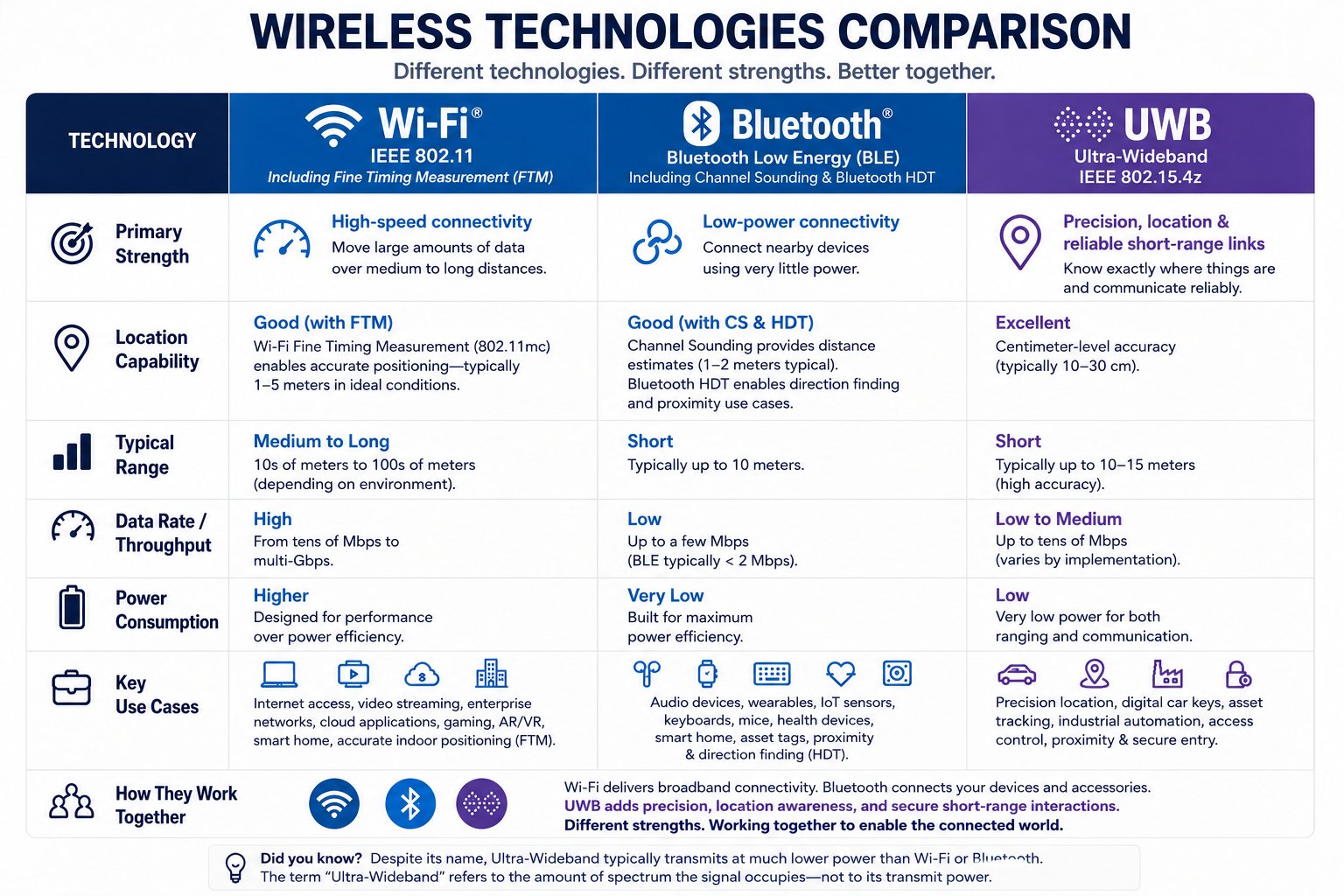
A smartphone, for example, may use Wi-Fi for broadband connectivity, Bluetooth for audio devices, NFC for authentication, and UWB for precise location awareness. Rather than replacing one another, these technologies increasingly work together. Some devices use all of Wi-Fi, Bluetooth, and UWB for precise location services depending on application.
What comes next?
The first wave of UWB adoption has already arrived through smartphones, digital tags, digital car keys, and industrial RTLS. The next phase is likely to be even broader.
Consumer devices will expand the use of spatial awareness and indoor navigation. Enterprise deployments will evolve from asset tracking to intelligent, AI-driven operational systems. Meanwhile, new generations of low-power wireless products may establish UWB as an important communications technology in its own right. In short, UWB is no longer simply about knowing where something is. It is becoming a technology that enables wireless devices to understand location, communicate efficiently, and interact intelligently.
WiFi NOW’s take: Ultra-Wideband is entering a new phase of commercial maturity. Its first success came through consumer location services. Its second is transforming enterprise operations (often using Wi-Fi infrastructure) through real-time tracking and location intelligence. A third market—ultra-low-power wireless connectivity – is now beginning to emerge. The common thread is not any single application. It is the unique capability of one radio technology to combine precise ranging, robust short-range communications, and exceptionally low power consumption.
For Wi-Fi professionals, UWB is not a competing technology. It is an increasingly important complement that adds a new dimension to wireless systems: precision. And as the ecosystem continues to mature, that precision is likely to become as fundamental to future connected devices as connectivity itself.