
Building better Wi-Fi systems from concept to deployment
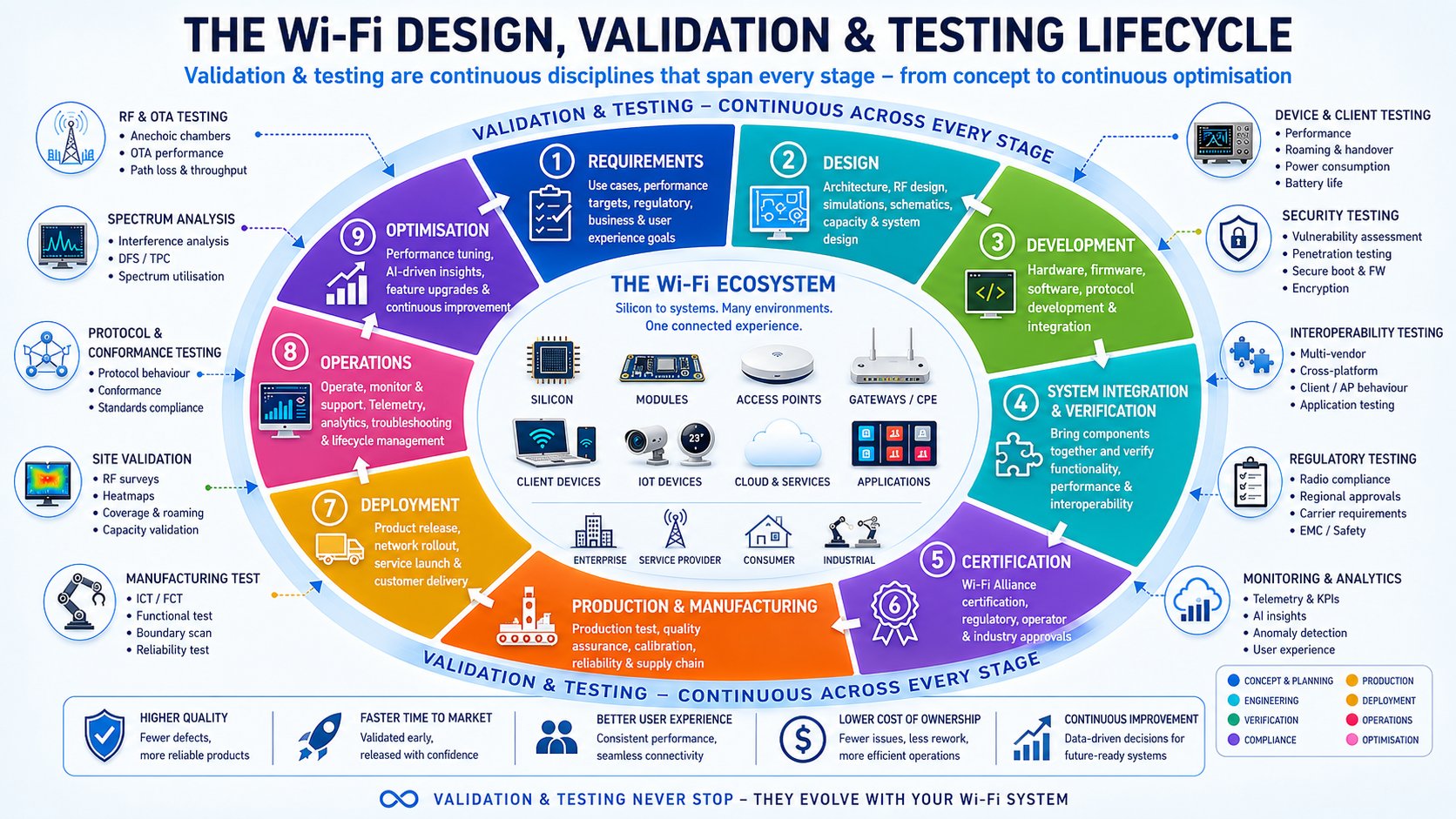
When most people think about Wi-Fi testing, they imagine engineers measuring throughput in a laboratory or placing devices inside an RF chamber. While these activities are certainly important, they represent only a small part of a much broader engineering discipline. Today, designing, validating, and testing Wi-Fi systems spans the entire lifecycle of a product or network – from the earliest stages of planning and RF design to product development, certification, deployment, optimisation, and long-term operational assurance.
As Wi-Fi continues to evolve, the challenge has become considerably more complex. Wi-Fi 7 introduces Multi-Link Operation (MLO), operation across three frequency bands, wider channels, deterministic performance requirements, and increasingly sophisticated coexistence mechanisms. Enterprise networks must support thousands of simultaneous users, service providers are expected to deliver consistently excellent home Wi-Fi experiences, and manufacturers are under constant pressure to reduce development time while maintaining interoperability and regulatory compliance.
The result is clear: high-quality Wi-Fi systems cannot be achieved through testing alone. They must be designed, validated, and continuously improved throughout their entire lifecycle.
Defining the discipline
Although the terms are often used interchangeably, design, validation, testing, certification, and operational assurance each serve a distinct purpose. Design establishes how a device or network is intended to perform. This includes RF architecture, antenna design, network planning, capacity modelling, channel planning, software architecture, and system integration.
Validation confirms that a design fulfils its intended objectives. Validation often combines laboratory measurements, simulations, interoperability exercises, field trials, and user experience assessments to determine whether the complete system performs as expected under realistic conditions. Testing provides the measurements that support validation. Testing may include RF performance measurements, protocol verification, throughput benchmarking, roaming analysis, stress testing, security verification, manufacturing tests, or over-the-air (OTA) measurements.
Certification demonstrates compliance with industry standards, regulatory requirements, and interoperability programmes such as those administered by the Wi-Fi Alliance and national regulatory authorities. Operational assurance extends validation into the field by continuously monitoring network performance, identifying problems, and ensuring that Wi-Fi systems continue to deliver the expected user experience throughout their operational lifetime.
Together, these activities form a continuous engineering process rather than a sequence of isolated tasks.
The complete Wi-Fi lifecycle
Design, validation, and testing should not be viewed as individual checkpoints. They form an integrated lifecycle in which each stage builds upon the previous one. A typical lifecycle includes:
- Planning and requirements
- Network or product design
- Hardware and software development
- Engineering verification
- System validation
- Interoperability testing
- Certification
- Manufacturing validation
- Deployment and commissioning
- Operational monitoring and optimisation
Each stage reduces technical risk while increasing confidence that the final system will deliver the required performance, reliability, and user experience.
A broad engineering ecosystem
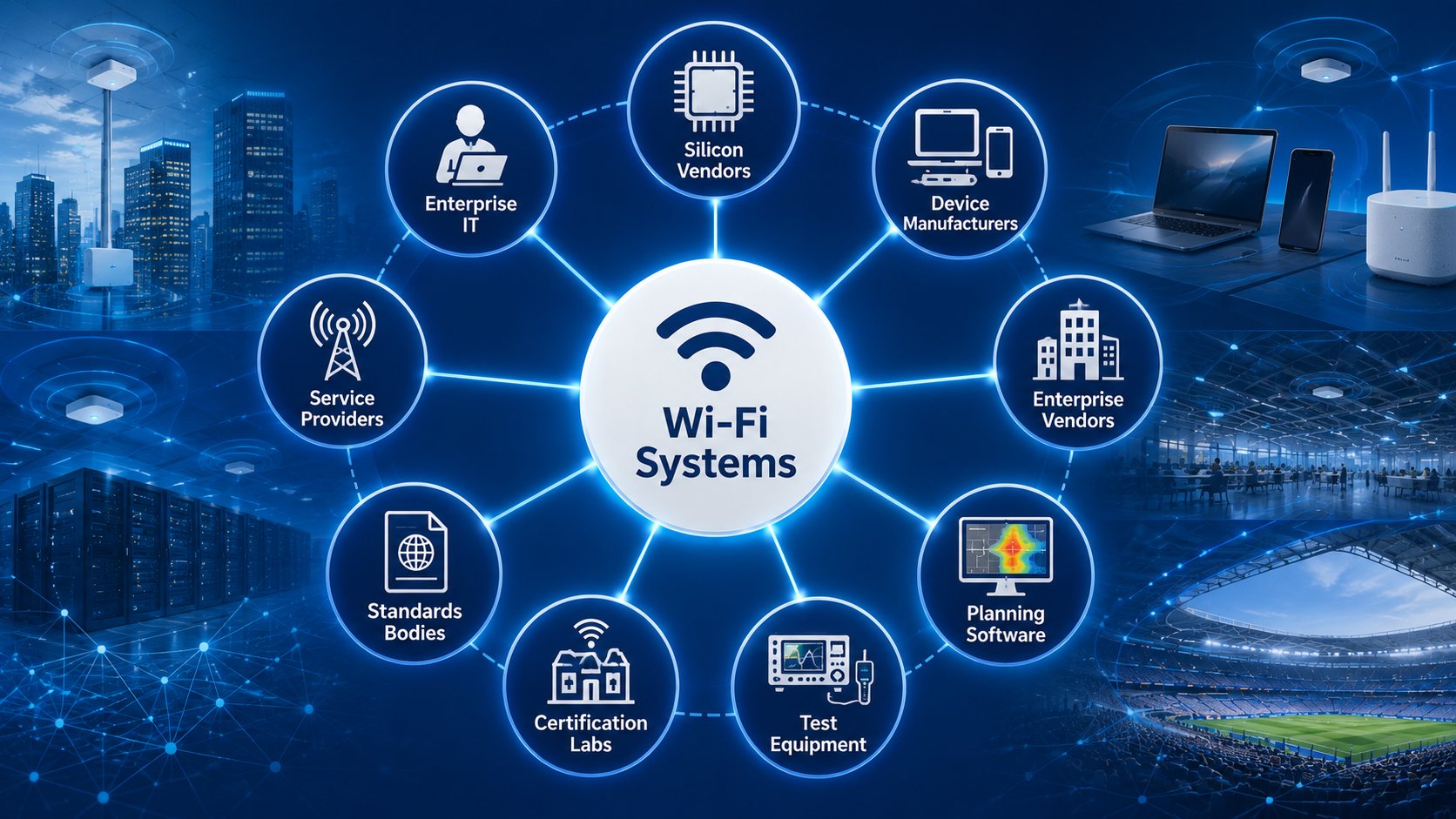
Cutting edge Wi-Fi products and networks are rarely developed by a single organisation. Instead, they rely on collaboration across a large ecosystem of specialists. This ecosystem includes:
- Silicon and chipset suppliers
- Module and device manufacturers
- Enterprise networking vendors
- Broadband gateway manufacturers
- Test equipment vendors
- Planning and design software providers
- Certification laboratories
- Standards organisations
- Service providers
- Enterprise IT organisations
- Systems integrators and consultants
Each contributes expertise that ultimately determines the quality and reliability of the finished Wi-Fi system.
Why this discipline matters
Demand for reliable wireless connectivity has never been greater. Wi-Fi now supports business-critical enterprise applications, healthcare, industrial automation, education, connected homes, hospitality, transportation, and public venues. Expectations for performance continue to increase while wireless environments become more crowded and technically challenging. Effective design, validation, and testing deliver measurable business value by:
- Reducing development risk
- Accelerating time-to-market
- Improving interoperability
- Increasing network reliability
- Reducing support costs
- Improving customer satisfaction
- Enabling predictable wireless performance
Perhaps most importantly, they allow organisations to identify problems before products reach customers or networks enter service, where failures become significantly more expensive to resolve.
About this guide
This article is the first in The State of Wi-Fi Design, Validation & Testing, WiFi NOW’s comprehensive guide to one of the wireless industry’s most important engineering disciplines. Over the coming chapters, we will explore every stage of the lifecycle—from enterprise network planning and RF engineering to device development, OTA measurements, certification, deployment, operational assurance, and the emerging role of artificial intelligence in designing, validating, and testing future Wi-Fi systems.
Whether you are designing enterprise networks, developing connected devices, building broadband gateways, validating new products, or deploying large-scale Wi-Fi infrastructure, understanding this discipline is becoming an essential part of delivering world-class wireless systems.
Also: Don’t miss our first WiFi NOW Design, Validation, & Test Forum happening online this September 29 – October 1. For details click here.