
Wi-Fi CERTIFIED has long provided the foundation for interoperability across the wireless ecosystem. But as residential Wi-Fi networks become increasingly complex, certification alone is not enough to guarantee a consistently good consumer experience. At the WiFi NOW DVT Forum, Wi-Fi Alliance highlighted the need for more extensive real-world validation, improved testing methodologies, and AI-driven network management. The organisation also acknowledged lessons from Wi-Fi 7 that could help shape the development of Wi-Fi 8.
When home Wi-Fi fails, the broadband provider gets the call
For residential broadband service providers, the quality of the in-home Wi-Fi experience has become a critical component of customer satisfaction. Consumers rarely distinguish between problems originating in the broadband connection, the home gateway, the Wi-Fi network, or individual client devices. When a video call freezes or television streaming begins buffering, the broadband provider is typically held responsible.
This creates a fundamental challenge for operators: How can they identify the cause of a connectivity problem quickly enough to resolve it efficiently? During the WiFi NOW DVT Forum, Wi-Fi Alliance highlighted the importance of extending the industry’s focus beyond device interoperability to encompass the performance of complete residential Wi-Fi systems under real-world conditions.
Watch the full video presentation & access DVT Forum 2026 presentation materials here.
The organisation argued that the industry needs to become better at validating whether Wi-Fi services actually perform as expected in the environments where consumers use them. This has implications for broadband providers in three important areas: Subscriber confidence, support efficiency, and service differentiation.
Reliable Wi-Fi strengthens the perceived value of broadband services, while improved diagnostics can reduce the operational burden associated with troubleshooting. Consistent performance is also increasingly important for operators seeking to differentiate premium broadband offerings.
Wi-Fi CERTIFIED provides the foundation, not the complete solution
Wi-Fi Alliance’s certification programs have played a central role in establishing interoperability between devices from different manufacturers. Wi-Fi CERTIFIED testing verifies that products meet defined requirements, that applicable capabilities function according to certification program specifications, and that devices interoperate across multiple vendors.
But certification does not automatically guarantee satisfactory performance in every residential environment. A newly installed Wi-Fi 7 gateway, for example, may be deployed into a household containing several generations of client devices, different building materials, challenging coverage conditions, and competing demands on wireless airtime.
The capabilities of the gateway do not automatically extend to older client devices, while the performance of the complete system depends on numerous factors beyond the gateway itself. Wi-Fi Alliance therefore distinguishes between three complementary responsibilities:
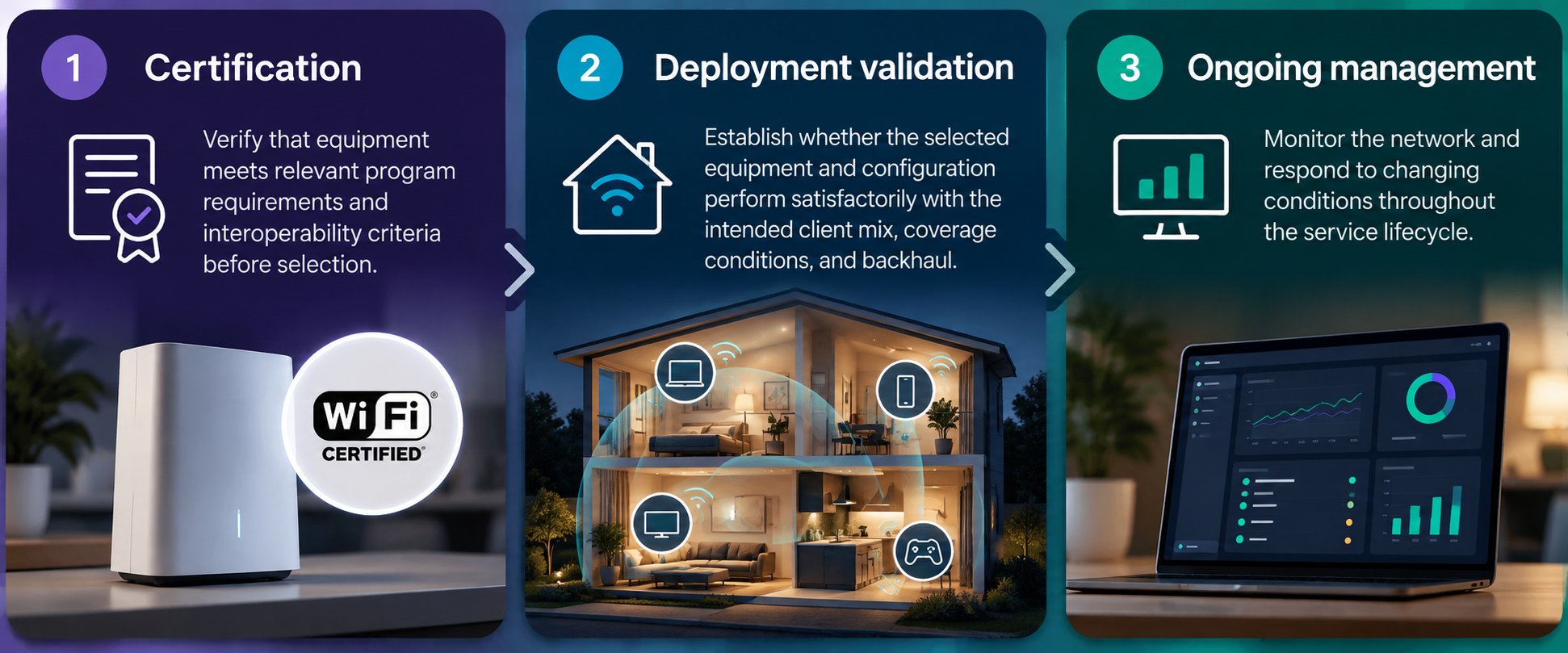
The message to broadband providers is that certification should be a starting point for equipment selection, followed by representative deployment testing and continuous service monitoring. Wi-Fi Alliance also sees an opportunity to evolve its certification programs by incorporating more evidence about how specific capabilities and use cases perform under realistic operating conditions.
Wi-Fi 7 and MLO: Lessons from real-world deployments
One of the most significant observations during the presentation concerned Wi-Fi 7 and Multi-Link Operation (MLO). MLO was introduced as a major Wi-Fi 7 capability, allowing compatible devices to use multiple wireless links through link switching or simultaneous operation, depending on the capabilities supported.
The technology offers opportunities to improve performance and responsiveness, particularly in demanding environments. But the practical benefits depend on implementation, client support, traffic conditions, coverage, and interference. According to Wi-Fi Alliance’s presentation, fewer than 10% of deployments had enabled MLO, despite Wi-Fi 7 beginning to achieve scale.
The figure was presented as an indication that the industry needs to do more to ensure that advanced capabilities can be deployed successfully in real-world environments. Wi-Fi Alliance acknowledged that the industry could have done a better job of anticipating the complexities associated with mixed-device residential networks. In particular, the interaction between different client capabilities, firmware implementations, network load, coverage conditions, and interference can make the practical deployment of advanced Wi-Fi features more challenging than laboratory testing alone might suggest. This experience is informing Wi-Fi Alliance’s thinking about Wi-Fi 8.
The organisation wants to reduce variability in the deployment of next-generation capabilities and improve the industry’s ability to validate performance before products reach consumers. The broader lesson is that the introduction of a new Wi-Fi generation does not, by itself, guarantee that its most advanced capabilities will be widely enabled or deliver the intended benefits.
Wi-Fi Alliance cuts certification testing time and testbed costs by more than 50%
Wi-Fi Alliance also reported significant progress in improving the efficiency of its certification infrastructure. According to the presentation, the organisation has reduced certification testing time by more than 50% over the past year, while also reducing the cost of the testbed by more than 50%.
These improvements are intended to make certification more efficient and accessible to the industry. The organisation is also working to improve the processes used to review firmware and configuration changes, allowing iterative and derivative certifications to be completed more quickly and at lower cost.
This is particularly relevant as Wi-Fi products become increasingly software-driven and manufacturers introduce new functionality through firmware updates. For equipment vendors and broadband operators, faster certification processes could help reduce the time and cost associated with validating product changes while maintaining a consistent interoperability foundation.
Real-world measurements must become part of the process
A central recommendation from Wi-Fi Alliance was that operators and the wider ecosystem should collect more systematic evidence from actual residential deployments. Rather than relying exclusively on laboratory performance claims or isolated case studies, operators should measure the performance of Wi-Fi networks across representative households, including older client devices, busy periods, and locations at the edge of coverage. The presentation identified four particularly important measurement categories:
- Connection success: Track successful connections across device types and firmware versions.
- Latency and stability: Measure performance under load, including jitter and retransmissions.
- Usable coverage: Evaluate connectivity in the rooms and locations where subscribers actually use their devices.
- Support contacts: Track customer support incidents per 1,000 subscriber-months.
Together, these measurements can help operators understand not only whether a product functions correctly but also whether the overall service delivers the experience customers expect. They can also provide the evidence needed to evaluate equipment, firmware changes, and network management solutions over time.
Importantly, Wi-Fi Alliance suggested that the industry has an opportunity to develop more consistent methodologies for this type of validation, rather than leaving individual operators to create their own processes independently.
AI could help bridge the gap between certification and real-world performance
Wi-Fi Alliance also identified applied AI as a potentially important tool for managing the growing complexity of residential Wi-Fi networks. The organisation suggested that AI-based analysis could help profile different residential environments, identify recurring performance problems, and support more systematic validation of equipment and configurations.
Over time, such insights could also help inform the evolution of Wi-Fi certification programs. At the operational level, AI-driven network management could improve the ability of broadband providers to identify and respond to changing conditions within subscribers’ homes. However, Wi-Fi Alliance described autonomous management functionality as still being at a relatively early stage of maturity.
Watch the full video presentation & access DVT Forum 2026 presentation materials here.
The opportunity is therefore twofold: To improve operational diagnostics and optimisation, and to use evidence from real deployments to make future certification and validation processes more representative of actual operating conditions. Neither approach eliminates the need for rigorous testing. Instead, AI could become an additional tool for improving the quality and consistency of residential Wi-Fi services.
What broadband providers should require from their next gateway procurement
Wi-Fi Alliance concluded with a practical recommendation: Operators should make relevant Wi-Fi certifications a requirement in their next gateway procurement process. But procurement requirements should extend beyond a simple certification label. The organisation proposed a four-stage approach:
- Specify: Identify the relevant certifications and capabilities required to support the intended broadband service.
- Verify: Confirm that the offered equipment model, certified configuration, and supported features meet those requirements.
- Validate: Test the equipment in representative residential environments with an appropriate mix of client devices before wider deployment.
- Monitor: Track service experience measurements and support trends after installation.
This approach places certification within a broader operational framework, connecting equipment selection with deployment readiness and ongoing service assurance. It also recognises that broadband operators must continuously manage changing network conditions, device populations, and software configurations throughout the lifetime of the equipment.
Looking ahead: Wi-Fi 8 and the reliability agenda
The lessons from Wi-Fi 7 are particularly relevant as the industry develops Wi-Fi 8, which places greater emphasis on ultra-high reliability and consistent performance. Wi-Fi Alliance suggested that the next generation presents an opportunity to improve how the ecosystem anticipates deployment complexity and validates advanced capabilities.
The objective is not simply to introduce additional technical features but to ensure that those features can be deployed effectively across diverse real-world environments. More comprehensive interoperability testing, better deployment validation, and improved visibility into actual network performance could all contribute to this objective.
For broadband providers, however, the most important message is one that applies today, regardless of Wi-Fi generation. Certification establishes the foundation for interoperability. Representative deployment validation establishes confidence in the complete system. Continuous monitoring and management help sustain the subscriber experience.
As Wi-Fi Alliance emphasised during the DVT Forum, confidence in residential Wi-Fi needs to begin before equipment is installed, and continue throughout the service lifecycle.
Source: Wi-Fi Alliance presentation, “The box in the corner: Better residential Wi-Fi with Wi-Fi CERTIFIED,” delivered at the WiFi NOW DVT Forum, September 2026, and accompanying presentation transcript.
/Claus.