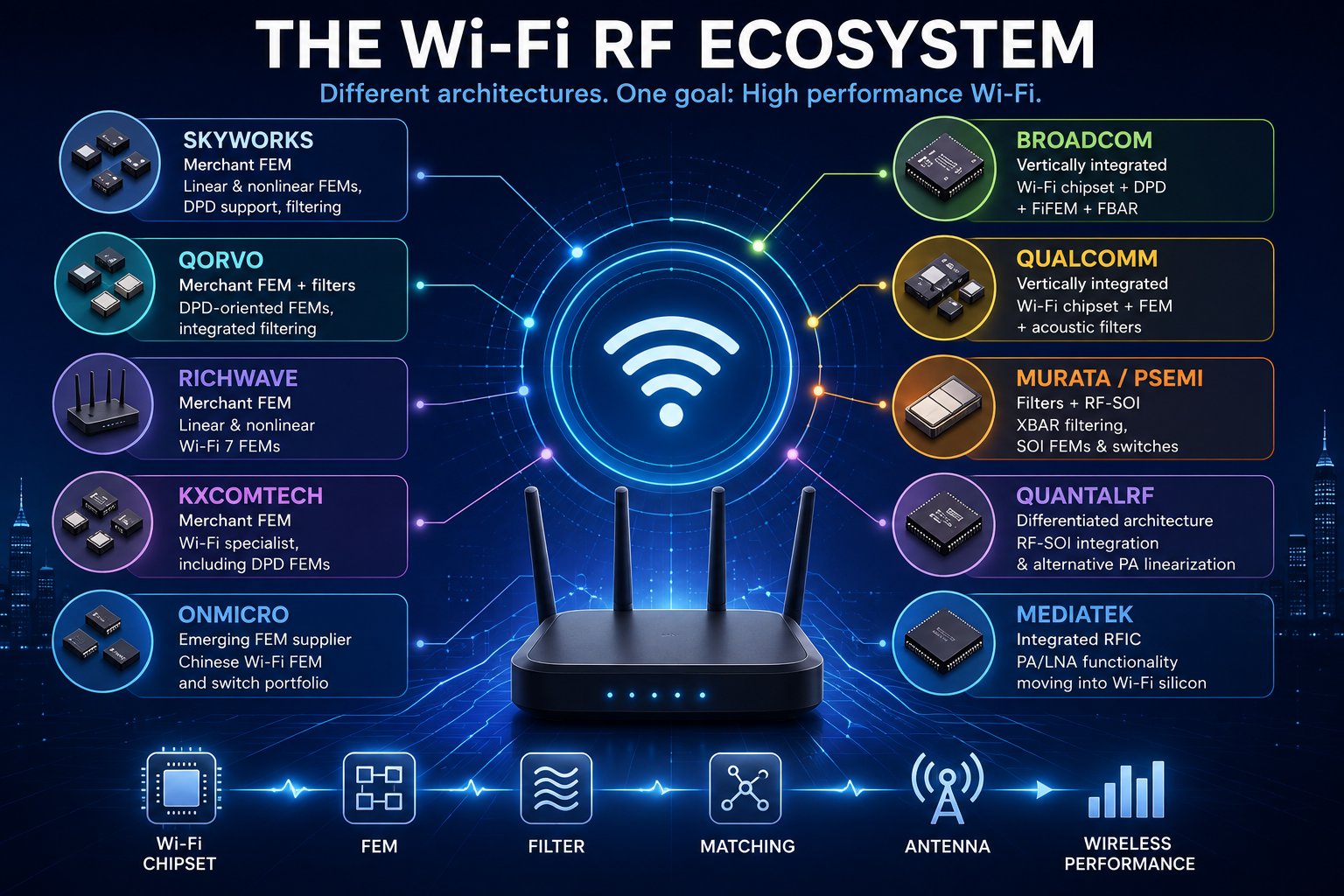

The previous parts of this series have examined why front-end modules matter, why filtering is becoming more difficult, how PA linearity and digital predistortion (DPD) affect RF architecture, and why the entire Wi-Fi radio chain ultimately needs to be designed as a system. So who supplies these technologies?
The answer reveals a market that is becoming increasingly diverse. Established RF specialists such as Skyworks and Qorvo compete with Asian FEM suppliers including RichWave and KXcomtech. Broadcom and Qualcomm have extended from Wi-Fi chipsets into FEMs and filtering. Murata combines advanced filter technology with pSemi’s RF-SOI semiconductor capabilities. QuantalRF is pursuing a differentiated approach to PA linearity and FEM integration. And MediaTek demonstrates another possibility: moving more RF functionality inside the Wi-Fi silicon itself.
These vendors are not simply competing over individual component specifications. They increasingly represent different approaches to the architecture of the complete Wi-Fi RF front end.
The Wi-Fi RF ecosystem at a glance
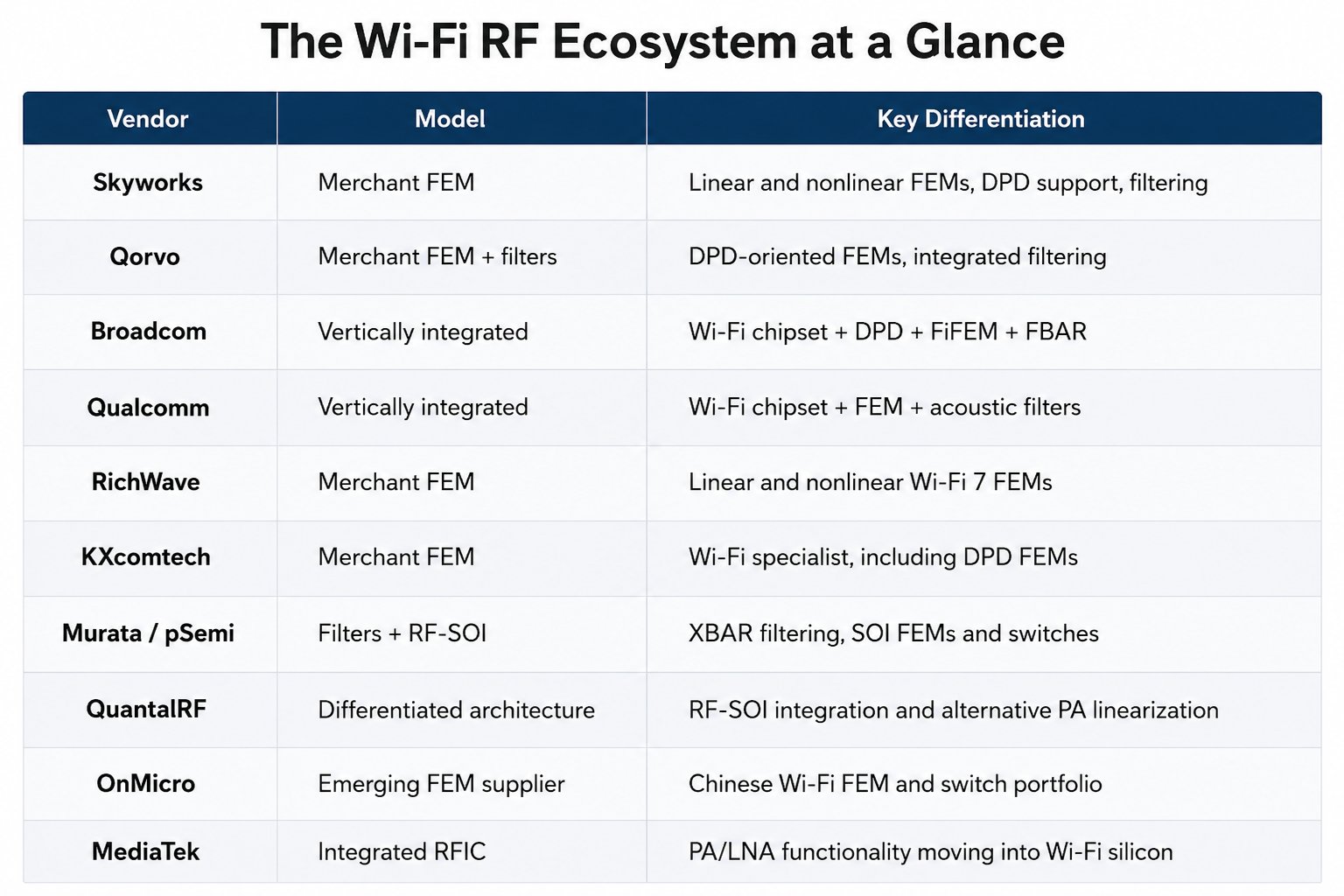
The boundaries are not absolute. Qorvo is both a FEM and filter company. Murata/pSemi also supplies semiconductor RF technology. Broadcom integrates filtering directly into its FEMs. Qualcomm supplies both FEMs and acoustic filters. That overlap is significant. The PA, LNA, switch, filter and Wi-Fi chipset can no longer always be viewed as independent building blocks.
Skyworks and Qorvo: The merchant FEM evolves
Skyworks and Qorvo remain two of the reference suppliers for external Wi-Fi FEMs. Both offer solutions across the major Wi-Fi bands, and both illustrate how the traditional FEM is becoming more sophisticated. A particularly important development is the nonlinear FEM designed to operate with chipset-based DPD.
Instead of requiring the PA itself to maintain the necessary linearity at high output power, the PA can operate more efficiently while DPD compensates for its nonlinear behaviour. As discussed in Part 3, this can improve power efficiency, but it also creates tighter dependencies between the Wi-Fi chipset and FEM.
Qorvo’s QPF4607 provides a good example: The 6 GHz Wi-Fi 7 FEM integrates the PA, switch and LNA and includes a coupler specifically intended for DPD feedback training. Other Qorvo products add filtering: the QPF7607 combines a nonlinear 6 GHz FEM with bandBoost filtering intended to improve coexistence between 5 and 6 GHz radios. Skyworks similarly offers both linear and nonlinear FEMs, including Wi-Fi 7 products designed for DPD operation, alongside filtering for increasingly difficult 5 and 6 GHz coexistence requirements.
The result is that the merchant FEM is no longer simply an external PA/LNA/switch module. It is increasingly part of a wider RF architecture involving filtering, calibration and active cooperation with the Wi-Fi chipset.
Broadcom and Qualcomm: Vertical integration from chipset to RF front end
Broadcom and Qualcomm represent a different model because both can control much more of the RF architecture. Broadcom’s Wi-Fi 7 FiFEM architecture combines PA, LNA, switching and FBAR filtering. Its 5 GHz and 6 GHz FiFEMs are designed to provide substantial isolation between the neighbouring Wi-Fi bands. More importantly, Broadcom combines these nonlinear FEMs with its own WiFAM adaptive DPD architecture. The company can therefore optimise the Wi-Fi chipset, DPD implementation, FEM and filtering as parts of the same platform.
Qualcomm has also expanded well beyond the Wi-Fi chipset. Its RF front-end portfolio includes Wi-Fi FEMs and acoustic filters for 2.4, 5 and 6 GHz, including solutions intended to address 5/6 GHz coexistence. This vertically integrated approach potentially allows more of the RF chain to be optimized together. But it also changes the equipment maker’s relationship with the silicon supplier: selecting the Wi-Fi chipset can increasingly influence the choice of FEM, filtering and RF architecture.
In other words: The chipset decision and the RF front-end decision are becoming less independent.
RichWave, KXcomtech and OnMicro: A broader merchant market
The merchant FEM market is also becoming more geographically diverse. Taiwan-based RichWave offers 2.4, 5 and 6 GHz Wi-Fi FEMs, including both linear and nonlinear Wi-Fi 7 solutions. The company says it has validated DPD operation with major US and Taiwanese chipset platforms and reports significant current-consumption advantages for some nonlinear FEMs compared with its linear alternatives.
China’s KXcomtech is particularly noteworthy because Wi-Fi RF front ends are a central part of its business. Its portfolio spans Wi-Fi 5, Wi-Fi 6 and Wi-Fi 7 and includes FEMs, amplifiers, switches and other RF components across the Wi-Fi bands. KXcomtech also offers dedicated nonlinear Wi-Fi 7 FEM families designed for DPD. Some integrate directional couplers and detectors supporting the wider linearization architecture, with high-order modulation performance specified under DPD operation.
OnMicro represents another emerging Chinese supplier, with publicly available 2.4 and 5 GHz Wi-Fi FEMs and RF switches, although its documented Wi-Fi 7 and 6 GHz portfolio is currently less extensive than KXcomtech’s. RichWave and KXcomtech are important because they demonstrate that nonlinear FEM + DPD is becoming a broader industry architecture, rather than something confined to the largest US RF suppliers.
Murata / pSemi and QuantalRF: Different approaches to RF integration
Not every supplier is following exactly the same architectural path. Murata brings extensive filtering expertise to the Wi-Fi ecosystem, while its subsidiary pSemi contributes RF semiconductor technology based particularly on silicon-on-insulator processes. Murata’s XBAR technology is especially relevant to 6 GHz Wi-Fi. In 2025 the company began commercial production of an XBAR filter covering 5.15–7.125 GHz, targeting applications including Wi-Fi 6E and Wi-Fi 7. The objective is to combine the wide bandwidth required at these frequencies with strong rejection and low insertion loss.
pSemi approaches the problem from the semiconductor side. Its portfolio includes highly integrated SOI Wi-Fi FEMs combining PA, LNA and switching on a single die. The company has also described Wi-Fi FEM architectures capable of high-linearity operation without requiring DPD in some applications.
QuantalRF is pursuing another highly integrated RF-SOI approach, but with particular emphasis on the PA architecture and linearisation. Its Elementum FEMs integrate PA, LNA and RF switching on a monolithic CMOS RF-SOI die. QuantalRF’s objective is to use adaptive analog techniques to improve PA linearity and efficiency while retaining the integration advantages of silicon.
There is an important distinction here: current QuantalRF products can support DPD. The proposition is not that DPD cannot be used. Rather, QuantalRF is seeking to achieve attractive linearity and efficiency without making conventional chipset-controlled DPD fundamental to acceptable FEM operation, while allowing DPD to provide additional performance where required.
If that approach proves successful at scale, it could reduce some of the chipset/FEM interworking, calibration and integration complexity associated with conventional DPD architectures. This makes QuantalRF particularly interesting because it is not merely attempting to build another version of the incumbent FEM. It is challenging assumptions about how PA linearity should be achieved in the first place.
Special case: MediaTek moves RF functionality inside
MediaTek illustrates another possibility: eliminating some of the boundary between the Wi-Fi chipset and FEM. The company has integrated PA and LNA functionality directly into some of its Wi-Fi RFICs. Its Filogic platforms demonstrate how moving RF functionality inside the silicon can reduce external components, PCB area and potentially power consumption.
This is not equivalent to offering a merchant FEM that can be paired with any Wi-Fi chipset. High-power access points and demanding multi-band designs can still require external FEMs and filtering. But it raises an important question: How much of today’s external Wi-Fi RF front end could eventually migrate into the Wi-Fi RFIC itself?
WiFi NOW’s take: The traditional division between Wi-Fi chipset suppliers and specialist RF component suppliers is becoming less clear. Broadcom and Qualcomm are extending from the chipset toward the antenna. Skyworks, Qorvo, RichWave and KXcomtech are developing FEMs designed to work increasingly closely with chipset-based DPD. Murata/pSemi combines advanced filtering with silicon RF integration. QuantalRF is exploring whether a different PA architecture can reduce dependence on conventional digital linearization. And MediaTek is moving portions of the RF front end inside the Wi-Fi RFIC.
The result is that competition in Wi-Fi RF is increasingly becoming competition between architectures and ecosystems—not simply between individual FEMs and filters. For equipment makers, the winning solution will not necessarily be the FEM with the highest output power or the filter with the sharpest rejection. It will be the RF architecture that delivers the required Wi-Fi performance with the best combination of linearity, power efficiency, coexistence, thermal performance, integration complexity, flexibility and cost.