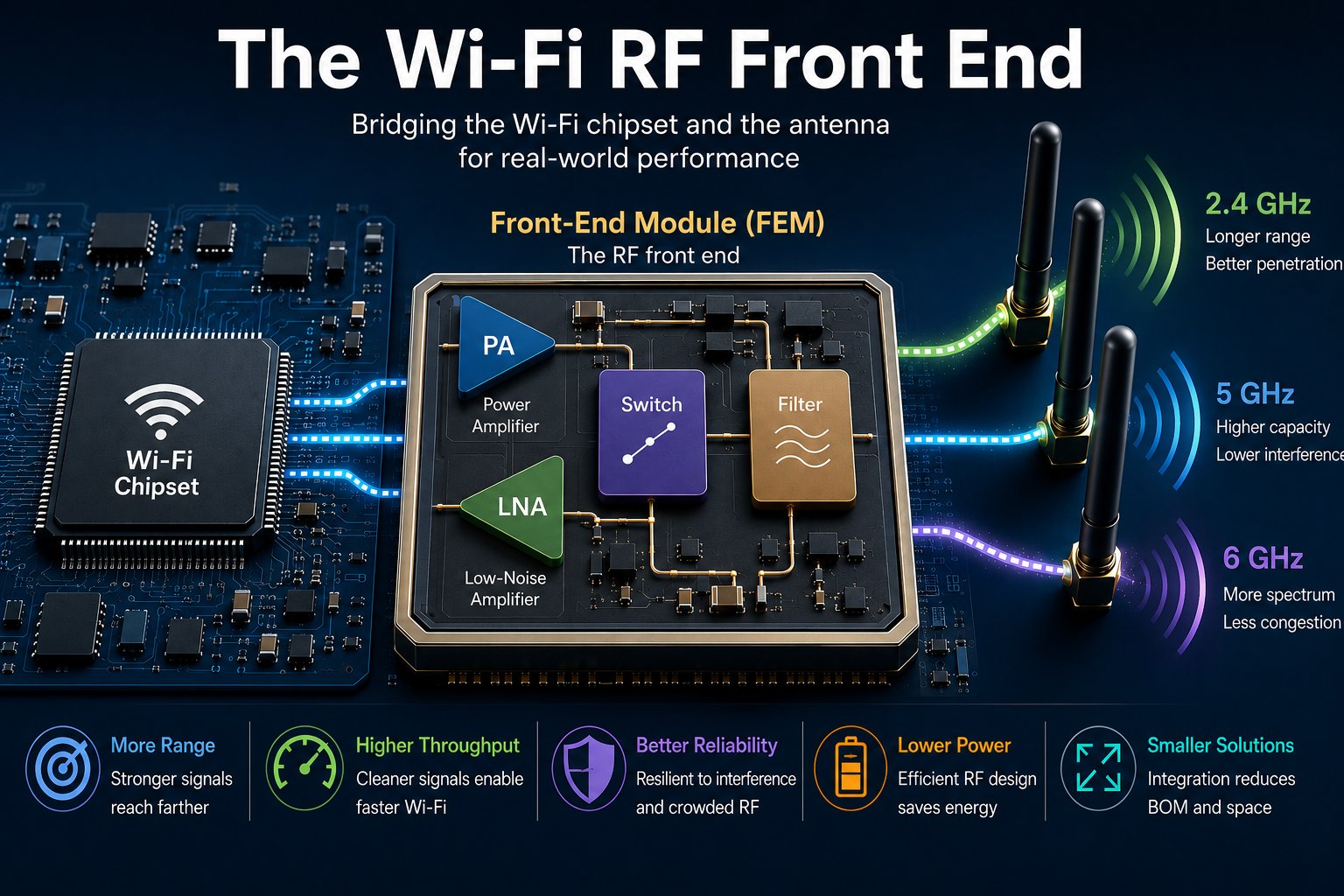

When we talk about Wi-Fi performance, most of the attention tends to go to the Wi-Fi chipset, the standard being supported, the number of spatial streams, channel bandwidth, or features such as Multi-Link Operation. But between the Wi-Fi chipset and the antenna sits another critical part of the radio system: the RF front end.
The RF front end has a major influence on how effectively a Wi-Fi device can transmit and receive radio signals. Its performance can affect coverage, throughput, reliability, power consumption, and the ability of a device to operate in increasingly crowded radio environments.
A key building block of the RF front end is the front-end module, or FEM. As Wi-Fi has expanded across the 2.4 GHz, 5 GHz, and 6 GHz bands – and as Wi-Fi signals have become wider and more demanding – the performance of these components has become increasingly important.
What is a Wi-Fi front-end module?
At the simplest level, a Wi-Fi radio needs to perform two fundamental tasks: transmit a radio signal through an antenna and receive signals arriving at that antenna. The Wi-Fi chipset performs much of the digital signal processing and radio control needed to create and interpret Wi-Fi signals. But the signal must also be amplified, routed, filtered, and connected efficiently to the antenna. These functions are handled by the RF front end.
A Wi-Fi FEM typically integrates several of the components required for this task into a single package. Depending on the particular design, these can include:
- Power amplifier (PA): Amplifies the Wi-Fi signal so that sufficient RF power reaches the antenna.
- Low-noise amplifier (LNA): Amplifies weak received signals while adding as little additional noise as possible.
- RF switches: Route signals between transmit and receive paths and between different RF functions.
- Filters: Suppress unwanted frequencies while allowing the required Wi-Fi frequencies to pass.
- Other RF functions: Depending on the level of integration, the module may incorporate additional switching, matching, filtering, or control functions.
Not every Wi-Fi FEM contains exactly the same components. The degree of integration varies considerably depending on the application, frequency band, performance requirements, semiconductor technology, and system architecture. The important point is that the FEM forms a critical interface between the Wi-Fi radio and the antenna.
Why not simply connect the Wi-Fi chipset to the antenna?
A Wi-Fi chipset cannot by itself deliver every RF characteristic required at the antenna. On transmit, the signal needs sufficient power while retaining the quality required for the Wi-Fi modulation being used. On receive, the device needs to detect and amplify signals that may be very weak. At the same time, unwanted signals need to be prevented from interfering with the wanted Wi-Fi signal.
These requirements create trade-offs. More transmit power, for example, can potentially improve coverage – but only if the amplifier can produce that power without degrading the signal beyond acceptable limits. Amplification on the receive side is useful only if it does not introduce excessive noise or distortion. Filtering unwanted frequencies is essential, but filters themselves introduce some loss.
The RF front end therefore has to balance power, signal quality, sensitivity, efficiency, filtering, isolation, and cost. This is why two Wi-Fi products using similar Wi-Fi chipsets and supporting the same Wi-Fi standard do not necessarily deliver identical RF performance.
The FEM’s role in Wi-Fi performance
The performance of the RF front end can ultimately show up in characteristics that Wi-Fi users and network operators care about. A well-designed transmit path can help a device maintain higher-order modulation at useful power levels. A good receive path can help the radio successfully recover weaker signals. Appropriate filtering can reduce the impact of unwanted signals. Efficient amplification can reduce power consumption and heat generation. These characteristics can contribute to practical differences in coverage, throughput, connection stability, and device power consumption.
The relationship is not always simple. Increasing one RF performance parameter can adversely affect another, and the antenna design, Wi-Fi chipset, software, regulatory requirements, and physical product design all contribute to the final result. For that reason, the FEM should not be thought of as a component that simply “boosts the Wi-Fi signal.” It is part of a complete RF system whose transmit and receive performance must be engineered together.
Power efficiency is becoming a critical Wi-Fi challenge
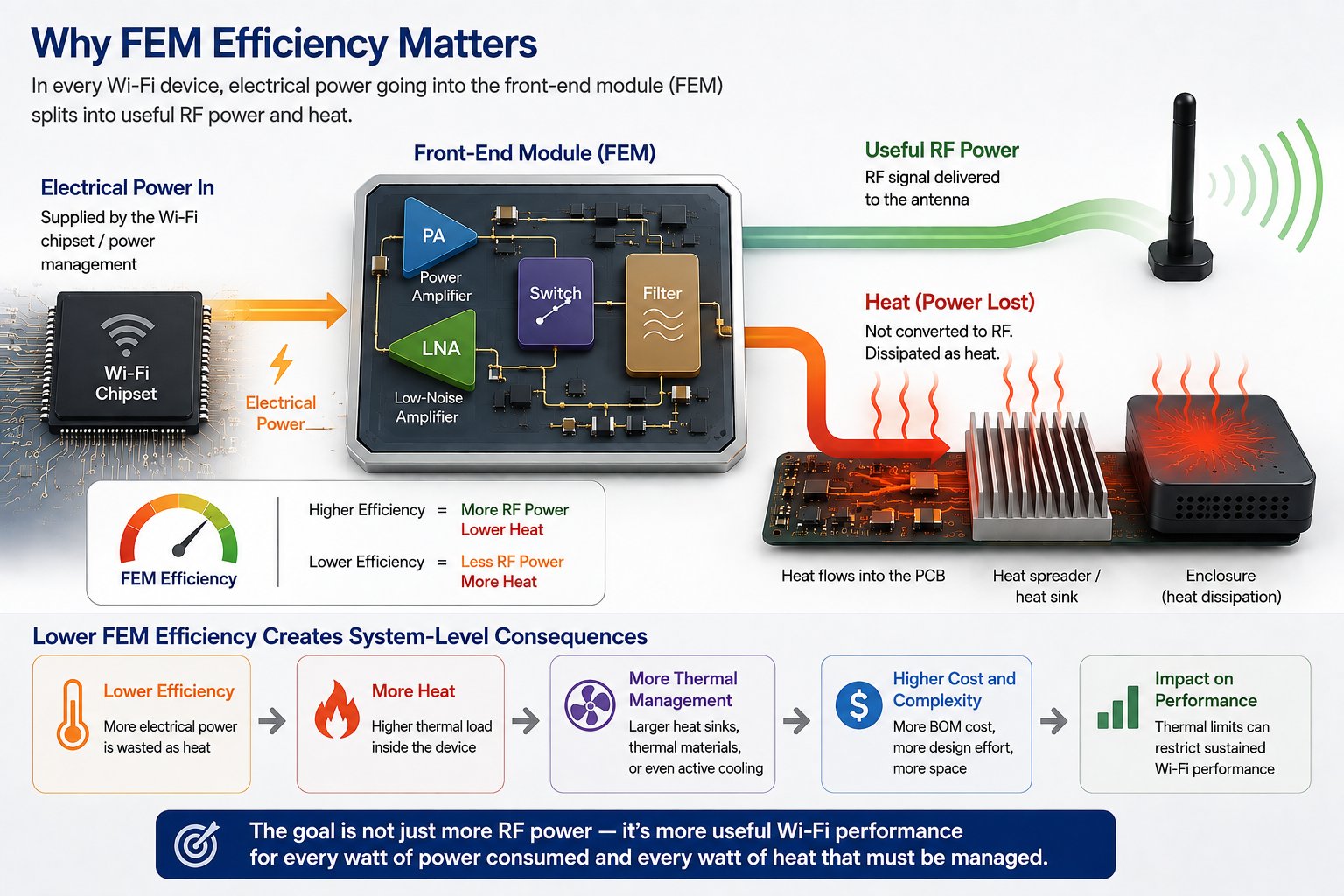
One of the less visible challenges facing Wi-Fi equipment designers is the power efficiency of the RF front end. A power amplifier does not convert all of the electrical power it consumes into useful RF output power. A significant portion is dissipated as heat. This means that achieving the required Wi-Fi transmit performance is not simply a question of supplying enough electrical power: the equipment must also be designed to remove the resulting heat while keeping components within acceptable operating temperatures.
This is becoming increasingly important because improvements in FEM power efficiency have not necessarily kept pace with the increasing performance demands placed on Wi-Fi equipment. New Wi-Fi generations can deliver substantially greater capacity and throughput, but the RF front end still faces fundamental trade-offs between output power, linearity, signal quality, and efficiency. Higher-order modulation places particularly demanding requirements on signal quality, which can require the power amplifier to operate below its maximum output capability. This operating back-off can reduce power efficiency and increase the amount of electrical energy dissipated as heat for a given level of usable RF output.
The consequences extend well beyond the FEM itself. For an access point or broadband gateway with multiple radio chains, RF front-end power consumption can contribute significantly to the overall thermal load. More heat may require larger heat sinks, additional thermal materials, more PCB area, different enclosure designs, or in some equipment active cooling. These measures add size, weight, complexity, and cost to the finished product. Thermal constraints can also place limits on sustained performance.
A device designed to deliver high RF performance under peak conditions must be able to do so without exceeding component or system temperature limits. Otherwise, the system may need to reduce performance as temperatures rise. The challenge becomes particularly relevant as Wi-Fi systems incorporate more bands, more radio chains, wider channels, and increasingly sophisticated radio capabilities. Adding RF capability without corresponding improvements in efficiency risks increasing both equipment power consumption and the cost of managing the resulting heat.
This makes FEM efficiency an important system-level consideration for future Wi-Fi products. Improvements in power-amplifier technology, FEM architecture, semiconductor processes, and techniques such as digital pre-distortion could potentially allow more useful RF performance to be delivered for the same – or lower – electrical power and thermal load.
For Wi-Fi equipment manufacturers, the objective is therefore not simply more RF output power. An increasingly important measure of progress is how much useful Wi-Fi performance can be delivered per watt of power consumed and per watt of heat that the product must manage.
More bands mean a more complicated RF front end
The RF challenge has grown as Wi-Fi has expanded. Wi-Fi devices historically operated primarily in the 2.4 GHz and 5 GHz bands. Wi-Fi 6E added access to the 6 GHz band, while Wi-Fi 7 makes extensive use of 6 GHz and introduces capabilities including channels up to 320 MHz wide and Multi-Link Operation.
Many devices therefore need to support several Wi-Fi frequency bands, wide channels, multiple antennas and spatial streams, and in some cases simultaneous operation across different links. Each antenna chain may require RF front-end functionality, while the device must also prevent the various radios and frequency bands from interfering with one another.
This increases the importance of component integration, filtering, isolation, power efficiency, and thermal management. The RF front end is consequently becoming an increasingly important part of the overall Wi-Fi system architecture.
Access points and client devices have different priorities
There is no single ideal Wi-Fi FEM. An enterprise access point or broadband gateway may place considerable emphasis on RF performance, output power, multiple spatial streams, reliability, and thermal management. A smartphone, laptop, or other battery-powered client faces a different set of constraints.
Physical space and power consumption can be extremely important, and Wi-Fi needs to coexist with cellular, Bluetooth, and potentially several other radios inside the same device. IoT devices introduce yet another set of priorities, often emphasizing low power consumption, low cost, and compact implementation. FEM design and selection therefore depend strongly on what kind of Wi-Fi product is being built.
Increasing integration
One important trend is the integration of more RF functions into increasingly compact modules. Integration can reduce the number of discrete RF components required around the Wi-Fi chipset, simplify product design, save board space, and potentially improve control over the interaction between different RF functions.
But integration also creates engineering choices. Different RF functions have historically benefited from different semiconductor technologies, and the optimum solution for a power amplifier may not necessarily be the optimum solution for a switch, filter, or low-noise amplifier. The Wi-Fi RF front end is therefore also an area of semiconductor and architectural innovation. This is becoming particularly interesting as vendors explore new approaches to integration, amplifier linearity, adaptive RF techniques, filtering, and digital compensation.
Why the RF front end matters more for Wi-Fi 7
Wi-Fi 7 increases the demands placed on the RF chain. Channels as wide as 320 MHz and 4096-QAM can deliver much higher data rates, but these capabilities also require excellent signal quality. Multi-Link Operation introduces additional possibilities for using multiple frequency bands and radios. At the same time, Wi-Fi equipment still has to meet regulatory limits, operate efficiently, manage heat, coexist with other radio technologies, and remain commercially viable.
The challenge is therefore not simply to generate more RF power. It is to deliver usable RF performance across increasingly demanding Wi-Fi operating conditions. This is where the design of the front end becomes particularly important.
The RF front end is becoming part of the Wi-Fi story
The Wi-Fi industry has traditionally focused much of its attention on standards and baseband capabilities. But advances in Wi-Fi increasingly depend on what happens after the signal leaves the chipset and before it reaches the antenna—and on what happens to weak signals travelling in the opposite direction.
Front-end modules, power amplifiers, low-noise amplifiers, switches, and filters are therefore not peripheral components. They help determine how much of the capability promised by a Wi-Fi chipset can actually be delivered over the air. Understanding the RF front end provides the foundation for several important questions facing Wi-Fi equipment designers and the broader industry.
Why is filtering becoming more difficult as Wi-Fi expands across 2.4, 5, and 6 GHz? Why is maintaining signal quality increasingly challenging at higher transmit powers? What role can technologies such as digital pre-distortion play? And could new semiconductor technologies and RF architectures change how Wi-Fi front ends are built? Those are the subjects we will explore in the remaining parts of this series.
WiFi NOW’s take: The Wi-Fi industry has become exceptionally good at adding more radio capability: more spectrum, wider channels, more spatial streams, higher-order modulation, and increasingly sophisticated multi-link operation. But RF front-end efficiency has not advanced at the same pace.
We believe this is becoming an important constraint on Wi-Fi equipment design. Every watt that is not converted efficiently into useful RF performance becomes heat that must be managed, adding cost, complexity, and potentially size to access points, gateways, and client devices.
The next major improvements in Wi-Fi will therefore not come from standards and chipsets alone. Better FEM efficiency, improved linearity, smarter techniques such as DPD, and new RF architectures will be increasingly important to delivering more Wi-Fi performance without an equivalent increase in power consumption and thermal burden.