• wifinowglobal.com
  • syndicated.wifinowglobal.com
  • Wi-Fi NOW Global
  • Wi-Fi NOW Asia
  • Wi-Fi NOW Latin America

Wi-Fi NOW Global

  • Wi-Fi
  • Wi-Fi HALOW
  • ULTRA-WIDEBAND
  • RESOURCES
  • OUR PARTNERS
  • BECOME A PARTNER
  • BECOME A FREE MEMBER
  • WiFi NOW AUDIENCE INTELLIGENCE 2027
  • WiFi NOW WORLD CONGRESS 2027 PROSPECTUS
  • SERVICES
  • SHOP
  • EVENTS
    • CURRENT EVENTS
    • PREVIOUS EVENTS
    • EXPO
    • EventSpace®
  • RESOURCES
  • HALL OF FAME
  • ACADEMY
    • Masterclasses
    • Wi-Fi 7 PHY/MAC
    • 6 GHz operation including AFC
  • AWARDS
    • ABOUT AWARDS
    • CATEGORIES
    • WHY ENTER?
    • HOW TO ENTER
    • JUDGES
    • SELECTION CRITERIA
  • NEWS & TV
  • HALL OF FAME
  • ABOUT US
    • ABOUT Wi-Fi NOW
    • MANIFESTO
    • OUR RATINGS
    • OUR CREDENTIALS
    • MEET THE TEAM
    • CONTACT US
    • EventSpace®

Wi-Fi & Mobile Convergence Part Two: Why the First Wave Didn’t Deliver (much) – and Why This Time Could Be Different

July 26, 2026 | TECHNOLOGY GUIDES | by Claus Hetting, Wi-Fi NOW CEO & Chairman

If mobile devices could automatically move traffic from cellular to Wi-Fi, operators could dramatically reduce congestion while postponing expensive investments in new spectrum and additional cell sites. The vision was compelling. The reality proved considerably more complicated.

Members-only article

Create your free WiFi NOW account to continue reading.

  • Solutions & Use Cases
  • Technology Guides
  • Expert Insights
  • Member-only content

Already a member? Log in

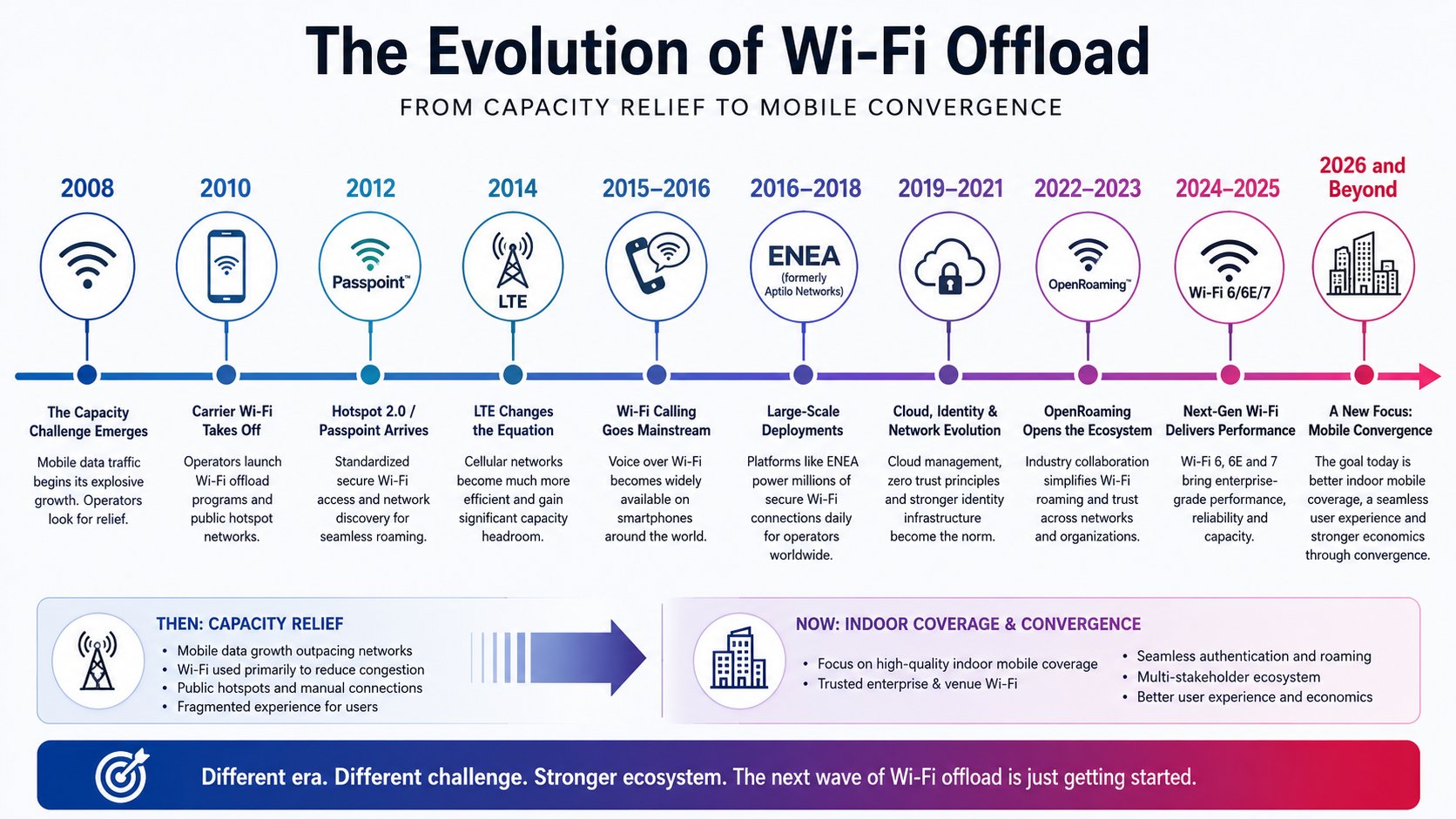
When Wi-Fi offload first emerged in the late 2000s and early 2010s, it was heralded as one of the biggest opportunities in mobile networking. Smartphone traffic was exploding and some mobile operators feared they would run out of capacity. The solution seemed obvious. Millions of Wi-Fi access points already existed. If mobile devices could automatically move traffic from cellular to Wi-Fi, operators could dramatically reduce congestion while postponing expensive investments in new spectrum and additional cell sites.

The vision was compelling. The reality proved considerably more complicated.

The Capacity Crisis That Never Quite Happened

It’s easy to forget how concerned the industry was about mobile capacity fifteen years ago. Forecasts predicted exponential traffic growth while operators expected their LTE networks to become saturated. Carrier Wi-Fi was promoted as an essential pressure valve, but several things happened simultaneously:

Mobile networks became dramatically more efficient, while operators acquired additional spectrum. LTE – and later 5G – delivered far greater capacity than expected and traffic management improved. Meanwhile Wi-Fi itself evolved. Ironically, cellular became much better at carrying traffic just as Wi-Fi became much better at carrying it too. The offload idea gradually faded – probably to the relief of mobile operators, who would rather not admit to using unlicensed spectrum while spending billions on exclusive spectrum licenses.

Carrier Wi-Fi Was Never Really the Problem

One of the biggest misconceptions today is that Carrier Wi-Fi failed when in fact, it didn’t. Many deployments worked extremely well. as large operators successfully implemented managed Wi-Fi services. Companies such as ENEA (formerly Aptilo Networks) built platforms that enabled millions of secure Wi-Fi authentications every day across operator networks worldwide.

Wi-Fi Calling became commonplace, Passpoint matured, while carrier-grade AAA infrastructure proved reliable at scale. The technology generally delivered what it was designed to do. The problem was commercial rather than technical.

The User Experience Wasn’t Ready

That said, early Wi-Fi offload – and public Wi-Fi in general – also suffered from an inconsistent user experience. Many users encountered:

  • Captive portals
  • Repeated logins
  • Unreliable authentication
  • Varying network quality (also after handoff)
  • Fragmented operator agreements

The result was that consumers quickly learned that “public Wi-Fi” often meant inconvenience – a perception that has lingered for years. Another lingering problem has been the inability of service providers to assess the quality of the Wi-Fi network to which the phone is being handed off. This has in many cases been a show-stopper for carriers. But this issue has now also found its solution.

The World Has Changed

Today’s environment looks very different. Smartphones now routinely support Passpoint authentication and Passpoint is widely available (in some countries). OpenRoaming has begun to simplify trust relationships, while Wi-Fi 6 and Wi-Fi 7 deliver much better enterprise-grade performance. Cloud-based management has become the norm, while identity has become a central part of network architecture. Most importantly: The business question has changed. Fifteen years ago the question was: How can Wi-Fi reduce congestion on cellular networks? Today the question is: How can existing Wi-Fi infrastructure improve indoor mobile coverage economically? That is an entirely different problem.

A Bigger Ecosystem

Another important change is that the ecosystem itself has evolved. The first generation of Carrier Wi-Fi was largely driven by mobile operators. Today’s convergence involves a much broader set of stakeholders. Increasingly, the question is no longer who owns the radio network, but how different networks can work together to deliver a seamless user experience. Carrier Wi-Fi proved that secure authentication, policy control, and large-scale Wi-Fi service management were achievable. What changed was not the technology but the commercial problem operators were trying to solve.

WiFi NOW’s Take: The first wave of Wi-Fi offload wasn’t a failure (and some forms of offload were indeed established early including at airports, for example) – it was an early chapter in a much longer story. Many of the technologies that underpin today’s convergence, from carrier-grade authentication to policy management and Wi-Fi Calling, were developed and proven during that period. What’s different today is the context: operators are no longer searching for relief from an anticipated capacity crunch but for practical, scalable ways to deliver high-quality indoor connectivity.

  • Wi-Fi & mobile convergence

Search

Topics covered in this article

  • Wi-Fi & mobile convergence
Resource Centre

Your hub for the latest Wi-Fi industry insights and resources

Research reports, in-depth technology guides and expert insights on Wi-Fi — new resources every week, free for members.

  • Solutions & Use Cases
  • Technology Guides
  • Expert Insights
Explore the Resource Centre →
  • Expert InsightsThe predistortion pioneer who says Wi-Fi has outgrown DPD: QuantalRF’s Dr Ali Fard speaks out on Wi-Fi 8 and AI at the edgeOctober 18, 2026
  • Expert InsightsInventor of AI Ops for enterprise Bob Friday explains why agentic AI will finally make self-driving enterprise networks a realityOctober 18, 2026
  • Expert InsightsFrom Hype to Hard Numbers: AI Arrives at the ISP Support DeskOctober 17, 2026

Subscribe to Wi-Fi NOW

Stay updated on Wi-Fi News & Information

  • This field is for validation purposes and should be left unchanged.

Upcoming events

WiFi NOW World Congress USA 2027

April 19, 2027

Register now
All events

Latest white papers All white papers

New Aprecomm white paper: Understanding the business-critical shift from QoS ...

New paper: Enea publishes the definitive technical guide to Wi-Fi Offloading

New MediaTek Filogic paper on Wi-Fi 8 (802.11bn) highlights Ultra High Availa...

Upcoming Masterclasses

On-demand: Inside Wi-Fi 6E & Wi-Fi 7

MASTERCLASS: A JOURNEY INSIDE Wi-Fi 6E

Register now
All masterclasses

Wi-Fi NOW Services

Job platform

Stay updated on the latest jobs in the Wi-Fi industry.

Go to jobs

Wi-Fi Academy

Interested in the latest technologies in Wi-Fi?

Go to academy

Syndicated

The latest press releases from all Wi-Fi companies.

Visit syndicated
This website uses cookies to improve your experience. Read more in our privacy statement. Accept
Privacy & Cookies Policy

Privacy Overview

This website uses cookies to improve your experience while you navigate through the website. Out of these, the cookies that are categorized as necessary are stored on your browser as they are essential for the working of basic functionalities of the website. We also use third-party cookies that help us analyze and understand how you use this website. These cookies will be stored in your browser only with your consent. You also have the option to opt-out of these cookies. But opting out of some of these cookies may affect your browsing experience.
Necessary
Always Enabled
Necessary cookies are absolutely essential for the website to function properly. This category only includes cookies that ensures basic functionalities and security features of the website. These cookies do not store any personal information.
Non-necessary
Any cookies that may not be particularly necessary for the website to function and is used specifically to collect user personal data via analytics, ads, other embedded contents are termed as non-necessary cookies. It is mandatory to procure user consent prior to running these cookies on your website.
SAVE & ACCEPT
Wi-Fi NOW

Join WiFi NOW for free

Create your free account to access unique insights and industry resources.

  • Unlock articles
  • Access reports & resources
  • Download presentations
  • Watch webinars
  • Stay updated on the latest
  • This field is for validation purposes and should be left unchanged.

Already have an account? Log in

Log in

Don’t know your password? Click here to login with an e-mail link instead.

Forgot your password?
Don’t know your password?

Enter your e-mail below and we'll send you a login link.

No account yet? Join for free

Wi-Fi NOW (Hetting Global ApS), Denmark company registry no. 40955437
Hedeskovvej 9
DK-8520 Lystrup, Denmark.
Contact: Tlf: +45 25341705 / Claus Hetting

For questions or comments, please contact Chief Administrator [email protected]

Visa logo MasterCard logo JCB logo American Express logo

Terms of Purchase - Privacy Statement - Terms of Service