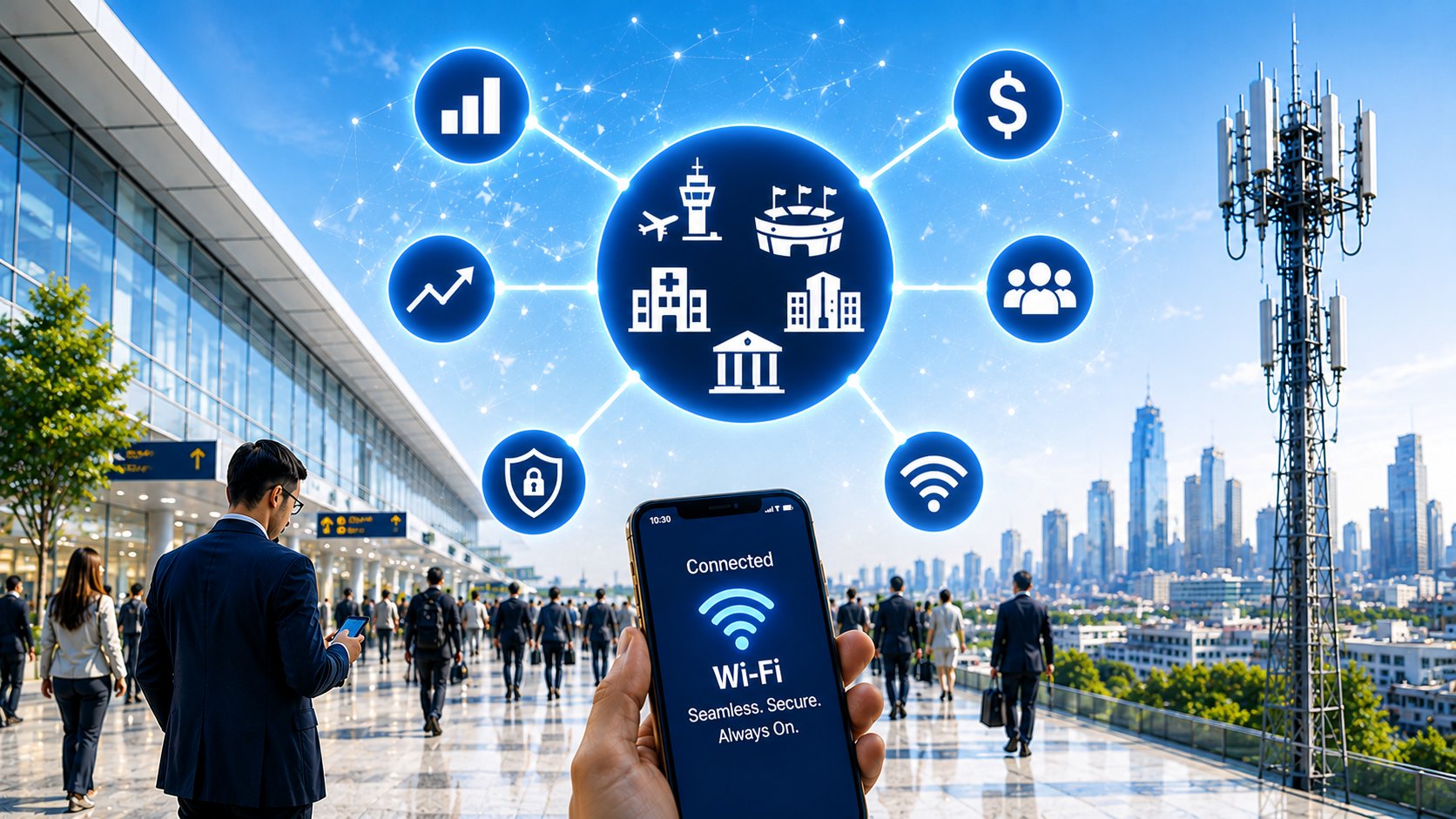

For more than a decade, the mobile industry has faced a problem that has never really gone away: Delivering reliable indoor mobile coverage. Today’s mobile networks provide remarkable outdoor coverage and capacity. Fifth-generation (5G) networks have dramatically improved spectral efficiency, increased throughput, and reduced latency.
Yet for millions of users, the experience changes the moment they step inside an office building, shopping centre, hotel, airport terminal, hospital, apartment block, or sports arena. Walls, energy-efficient glass, reinforced concrete, and steel remain stubborn obstacles to radio signals, and indoor coverage continues to be one of the industry’s most difficult engineering challenges.
The traditional answer has been to extend the mobile network indoors using Distributed Antenna Systems (DAS), small cells, or other dedicated cellular infrastructure. Technically, these solutions work extremely well. Commercially, however, they are far more difficult to justify. For mobile operators, the challenge is not simply one of radio engineering—it is one of economics.
The economics of indoor coverage
Consumers increasingly regard reliable indoor coverage as a basic expectation rather than a premium service. At the same time, mobile operators in many mature markets continue to face intense price competition, relatively flat revenue growth, and ever-increasing investment requirements for 5G networks.
Improving indoor coverage certainly improves the customer experience, but it rarely generates additional revenue. As a result, operators must carefully decide where dedicated indoor cellular infrastructure can be economically justified.
This explains why DAS has traditionally been deployed in airports, major stadiums, convention centres, large hospitals, and other high-value venues where network performance is critical and costs can be shared among multiple stakeholders. But these locations represent only a small fraction of the buildings where mobile subscribers expect reliable service.
The network already exists
This is where the discussion becomes interesting – and this is the crux of the current ‘Wi-Fi offload’ discussion: While operators continue to evaluate investments in dedicated indoor cellular infrastructure, another wireless network has quietly become almost universal. Modern office buildings, hotels, universities, shopping centres, apartment complexes, hospitals, factories, and public venues are already equipped with sophisticated Wi-Fi networks designed to deliver high-capacity, reliable indoor connectivity.
These networks represent billions of dollars of existing infrastructure investment. The obvious question is therefore not whether Wi-Fi can carry mobile traffic – it already can – but whether these existing Wi-Fi networks can become trusted extensions of the mobile network itself. If yes, operators may be able to improve the indoor customer experience without building entirely new radio infrastructure in every building.
The good news is that the technology exist today (it has existed for more than a decade) to deliver the secure Wi-Fi connectivity that carriers need to establish Wi-Fi offload.
Why now?
The idea of using Wi-Fi as part of the mobile network is hardly new. More than a decade ago, operators began experimenting with Wi-Fi offload as a way of moving traffic from congested cellular networks onto Wi-Fi hotspots. Although technically promising, many early deployments struggled to deliver a seamless user experience. Manual network selection, captive portals, inconsistent authentication, fragmented roaming agreements, and limited device support all hindered widespread adoption.
Much has changed since then. Wi-Fi technology has advanced significantly. Smartphones now support sophisticated authentication methods. Identity management has matured. Secure roaming between trusted Wi-Fi networks has become increasingly practical. At the same time, operators have accumulated years of operational experience with carrier Wi-Fi deployments.
Perhaps more importantly, the commercial environment has changed. Rather than asking how Wi-Fi can reduce congestion on the mobile network, operators are increasingly asking a different question: Can existing Wi-Fi infrastructure help solve the indoor coverage challenge more economically? That subtle shift changes the conversation entirely.
Perhaps the single most important development in recent years is that all major operators in the US now support Passpoint technology on phones. This means phones from Verizon, T-Mobile, and AT&T are all pre-configured to auto-connect to Wi-Fi networks equipped and configured to support Passpoint. The same is currently not true in Europe and elsewhere.
Beyond offload
The term Wi-Fi offload suggests that traffic simply moves from one network to another. In reality, the industry is moving toward something much broader. The objective is increasingly to deliver a seamless wireless experience regardless of whether a device happens to be connected through licensed cellular spectrum or licence-exempt Wi-Fi spectrum.
Users should not need to think about authentication, network selection, roaming agreements, or radio technologies. They simply expect their devices to remain securely connected wherever they go. Achieving this vision requires much closer integration between Wi-Fi and mobile networks than traditional hotspot deployments ever attempted.
It also raises new questions about network ownership, identity, security, commercial relationships, and the future role of enterprise Wi-Fi infrastructure. These questions are becoming increasingly important – not only for mobile operators, but also for broadband providers, enterprises, venue owners, equipment vendors, and policymakers.
Reality Check
- Myth: Wi-Fi offload is primarily about increasing network capacity.
- Reality: While Wi-Fi can certainly provide additional capacity, renewed interest in offload is increasingly driven by the economics of indoor mobile coverage. Operators are exploring whether trusted, existing Wi-Fi infrastructure can complement cellular networks in locations where deploying dedicated indoor cellular systems is difficult to justify commercially.
What’s next?
Part 2 of this guide examines why the first generation of carrier Wi-Fi and offload solutions fell short of expectations—and why advances in authentication, identity, and roaming technologies may make today’s approach fundamentally different.
WiFi NOW’s take: The industry often frames Wi-Fi offload as a technical capability. In reality, it is increasingly a business strategy. The fundamental question is no longer whether Wi-Fi can carry mobile traffic – it can – but whether existing Wi-Fi infrastructure can become an economically viable extension of the mobile network. If that proves possible at scale, the future of indoor mobile connectivity may depend less on building new radio networks and more on integrating the ones that already exist.