
But they’ve also highlighted a challenge: If Wi-Fi sensing is to become a mainstream capability available across millions of homes, enterprises, and public venues, the industry will require a common framework. That is where IEEE 802.11bf comes in. The standard is laying the foundation for an interoperable Wi-Fi sensing ecosystem while allowing companies to continue innovating in software, artificial intelligence, and applications.
The pioneers
Long before IEEE 802.11 began developing a sensing standard, a handful of companies were already commercialising the technology. Among the pioneers are Cognitive Systems and Origin AI, both of which demonstrate that existing Wi-Fi infrastructure can be used for applications such as motion detection, occupancy awareness, and home security. Their work has been instrumental in shifting Wi-Fi sensing from academic research into commercial reality.
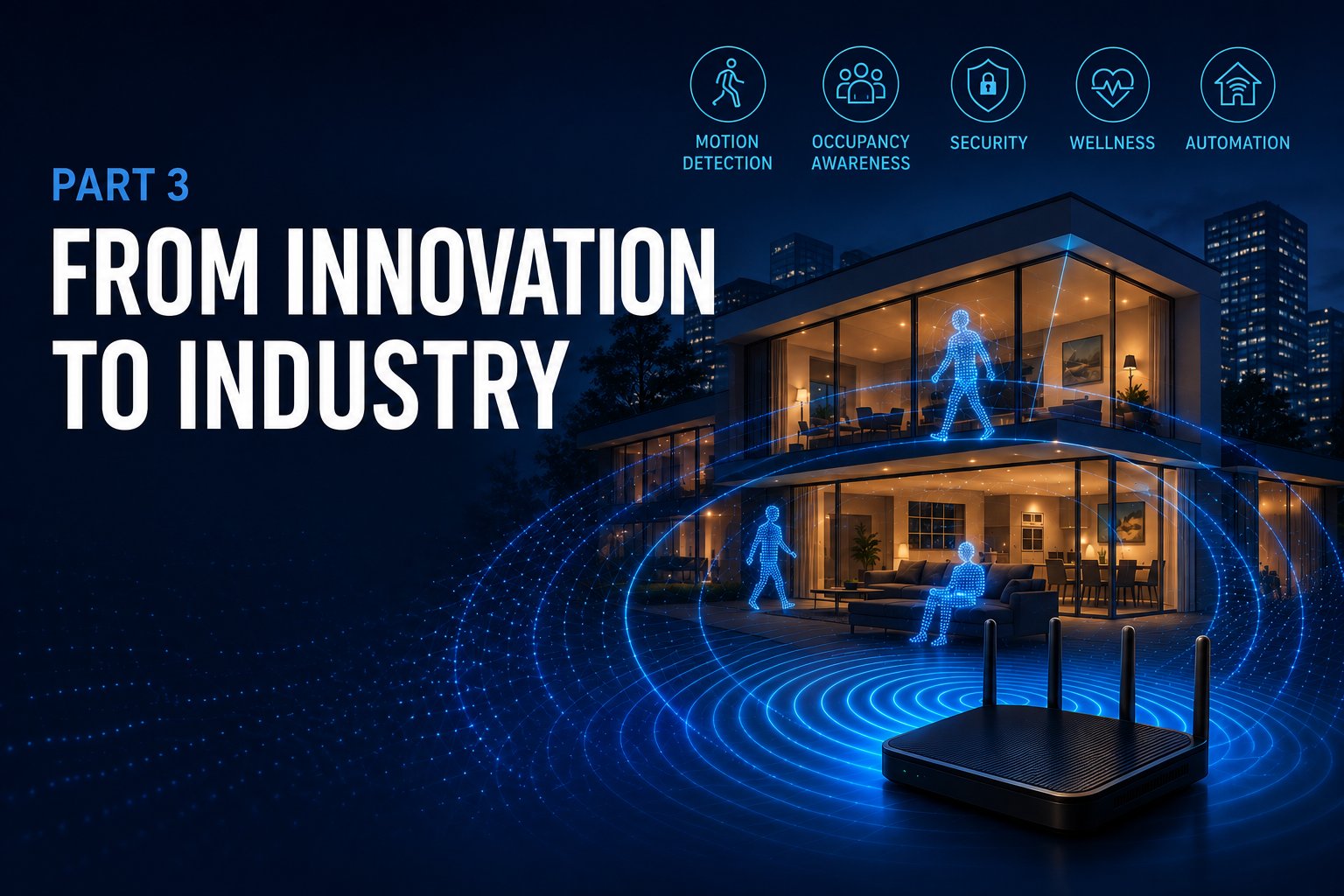
One of the strongest validations of this transition came in early 2026, when ADT acquired Origin AI. The acquisition signalled that one of the world’s largest residential security providers sees Wi-Fi sensing as a strategic technology for future smart-home services. Today, commercial deployments are primarily focused on practical applications including:
- Home motion detection
- Occupancy awareness
- Home security
- Basic wellness monitoring
- Smart-home automation
Many more advanced capabilities described in research—including respiration monitoring and aspects of sleep monitoring – remain active areas of research and product development.
Why Wi-Fi sensing needs a standard
Imagine a broadband operator deploying millions of Wi-Fi gateways. The gateway may come from one vendor while the mesh extenders come from another and the Wi-Fi chipset comes from a third. On top of all this, the sensing application comes from a specialist software company. This means that without common procedures, every deployment becomes a custom integration project. A standard provides a common technical framework that allows equipment from different vendors to support sensing using consistent procedures. This is precisely the role of IEEE 802.11bf.
What IEEE 802.11bf actually standardises
One of the most common misconceptions about IEEE 802.11bf is that it standardises Wi-Fi sensing itself. It does not. Instead, the standard defines the mechanisms that allow Wi-Fi devices to perform sensing measurements and exchange sensing-related information in a consistent manner. Among other things, IEEE 802.11bf introduces standardised procedures for:
- Initiating sensing operations between Wi-Fi devices
- Performing sensing-related channel measurements
- Exchanging sensing information
- Reporting sensing measurements
- Coordinating sensing sessions alongside normal Wi-Fi communications
Importantly, the standard does not define how those measurements should be interpreted and it does not specify algorithms for detecting motion, recognising people, classifying activities, or identifying specific applications. Those remain areas where vendors can innovate and differentiate. In many ways, IEEE 802.11bf plays the same role for sensing that earlier Wi-Fi standards played for wireless communications: It establishes a common framework while leaving room for competitive innovation above the protocol layer.
The next battleground: software and AI
As measurement procedures become standardised, competitive advantage increasingly shifts elsewhere. The challenge is no longer simply collecting radio measurements as it is understanding what those measurements mean. Instead machine learning models are becoming increasingly important for:
- Distinguishing people from pets
- Reducing false alarms
- Adapting to changing environments
- Recognising complex patterns of activity
In other words, the value increasingly lies in software – and this mirrors the evolution of many other technology markets, where standardised hardware becomes the platform for increasingly sophisticated AI.
New opportunities for service providers
For broadband operators, Wi-Fi sensing represents far more than another networking feature: It creates opportunities to offer new value-added services using infrastructure already installed in customers’ homes. Potential services include:
- Home security
- Occupancy-aware energy management
- Wellness monitoring
- Smart-home automation
- Family safety services
Instead of selling connectivity alone, operators can increasingly build recurring service revenues on top of their managed Wi-Fi platforms. For many service providers, this may ultimately become the strongest business case for Wi-Fi sensing.
Enterprise opportunities
Enterprise Wi-Fi networks present another compelling opportunity. Most offices, hospitals, schools, hotels, factories, and warehouses already have extensive Wi-Fi coverage. Adding sensing capabilities could enable applications such as:
- Occupancy analytics
- Meeting room utilisation
- Intelligent lighting and HVAC control
- After-hours security monitoring
- Warehouse activity monitoring
- Workplace safety
Because the wireless infrastructure is already in place, these capabilities may often be introduced with significantly less additional hardware than conventional sensing systems.
Challenges ahead
Although commercial momentum is building, several challenges remain. Interoperability between products from different vendors will need to mature as IEEE 802.11bf implementations reach the market. Meanwhile, algorithms must continue improving their ability to distinguish meaningful human activity from environmental effects such as pets, moving curtains, ventilation systems, and robotic vacuum cleaners.
Privacy is an important and sensitive issue and this will remain central to user acceptance. While Wi-Fi sensing does not capture images, users will rightly expect transparency regarding what information is collected, where it is processed, and how it is used. Finally, the industry will need certification programmes and objective performance benchmarks to help customers compare sensing capabilities across products.
WiFi NOW’s take: The pioneering work of companies such as Cognitive Systems and Origin AI has proven that the technology is on the cusp of delivering significant commercial value. ADT’s acquisition of Origin AI demonstrates that major players now see Wi-Fi sensing as a strategic capability rather than an experimental feature. At the same time, IEEE 802.11bf is providing the common framework needed to support a broader, multi-vendor ecosystem. As happened with Wi-Fi communications, standardisation is likely to accelerate innovation—not by defining the applications themselves, but by enabling companies to compete on software, artificial intelligence, and the services built on top of a shared technical foundation.