• wifinowglobal.com
  • syndicated.wifinowglobal.com
  • Wi-Fi NOW Global
  • Wi-Fi NOW Asia
  • Wi-Fi NOW Latin America

Wi-Fi NOW Global

  • Wi-Fi
  • Wi-Fi HALOW
  • ULTRA-WIDEBAND
  • RESOURCES
  • OUR PARTNERS
  • BECOME A PARTNER
  • BECOME A FREE MEMBER
  • WiFi NOW AUDIENCE INTELLIGENCE 2027
  • WiFi NOW WORLD CONGRESS 2027 PROSPECTUS
  • SERVICES
  • SHOP
  • EVENTS
    • CURRENT EVENTS
    • PREVIOUS EVENTS
    • EXPO
    • EventSpace®
  • RESOURCES
  • HALL OF FAME
  • ACADEMY
    • Masterclasses
    • Wi-Fi 7 PHY/MAC
    • 6 GHz operation including AFC
  • AWARDS
    • ABOUT AWARDS
    • CATEGORIES
    • WHY ENTER?
    • HOW TO ENTER
    • JUDGES
    • SELECTION CRITERIA
  • NEWS & TV
  • HALL OF FAME
  • ABOUT US
    • ABOUT Wi-Fi NOW
    • MANIFESTO
    • OUR RATINGS
    • OUR CREDENTIALS
    • MEET THE TEAM
    • CONTACT US
    • EventSpace®

Your Guide to Enterprise Wi-Fi Planning, Validation, & Deployment (State of Wi-Fi DVT Part Two)

August 3, 2026 | TECHNOLOGY GUIDES | by Claus Hetting, Wi-Fi NOW CEO & Chairman

What was once largely an exercise in achieving adequate signal coverage has become a sophisticated engineering discipline balancing RF propagation, user density, application requirements, client behaviour, interference, security, and complex spectrum environments. As organisations adopt Wi-Fi 7 and prepare for future generations, careful planning and systematic validation have become more important than ever.

Designing Wi-Fi Networks That Perform as Intended

Every successful enterprise Wi-Fi network begins long before the first access point is installed. Decisions made during planning determine whether a network will ultimately deliver reliable coverage, sufficient capacity, predictable roaming, and a consistent user experience – or whether it will require costly redesigns after deployment. Enterprise Wi-Fi design has evolved considerably over the past decade.

Members-only article

Create your free WiFi NOW account to continue reading.

  • Solutions & Use Cases
  • Technology Guides
  • Expert Insights
  • Member-only content

Already a member? Log in

What was once largely an exercise in achieving adequate signal coverage has become a sophisticated engineering discipline balancing RF propagation, user density, application requirements, client behaviour, interference, security, and complex spectrum environments. As organisations adopt Wi-Fi 7 and prepare for future generations, careful planning and systematic validation have become more important than ever.

From Coverage to Capacity

One of the biggest misconceptions about enterprise Wi-Fi is that strong signal strength alone determines network quality In reality, enterprise Wi-Fi must satisfy many simultaneous objectives:

  • Reliable coverage throughout the facility
  • Capacity for hundreds or thousands of users
  • Low latency for real-time applications
  • Seamless roaming
  • Minimal interference
  • Predictable application performance
  • Efficient spectrum utilisation

Meeting these objectives requires understanding how users actually use the network rather than simply where they are located.

Predictive Design: Building the Network Before It Exists

Most enterprise Wi-Fi projects now begin with predictive RF modelling. Using detailed floor plans and sophisticated propagation models, engineers estimate how radio signals will behave throughout a building before any equipment is installed. Predictive design allows engineers to optimise:

  • Access point placement
  • Channel allocation
  • Transmit power
  • Capacity
  • Roaming behaviour
  • Expected application performance

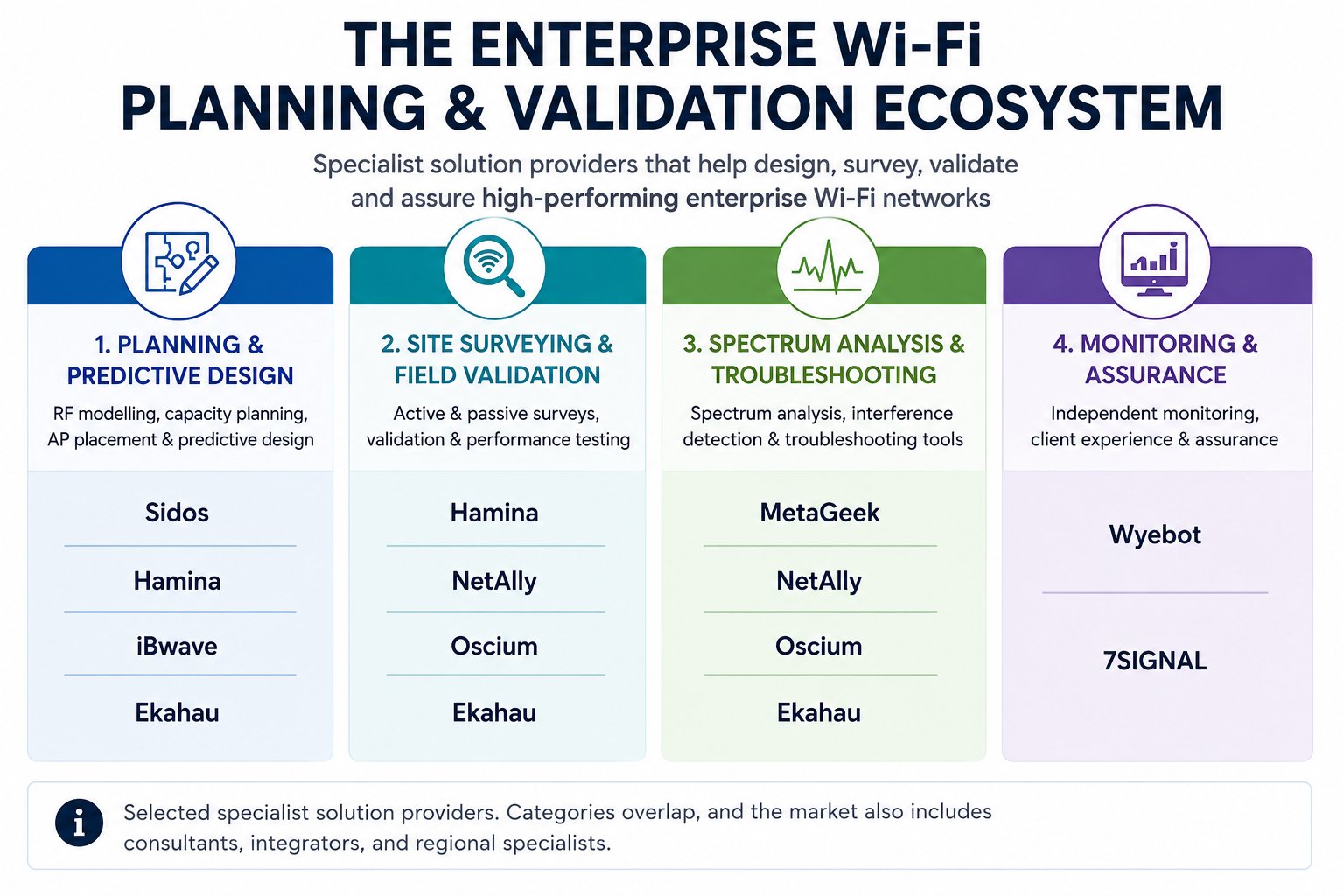
Solutions from companies such as Hamina, Sidos, and Ekahau have become essential tools for enterprise Wi-Fi design, enabling organisations to identify potential problems long before deployment begins. Yet predictive design remains a model rather than reality.

Why Validation Still Matters

Buildings rarely behave (in RF terms) exactly as expected. Construction materials differ from architectural drawings. Furniture changes. People absorb RF energy. New sources of interference appear unexpectedly. Adjacent networks evolve over time. For these reasons, every predictive design must be validated. Validation confirms whether the deployed network performs as originally intended. Typical validation activities include:

  • Passive site surveys
  • Active performance testing
  • Roaming verification
  • Voice and video testing
  • Interference analysis
  • Spectrum measurements
  • Capacity validation

The objective is not merely to identify faults but to confirm that the network satisfies its original design objectives.

Deployment Is Never the End

Installing access points is only one milestone. Wi-Fi usage can change a lot over time, so once traffic enters the network, engineers frequently discover opportunities for improvement. Common optimisation activities include:

  • Channel tuning
  • Power adjustments
  • Load balancing
  • Client steering
  • Capacity optimisation
  • Coverage improvements

Enterprise Wi-Fi therefore becomes a continuous optimisation process rather than a completed installation.

The Growing Role of Artificial Intelligence
CLICK ON THE IMAGE TO ENLARGE

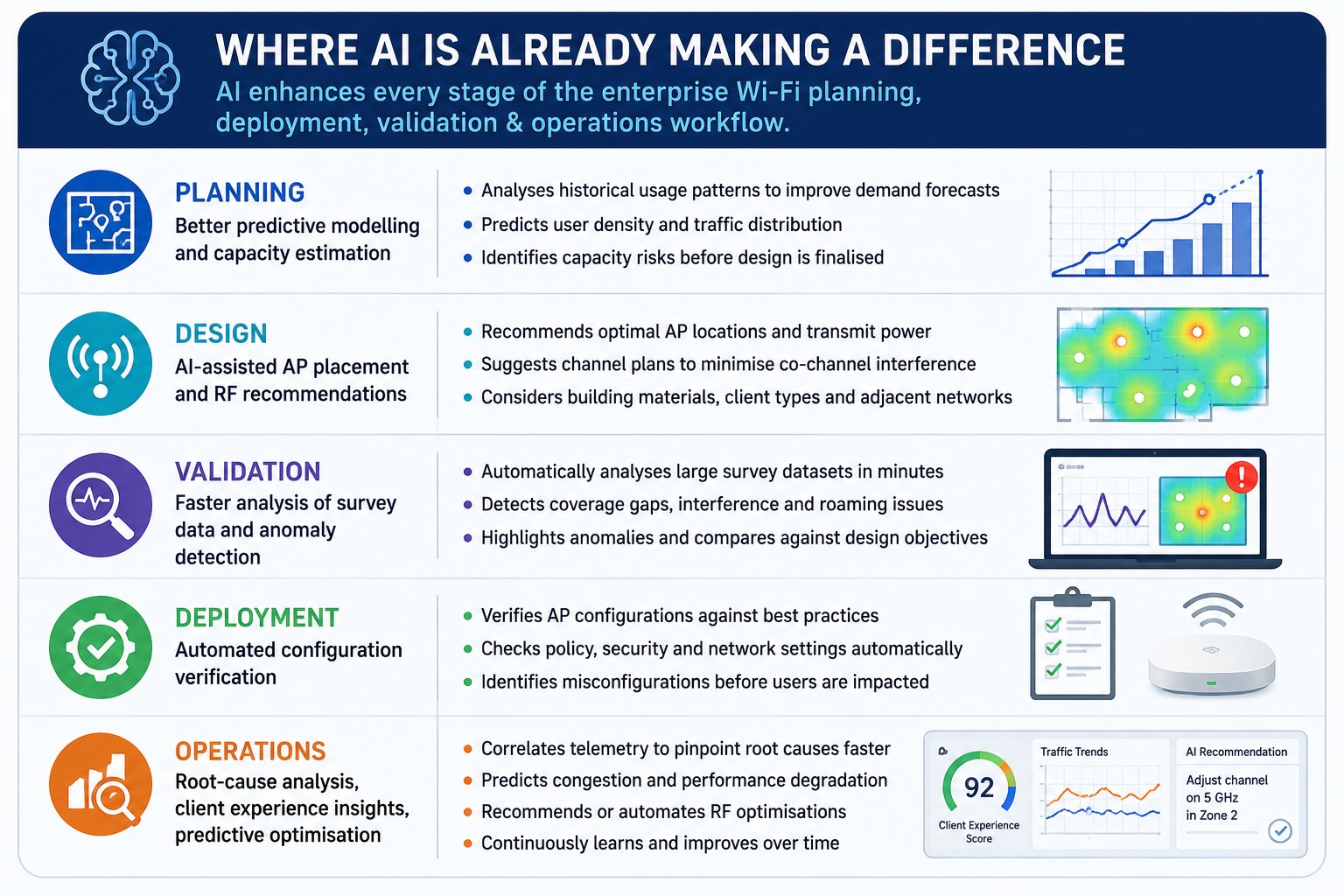
Artificial intelligence is beginning to influence nearly every stage of enterprise Wi-Fi planning and operations. Today’s AI capabilities are primarily focused on helping engineers analyse large amounts of operational data, identify anomalies, recommend configuration changes, and automate repetitive optimisation tasks. Several enterprise networking platforms now incorporate AI-assisted features that can:

  • Identify likely root causes of client problems
  • Detect abnormal roaming behaviour
  • Recommend RF configuration changes
  • Predict congestion before users experience poor performance
  • Assist with capacity planning using historical traffic patterns
  • Prioritise issues based on user impact

These capabilities allow engineers to investigate problems more quickly and manage larger deployments with fewer manual interventions.

However, AI should not be viewed as a replacement for RF engineering. Successful enterprise Wi-Fi design still depends on accurate floor plans, a sound understanding of radio propagation, appropriate hardware selection, and thorough field validation. AI recommendations are only as reliable as the operational data and design assumptions on which they are based. In the near term, AI is likely to become an increasingly capable engineering assistant rather than an autonomous network designer.

The Enterprise Wi-Fi Ecosystem

Delivering a successful enterprise Wi-Fi network requires collaboration across a broad ecosystem. Planning and design software providers develop predictive modelling and survey tools, while enterprise networking vendors supply access points, controllers, and cloud management platforms. Test equipment manufacturers provide spectrum analysis, validation, and troubleshooting solutions. Finally, systems integrators and consultants translate designs into operational networks, while enterprise IT teams monitor, optimise, and maintain long-term performance. Each contributes specialised expertise to the overall design, validation, and deployment process.

Disclaimer: This chapter provides a high-level overview of enterprise Wi-Fi planning, deployment, validation, and optimisation. The companies referenced are representative examples of specialist solution providers and are included for illustrative purposes only. The market also includes many additional vendors, consultants, systems integrators, and regional specialists. Inclusion or omission should not be interpreted as an endorsement or ranking.

  • Wi-Fi DVT

Search

Topics covered in this article

  • Wi-Fi DVT
Resource Centre

Your hub for the latest Wi-Fi industry insights and resources

Research reports, in-depth technology guides and expert insights on Wi-Fi — new resources every week, free for members.

  • Solutions & Use Cases
  • Technology Guides
  • Expert Insights
Explore the Resource Centre →
  • Expert InsightsThe predistortion pioneer who says Wi-Fi has outgrown DPD: QuantalRF’s Dr Ali Fard speaks out on Wi-Fi 8 and AI at the edgeOctober 18, 2026
  • Expert InsightsInventor of AI Ops for enterprise Bob Friday explains why agentic AI will finally make self-driving enterprise networks a realityOctober 18, 2026
  • Expert InsightsFrom Hype to Hard Numbers: AI Arrives at the ISP Support DeskOctober 17, 2026

Subscribe to Wi-Fi NOW

Stay updated on Wi-Fi News & Information

  • This field is for validation purposes and should be left unchanged.

Upcoming events

WiFi NOW World Congress USA 2027

April 19, 2027

Register now
All events

Latest white papers All white papers

New Aprecomm white paper: Understanding the business-critical shift from QoS ...

New paper: Enea publishes the definitive technical guide to Wi-Fi Offloading

New MediaTek Filogic paper on Wi-Fi 8 (802.11bn) highlights Ultra High Availa...

Upcoming Masterclasses

On-demand: Inside Wi-Fi 6E & Wi-Fi 7

MASTERCLASS: A JOURNEY INSIDE Wi-Fi 6E

Register now
All masterclasses

Wi-Fi NOW Services

Job platform

Stay updated on the latest jobs in the Wi-Fi industry.

Go to jobs

Wi-Fi Academy

Interested in the latest technologies in Wi-Fi?

Go to academy

Syndicated

The latest press releases from all Wi-Fi companies.

Visit syndicated
This website uses cookies to improve your experience. Read more in our privacy statement. Accept
Privacy & Cookies Policy

Privacy Overview

This website uses cookies to improve your experience while you navigate through the website. Out of these, the cookies that are categorized as necessary are stored on your browser as they are essential for the working of basic functionalities of the website. We also use third-party cookies that help us analyze and understand how you use this website. These cookies will be stored in your browser only with your consent. You also have the option to opt-out of these cookies. But opting out of some of these cookies may affect your browsing experience.
Necessary
Always Enabled
Necessary cookies are absolutely essential for the website to function properly. This category only includes cookies that ensures basic functionalities and security features of the website. These cookies do not store any personal information.
Non-necessary
Any cookies that may not be particularly necessary for the website to function and is used specifically to collect user personal data via analytics, ads, other embedded contents are termed as non-necessary cookies. It is mandatory to procure user consent prior to running these cookies on your website.
SAVE & ACCEPT
Wi-Fi NOW

Join WiFi NOW for free

Create your free account to access unique insights and industry resources.

  • Unlock articles
  • Access reports & resources
  • Download presentations
  • Watch webinars
  • Stay updated on the latest
  • This field is for validation purposes and should be left unchanged.

Already have an account? Log in

Log in

Don’t know your password? Click here to login with an e-mail link instead.

Forgot your password?
Don’t know your password?

Enter your e-mail below and we'll send you a login link.

No account yet? Join for free

Wi-Fi NOW (Hetting Global ApS), Denmark company registry no. 40955437
Hedeskovvej 9
DK-8520 Lystrup, Denmark.
Contact: Tlf: +45 25341705 / Claus Hetting

For questions or comments, please contact Chief Administrator [email protected]

Visa logo MasterCard logo JCB logo American Express logo

Terms of Purchase - Privacy Statement - Terms of Service