By Claus Hetting, WiFi NOW CEO & Chairman
Wi-Fi 8 should not be understood as another headline-grabbing speed upgrade, Cisco Wireless CTO Matt MacPherson says. Instead, the next generation of Wi-Fi is being designed around a less glamorous but increasingly important goal: Making wireless networks behave more predictably under pressure, especially as AI-driven devices and agents, mobile endpoints, and densely managed environments place new demands on connectivity.
How should the enterprise networking industry view the new Wi-Fi 8 standard? Cisco Wireless CTO Matt MacPherson – who has participated in and contributed to much of the standardisation work for both Wi-Fi 8 and previous generations – says Wi-Fi 8 is a shift away from the traditional speeds and feeds narrative.

“We’re moving into a domain where networks have to become more predictable,” he says, pointing out that emerging applications – including AI – increasingly require consistently low latency and reduced performance variability. Reflecting the direction of IEEE standardisation, Wi-Fi 8 builds on Wi-Fi 7’s Extremely High Throughput and makes Ultra High Reliability its central objective, with more consistent performance as devices move and traffic conditions change. Cisco has actively contributed to standardisation work on seamless mobility, coordinated AP operation, and flexible spectrum use, Matt MacPherson says.
Same channels, same highest-order modulation – more predictable performance
Importantly, Wi-Fi 8 does not raise the marketing-friendly speed specifications that consumers (and enterprises) have been trained to look for and value. It keeps Wi-Fi 7’s maximum 320 MHz channel width and 4096-QAM as its highest-order modulation scheme. “The Wi-Fi 8 standard builds on that foundation and adds coordination, mobility, reliability and improved latency consistency. The aim is to deliver more dependable connections as devices move, networks become more congested, and traffic patterns become more demanding,” Matt MacPherson says.
Access points that cooperate instead of competing
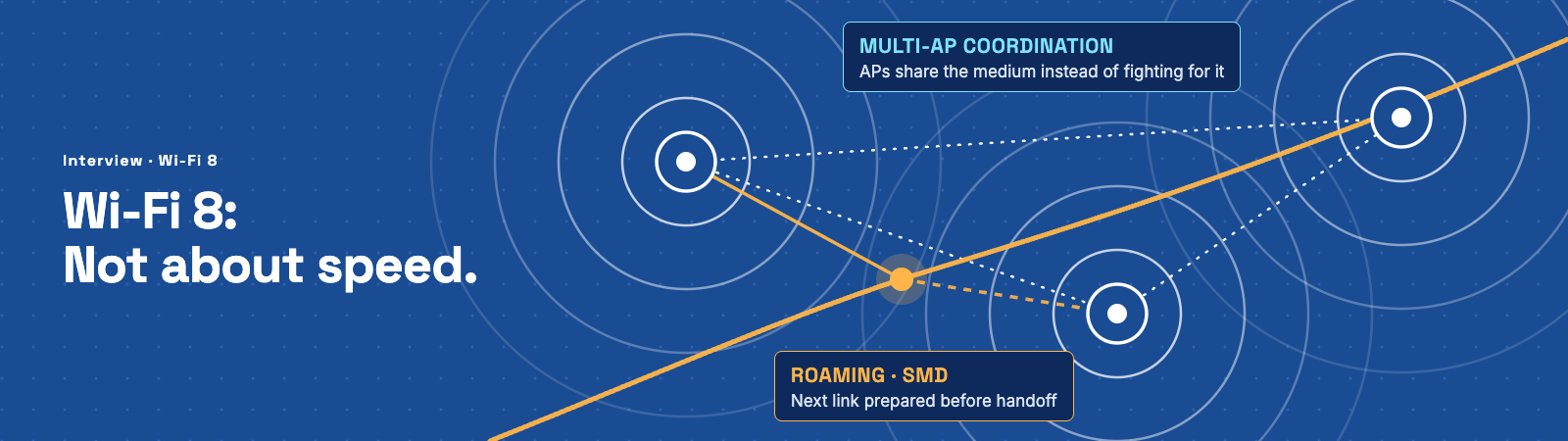
Matt MacPherson highlights two marquee Wi-Fi 8 features: The first is Multi-AP Coordination (MAPC), which introduces standardised mechanisms for neighbouring access points to coordinate access to the shared wireless medium. Today, neighbouring APs largely contend independently for access to the same medium, even when they belong to the same managed network.
“Depending on which mechanisms are implemented, MAPC can reduce avoidable contention and interference between neighbouring APs in dense deployments, improving spectrum efficiency and performance consistency under load,” he says.
The second is Seamless Mobility Domain (SMD), which improves roaming performance. Matt MacPherson describes SMD as a logical mobility framework that allows target links to be prepared and mobility-related association and security context to be coordinated before a station transitions between APs.
“The serving and target APs can exchange context over the network and prepare one or more target links ahead of the transition, potentially reducing interruption and packet loss. The key innovation is a common logical mobility domain spanning multiple AP Multi-Link Devices, supported by an SMD Management Entity (SMD-ME), without requiring a dedicated physical AP-to-AP link,” Matt MacPherson says.
Roaming with fewer interruptions
The SMD feature is designed to make roaming between APs more reliable – and that is particularly important when applied to multi-link operation, he says. “Wi-Fi 7 introduced MLO, enabling a station to establish multiple links, for example on 5 GHz and 6 GHz, with an AP Multi-Link Device. But handing off a multi-link connection between APs is more complex than moving a single connection. SMD is designed to preserve the benefits of multi-link connectivity even when users or machines are moving through buildings, campuses, or industrial sites,” he says.
Built for networks with multiple APs
The obvious beneficiaries of both MAPC and SMD are large, managed Wi‑Fi environments. When asked whether Wi‑Fi 8 mainly favours enterprise deployments, Matt MacPherson says he prefers a broader term: “I would say Wi-Fi 8 is highly multi-AP friendly. In a single-AP home network, Wi‑Fi 8’s multi-AP advantages of course matter less. But in enterprises with hundreds or thousands of APs under management, the potential benefits are substantial because Wi-Fi 8 adds standards-based coordination of channel access and mobility to existing controller-based optimisation and roaming already used in enterprise networks,” he says. He also points to residential Wi-Fi networks deployed by service providers in multi-dwelling units as environments that could see similarly significant gains.
But of course, Wi-Fi 8 is not only about multiple APs, Matt MacPherson says.”Proposed enhancements such as Enhanced Long Range (ELR), Distributed Resource Units (DRU), and Non-Primary Channel Access (NPCA) also aim to improve link robustness and spectrum access in single-AP environments,” he says.
Agentic AI is reshaping wireless traffic
Matt MacPherson believes Wi-Fi 8 is arriving at precisely the right time, as agentic AI begins to transform traffic patterns and the demands placed on wireless networks. “Cisco research has found that 50% of surveyed organisations identify campus Wi-Fi as an area experiencing some of the greatest increases in AI-driven performance and capacity needs. That is not surprising given how many endpoints depend on wireless connectivity. Laptops, glasses, robots, and edge devices increasingly run local or distributed AI functions, often while pulling data from other nearby systems and from Cloud services,” he says.
The result is a change in traffic patterns. Alongside established downlink-heavy applications such as video, agentic AI can increase east-west exchanges among devices and campus servers, as well as north-south traffic to Cloud services. “AI agents are creating new east-west and north-south traffic patterns that do not involve humans, and these exchanges often happen at machine speed,” he says.
And that has significant consequences for wireless network design. Networks built for interaction at human speeds are increasingly being asked to support much faster machine-to-machine communications among moving devices. Matt MacPherson mentions robotics as an example. “Operating and coordinating robots can generate substantial sensor, control, and inference traffic, but tethering them with cables defeats the purpose of robots in the first place. In the robotic world, wireless mobility is not merely a convenience feature – it becomes foundational infrastructure,” Matt MacPherson says.
The certification and optionality challenge
Matt MacPherson also highlighted a standards and certification challenge: Many advanced IEEE 802.11 capabilities are optional or conditionally mandatory, and Wi-Fi Alliance certification does not require every capability to be implemented as defined by IEEE. Wi-Fi 8 certification requirements are still being developed, so products of the same Wi-Fi generation may implement different advanced features.
He and other industry leaders are advocating that one or more enterprise or carrier-class certification profiles be created by the Wi-Fi Alliance. These profiles would establish a more meaningful interoperability baseline for enterprise and service-provider deployments.
This does not mean making all optional Wi-Fi 7 and Wi-Fi 8 features mandatory. Rather, the objective is to ensure that the capabilities most relevant to large, managed Wi-Fi environments are supported by both the network infrastructure and the devices connecting to it. “I think many within the ecosystem in principle agree with such an approach. The challenge is not so much selling the idea, but agreeing on what features and capabilities belong to these advanced profiles,” Matt MacPherson says.
/Claus.