By Claus Hetting, WiFi NOW CEO & Chairman
Enterprise Wi-Fi 7 has reached an inflection point: According to new IDC data, Wi-Fi 7 accounted for 53% of enterprise access point revenue during the second quarter of 2026, making it the single largest revenue category in the enterprise WLAN market. IDC says the broader enterprise WLAN market grew 23.2% year-on-year to $3.2 billion, with the transition to Wi-Fi 7 now moving beyond early adoption and into a full replacement cycle.
The enterprise Wi-Fi 7 upgrade cycle is accelerating rapidly. According to new figures released this week by IDC, the latest Wi-Fi generation has now become the largest revenue category in the worldwide enterprise WLAN market.
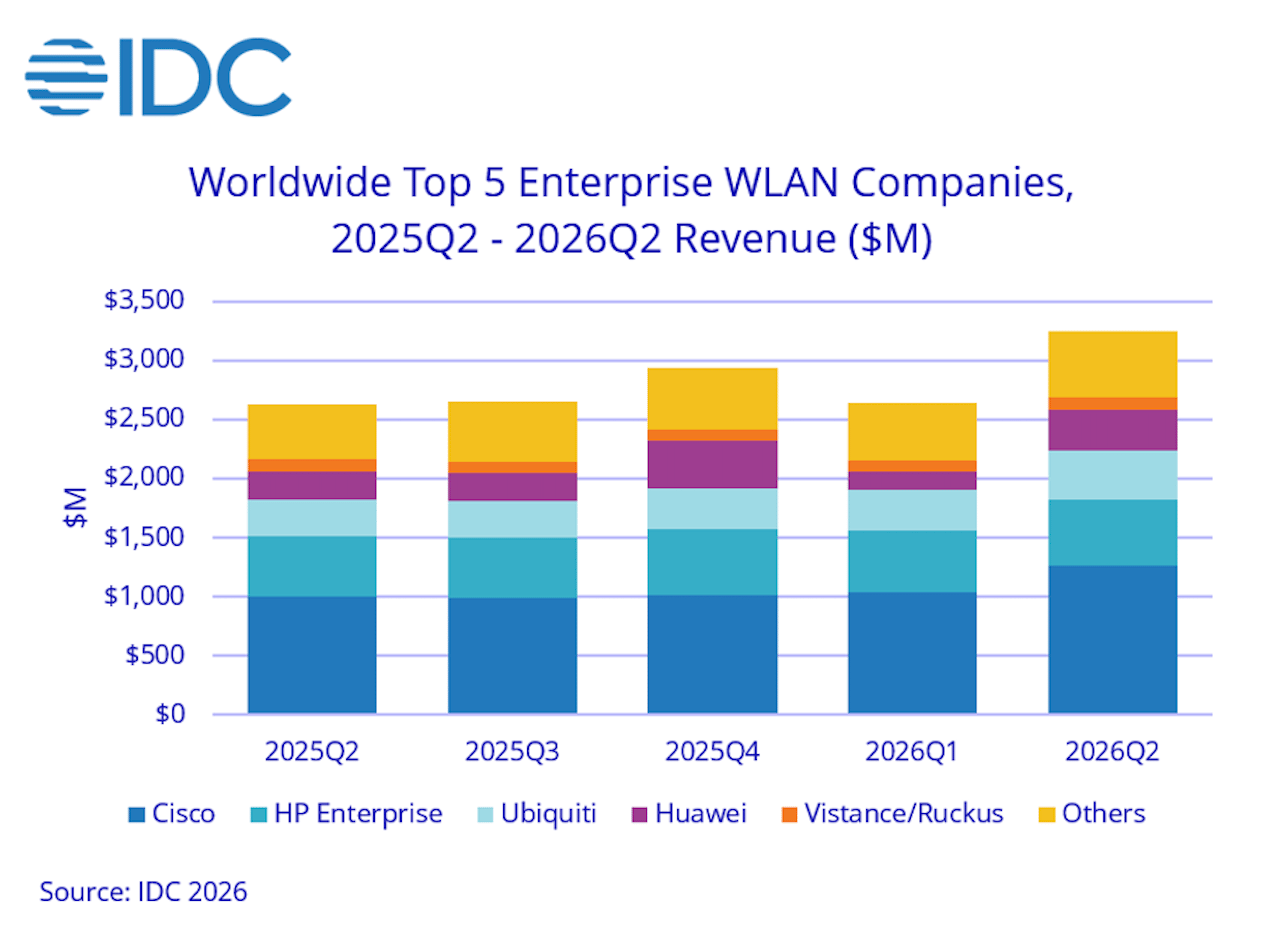
IDC says worldwide WLAN revenue reached $3.2 billion during the second quarter of 2026, representing growth of 23.2% year-on-year and a notable acceleration from the roughly 16% growth recorded during the first quarter. Revenue from enterprise dependent access points — the segment covering centrally managed enterprise APs — grew even faster, rising 27.6% year-on-year to $2.7 billion.
The biggest change – however – is the speed at which Wi-Fi 7 is replacing earlier generations. IDC says Wi-Fi 7 dependent AP revenue reached $1.4 billion during the quarter, equivalent to 53% of total enterprise dependent AP revenue, while growing 219.5% compared with the same quarter last year. IDC now describes Wi-Fi 7 as the enterprise WLAN market’s new dominant standard and says the market has moved beyond the early-adoption phase into a broader replacement cycle.
The shift has happened quickly. During the first quarter of this year, Wi-Fi 7 represented 44.5% of dependent AP revenue, up from just 11.8% one year earlier. By the second quarter, it had crossed the 50% mark, while Wi-Fi 6 fell to 29.4% of revenue and Wi-Fi 6E to 16.9%. IDC says Wi-Fi 6 and 6E remain relevant for phased rollouts and cost-sensitive deployments, but that most new enterprise projects are now moving toward Wi-Fi 7.
IDC attributes the acceleration to several factors coming together at once: A broader enterprise network refresh cycle, a rapidly maturing Wi-Fi 7 product ecosystem, falling price premiums relative to Wi-Fi 6, and growing demand for higher-capacity infrastructure capable of supporting AI-driven applications, high-density environments and increasingly automated network operations. IDC also points to Wi-Fi 7 capabilities such as Multi-Link Operation, 320 MHz channels and improved performance in congested environments as increasingly relevant to enterprise buyers.
The growth is geographically broad-based. EMEA was the fastest-growing region during the quarter, with enterprise WLAN revenue increasing 32.2% year-on-year to approximately $1 billion, while the Americas remained the largest market at roughly $1.5 billion, growing 21.6%. Asia-Pacific and Japan increased 15.2% to $708 million.
Perhaps the most important takeaway is that Wi-Fi 7 can no longer reasonably be described as ‘an emerging enterprise technology’. The transition is now well underway, and for most new enterprise WLAN projects the question is increasingly not whether to deploy Wi-Fi 7, but how quickly existing Wi-Fi 6 and Wi-Fi 6E infrastructure should be replaced.
IDC itself makes essentially the same point, saying that for most new deployments and refresh projects started today, Wi-Fi 7 has become the recommended baseline as the ecosystem has matured and the price premium has narrowed.
For vendors, the numbers also suggest that the next stage of the Wi-Fi 7 market will be less about convincing enterprises that the technology is ready and more about competing on AI operations, security, automation, management architecture and total cost of ownership. Once the radio generation becomes the default, differentiation inevitably moves higher up the stack. Read more here.
/Claus.