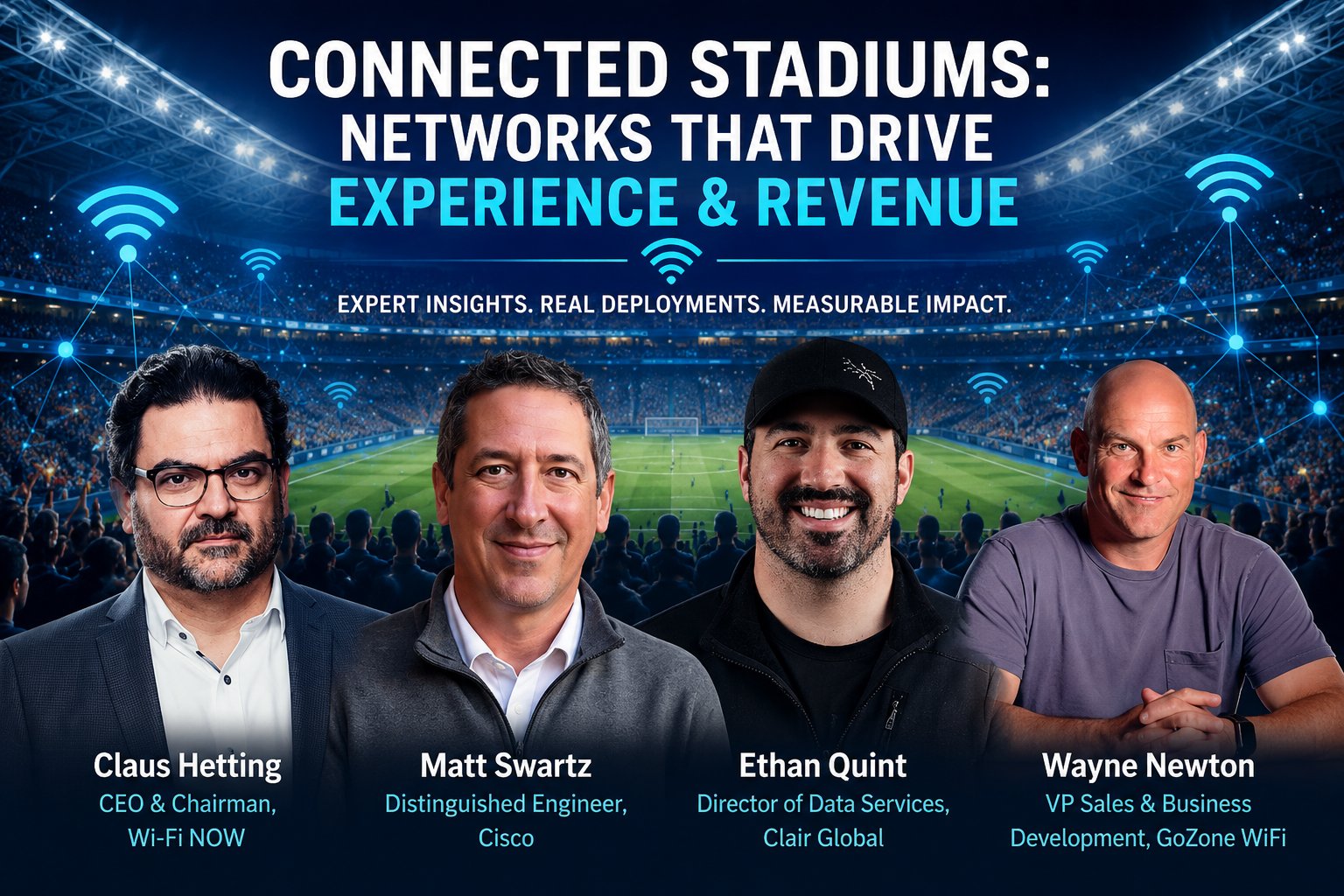

Modern stadiums have evolved into some of the world’s most demanding wireless environments. Supporting tens of thousands of simultaneous users while enabling broadcasting, ticketing, payments, security, operations, and immersive fan experiences requires a new generation of high-density Wi-Fi networks.
During this Wi-Fi NOW Industry Update webinar, experts from Cisco, Clair Data Services, and GoZone WiFi discussed how advances in Wi-Fi 7, 6 GHz spectrum, temporary event networking, and digital engagement platforms are changing the economics and capabilities of connected venues.
The discussion highlighted one key message: High-performance Wi-Fi is no longer an optional amenity—it has become critical infrastructure.
Why Stadium Wi-Fi Is Different
According to Cisco Distinguished Engineer Matt Swartz, stadium Wi-Fi has always been one of the industry’s toughest engineering challenges. Unlike office or campus environments, stadiums must support:
- Tens of thousands of simultaneous users
- Extreme client density
- Massive uplink demand
- Rapidly changing traffic patterns
- Multiple mission-critical operational services
Early stadium deployments relied heavily on under-seat access points, but years of experience have shown that hybrid deployments combining overhead and under-seat coverage deliver superior performance.Cisco has also spent years refining specialized high-density access points with:
- Hyper-directional antennas
- Software-controlled beam steering
- Integrated antenna systems
- Front/back coverage modes
- Improved side-lobe suppression
These innovations significantly reduce interference while improving capacity and client performance.
The Uplink Has Become the New Bottleneck
One of the webinar’s most important insights was how dramatically user behaviour has changed. Historically, stadium networks were designed primarily around download traffic. Today, fans are content creators. During concerts and sporting events, thousands of attendees simultaneously:
- Stream live video
- Upload photos
- Post to social mediaShare high-resolution content in real time
Matt Swartz shared examples showing that network traffic often shifts from download-heavy before an event to overwhelmingly upload-heavy once the performance begins. This trend places far greater importance on Wi-Fi performance than many realise, particularly because Wi-Fi frequently delivers substantially stronger uplink performance than cellular networks in dense environments.
6 GHz Is Changing High-Density Networking
The panel agreed that 6 GHz spectrum has become one of the biggest breakthroughs for stadium Wi-Fi. At Cisco’s BottleRock Music Festival deployment, nearly 50% of connected devices used the 6 GHz band, representing an enormous increase over the previous year. Benefits include:
- Dramatically increased capacity
- Reduced interference
- Wider channel availability
- Improved user experience
- Support for growing Wi-Fi 7 deployments
OpenRoaming also contributed to rapid adoption by automatically onboarding users onto the network. The message was clear: Device adoption of 6 GHz is accelerating much faster than many expected.
Temporary Networks Built Like Permanent Infrastructure
While many stadiums have permanent Wi-Fi infrastructure, global sporting events often require extensive temporary networking. Ethan Quint, Director of Data Services at Clair Data Services, explained how his team builds enterprise-grade temporary networks for major festivals and international sporting events. For BottleRock alone, Clair deploys approximately:
- 500 access points
- 75 network switches
- 40,000 feet of fibre
- Complete operational networking
- Attendee Wi-Fi
- CCTV
- Ticket scanning
- Point-of-sale systems
- Backstage operations
Remarkably, this infrastructure is installed in approximately three weeks using a team of only twelve engineers before being dismantled within days after the event. The company’s success depends on:
- Predictive RF modelling
- Extensive automation
- Repeatable deployment processes
- Custom mounting systems
- Rigorous staging and testing before arriving onsite
Automation Is Essential
Large-scale temporary deployments simply could not operate without automation. Clair uses automated workflows for:
- AP configuration
- Switch provisioning
- RF planning
- Channel allocation
- Power settings
- Monitoring
- Alerting
- Reporting
By automating repetitive tasks, engineers can focus on solving real-world deployment challenges rather than manual configuration. Automation also allows teams to maintain consistent quality across hundreds of deployments every year.
Stadium Wi-Fi Has Become a Revenue Platform
The discussion moved beyond connectivity into monetisation. Wayne Newton, CEO of GoZone WiFi, explained that modern venue Wi-Fi has become an integral part of fan engagement and commercial strategy. Once guests connect to Wi-Fi, venues can deliver highly targeted content including:
- Concession offers
- Merchandise promotions
- Premium seating upgrades
- VIP experiences
- Future ticket sales
- Loyalty programme enrolment
- Sponsor activation
- Digital advertising
Rather than simply providing internet access, Wi-Fi becomes a customer engagement platform that generates measurable business value.
Sponsors Benefit from Connected Experiences
Many stadiums depend heavily on sponsorship revenue. Wi-Fi marketing provides another valuable activation channel. Instead of relying solely on digital signage or physical advertising, sponsors can engage fans directly through:
- Captive portals
- SMS campaigns
- Targeted promotions
- Event-specific messaging
These campaigns increase sponsor visibility while helping venues demonstrate measurable return on sponsorship investment.
Data Drives Better Decisions
Beyond connectivity, Wi-Fi networks generate valuable operational insights. Without collecting personally identifiable information, venue operators can analyse:
- Visitor movement
- Dwell time
- Crowd density
- Traffic flow
- Popular areasOperational bottlenecks
These insights support decisions about:
- Staffing
- Concession placement
- Crowd management
- Advertising locations
- Premium seating strategy
As Wayne Newton noted, the challenge is no longer collecting data—it is turning that data into actionable intelligence.
AI Is Already Improving Operations
Although the speakers joked about AI becoming an overused buzzword, all agreed it is now delivering practical value. Current applications include:
- RF planning
- Automated radio resource management
- Deployment modelling
- Predictive analytics
- Operational reporting
- Customer support
- Data analysis
Rather than replacing engineering expertise, AI is helping experienced professionals interpret increasingly complex datasets and make better decisions faster. The consensus was clear: AI delivers its greatest value when combined with domain expertise.
Is Stadium Wi-Fi Worth the Investment?
One audience member asked about return on investment. The panel’s response was straightforward. Wi-Fi is no longer viewed as a discretionary technology. Today’s venues rely on wireless connectivity for:
- Ticketing
- Payments
- Security
- Broadcast operations
- Staff communications
- Fan services
- Digital engagement
Once that infrastructure is in place, additional revenue opportunities—from concessions to sponsorship activation—help maximise the return on investment. As one panellist summarised: Wi-Fi has become as fundamental to modern venues as electricity or water.
Key Takeaways
- High-density Wi-Fi has become essential infrastructure for modern stadiums and large venues.
- Upload traffic is growing rapidly as fans increasingly create and share content in real time.
- Wi-Fi 7 and 6 GHz spectrum are dramatically improving capacity and performance.
- Temporary event networks now deliver enterprise-grade reliability through automation and repeatable deployment methods.
- Connected Wi-Fi platforms generate measurable business value through marketing, sponsorship activation, ticket sales, and premium experiences.
- AI is accelerating network planning, optimisation, and operational intelligence while complementing—not replacing—engineering expertise.
- The future of connected venues lies in integrating networking, analytics, automation, and fan engagement into a single digital platform.
/Claus.