
By Claus Hetting, WiFi NOW CEO & Chairman
China is famously the only large nation to fully reject Wi-Fi operations in the 6 GHz band – but could this now be changing? Since regulatory consultations are not public in China, we don’t know if China is seriously rethinking its 6 GHz spectrum strategy. But strong statements in a recent op ed published in a major and official Chinese tech publication seem to indicate that speaking out in favour of 6 GHz Wi-Fi is now acceptable.
Could China be changing its mind on 6 GHz Wi-Fi? A recent article in leading Chinese online telecoms journal cww.net.cn (find it here) suggest that perhaps the idea is no longer off the table. The journal is (according to Grok) supervised by Ministry of Industry and Information Technology (MIIT) of China and operated by Beijing Xintong Media Co., Ltd., a subsidiary of People’s Posts and Telecommunications Publishing House. The commentary was first discovered by analyst Dean Bubley.
“The article in CWW points to India as a recent example of a major economy opting for Wi-Fi in the lower 6 GHz band. It notes growing congestion for China’s existing Wi-Fi and the fact that fixed broadband traffic if now growing faster than mobile. It notes risks of China falling behind in Wi-Fi & openly advocates for a change in direction,” says Dean Bubley in LinkedIn post here.
The op ed notes that opening the lower 6 GHz band to Wi-Fi would “greatly improve China’s fixed broadband network speeds and satisfy the users’ good experience” while promoting “the competitiveness of China’s Wi-Fi industry ecosystem and international influence.” The article also contends that that China’s domestic Wi-Fi industry lags behind that of the rest of the world (see more below).
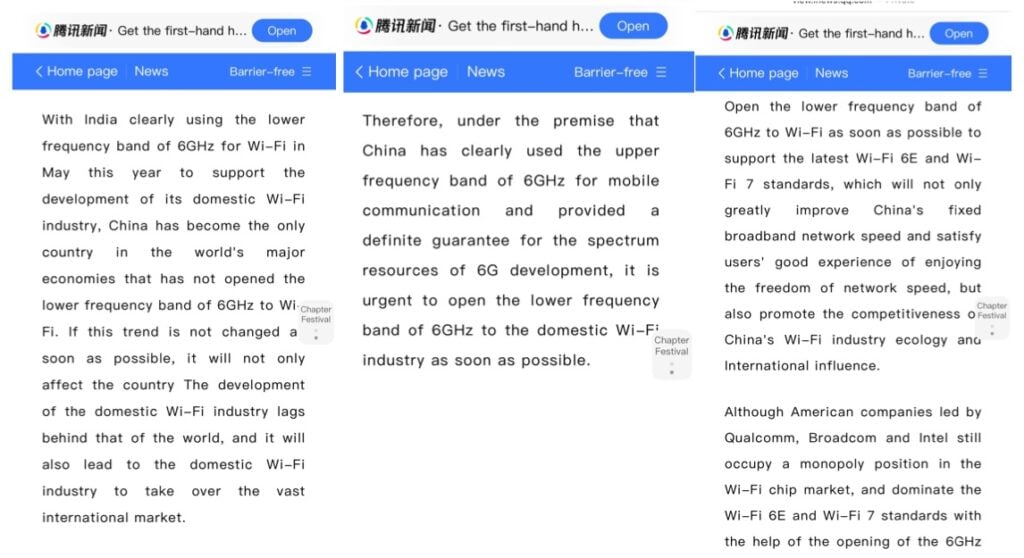
One thing is certain: If China originally had the intention of delivering gigabit wireless data to home broadband subscribers via 5G (or some other non-Wi-Fi technology) it thus far has little to show for it. In fact, Chinese businesses and consumers must be increasingly aware that Chinese Wi-Fi is substantially slower and less capable than its equivalent in the West. For how long will China accept to suffer the consequences of – for example – lowered productivity?
The short answer is that we don’t know. But perhaps China’s stance is softening. The good news is – of course – that the 6 GHz Wi-Fi ecosystem is fully evolved and that Chinese consumers and businesses would benefit nearly immediately from 6 GHz Wi-Fi if the government releases the band.
/Claus.