By Claus Hetting, WiFi NOW CEO & Chairman
Thus far, private 5G and Wi-Fi have largely been deployed and operated as separate enterprise access networks. Celona now wants to change that. Its new Orion platform brings Wi-Fi and private 5G into a common service fabric while extending the model to public cellular and satellite connectivity. The converged networking platform – the first of its kind that we know of – is managed by ‘Orchestrator AI’ for agentic operations, Celona says.
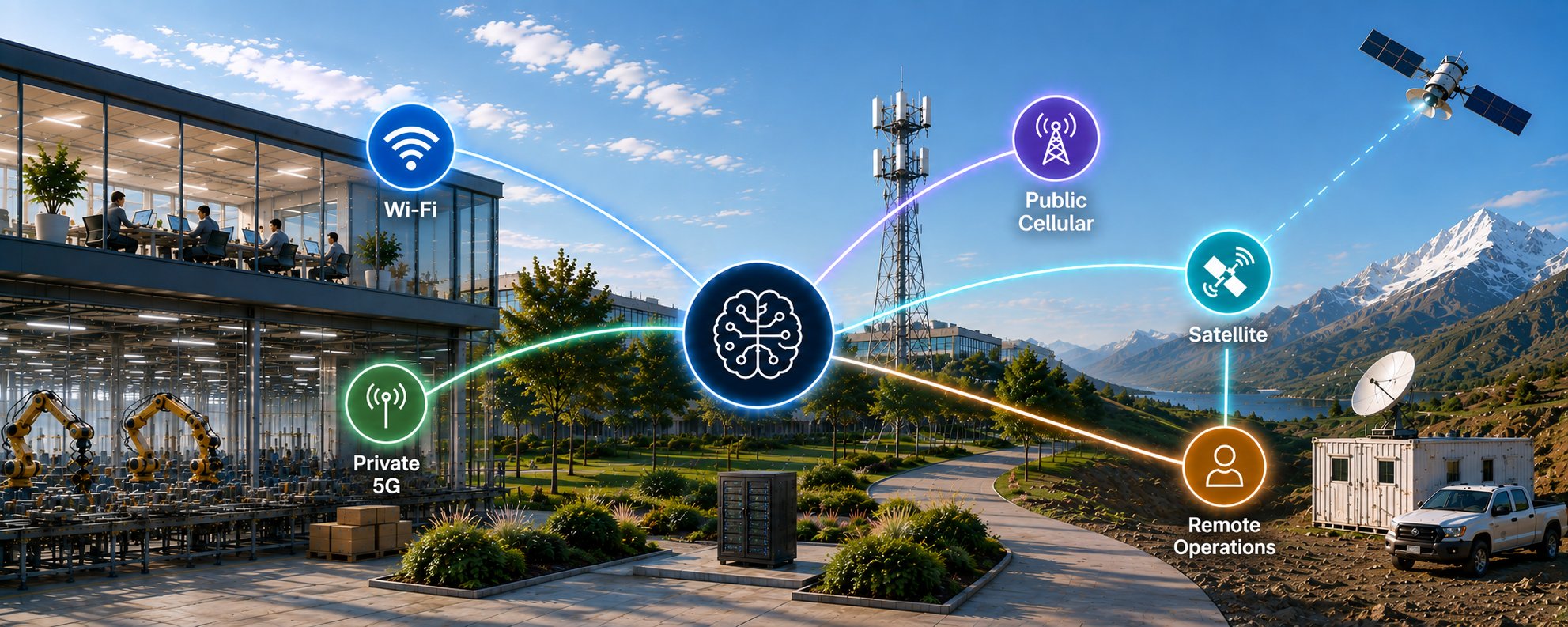
Is the world of enterprise networking entering a new era of technological convergence driven by AI? If you ask private wireless solution provider Celona the answer is a resounding yes. This week Celona launched Orion, an ambitious, AI-orchestrated platform that combines an array of wireless networking solutions into a single fabric. For the first time – that we know of – private 5G, Wi-Fi, public cellular, and even satellite are being combined into a single convergent solution.
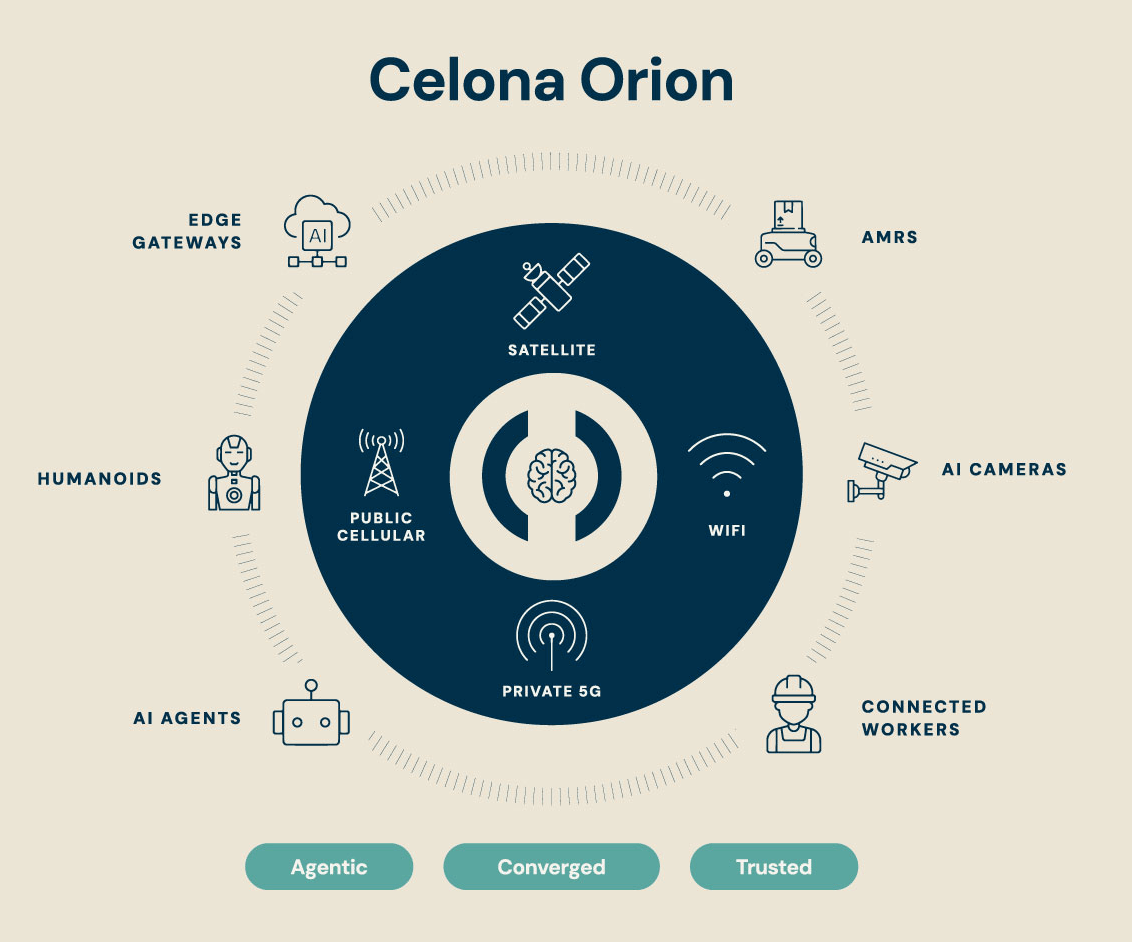 The new solution – Celona says – combines the benefits of multiple enterprise connectivity technologies: Inside campuses, private 5G provides reach and deterministic performance while Wi-Fi delivers high capacity for bandwidth-intensive applications. Meanwhile, public cellular and satellite connectivity enable guest access, remote operations, and more. Celona says that Celona Wi-Fi 7 access points can now be included under a single subscription model at no additional cost. Celona currently serves 225 enterprise customers, the company says.
To manage the complexity, Celona is introducing Orchestrator AI with Celona Brain at its core. The company describes Orchestrator AI as ‘the agentic OS for converged wireless’. Celona agents work with the enterprise’s preferred LLM platform while collaborating with other agents, resulting in “a new operating model that elevates wireless teams from network operators to orchestrators of the infrastructure the AI-native enterprise depends on,” Celona says. The Orion platform integrates management of Starlink satellite connectivity, allowing enterprises to extend services to remote locations.
Resolving the client-side challenge
So how will client-side devices navigate this new paradigm of multiple access technologies? Fortunately, Celona has thought this through and is including in the solution an open-source wireless agent dubbed Celona AerConnect. AerConnect allows – for example – robotics and AI device makers to embed intelligent, multi-network connectivity into their products, the company says. If Celona is to be successful in its new venture, AerConnect may indeed become the critical component. Client-side convergence has over the years proven a lot more challenging to enable than network-side convergence.

Celona points out that the solution is not hardware-converged, meaning that private wireless base stations and Wi-Fi APs are still separate units due to widely varying propagation characteristics. “We’re also targeting robotics connectivity specifically with AerConnect, because robots need 5G for connectivity and Wi-Fi for video upload, telemetry, and upgrades. And AerConnect is 100% open source. It is also not tied to Celona infrastructure and anyone can use it,” says Celona founder and CEO Rajeev Shah.
Rajeev Shah says he founded Celona in 2019 for the purpose of building an enterprise-first private 5G solution with many of the same operability and deployment characteristics as Wi-Fi. In contrast to HPE – which is today arguably Celona’s primary architectural competitor – Celona has no incumbent Wi-Fi business to defend. “There is not always a strong incentive for established Wi-Fi vendors to try to sell private 5G to their Wi-Fi clients. In our case, the opposite is very much a growth opportunity in particular when AI can be employed for optimisation and management,” Rajeev Shah says.
WiFi NOW’s take: Outside of the large cellular infrastructure providers such as Nokia, Ericsson, and Huawei, only a few vendors have managed to amass a significant installed base of private 5G networks. While initially heralded as a major growth opportunity by the cellular industry, private 5G has turned out to be much less significant than initially thought. Celona’s launch challenges the paradigm and suggests that AI could be the means by which enterprises can benefit from all radio access technologies without additional complexity and cost. We will soon issue our expert opinion on this in our Resource Centre.
/Claus.