By Claus Hetting, WiFi NOW CEO & Chairman
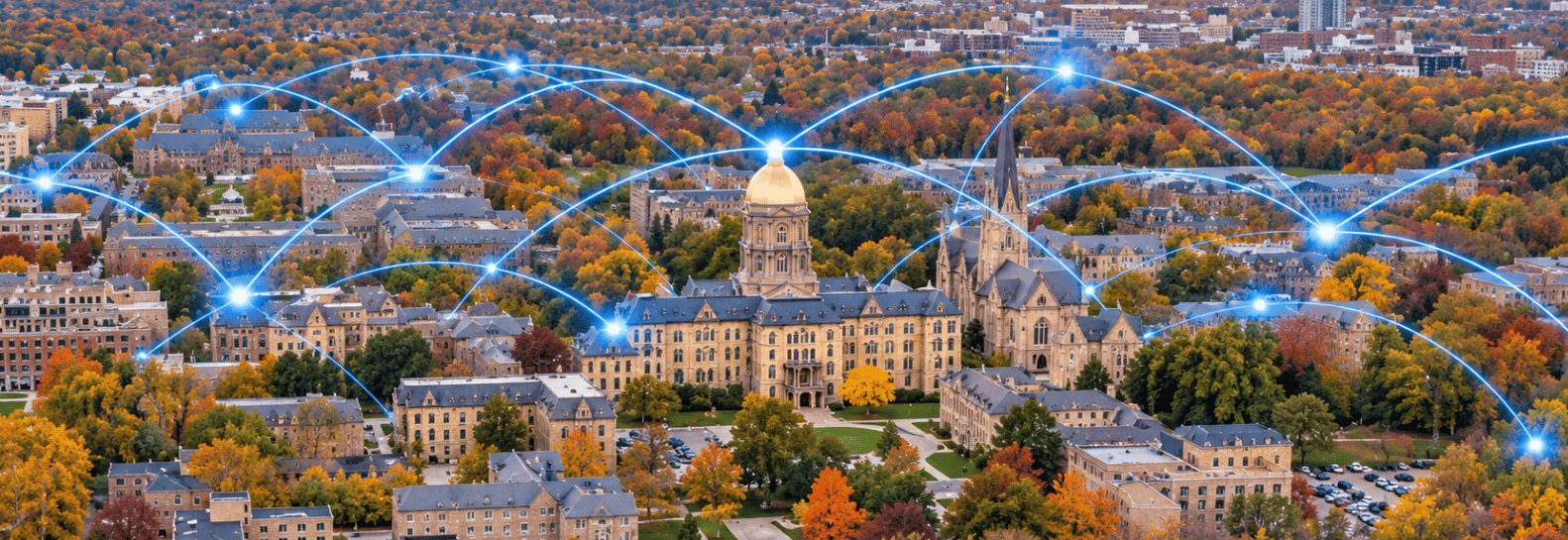
Cisco has completed a major campus-network modernisation at the University of Notre Dame, deploying nearly 1,000 switches across dormitories, educational buildings, and the campus core during a single summer. Most of the work was completed before the start of the school year, Cisco says. The project represents an incumbent modernisation for Notre Dame, which was already a Cisco customer for collaboration and switching.
The driving issue is familiar to university IT teams: Ageing or insufficient infrastructure is no longer only an operational problem because legacy systems can affect the student experience, research effectiveness, and the school’s ability to introduce new services. Cisco says other drivers for the upgrade include delivering greater network capacity, introducing state-of-the-art software-defined operations, as well as improved security and operational visibility.
Add to this that increasing reliance on AI workloads is – of course – a critical driver for getting university IT networks ready for the future. Cisco says that AI workloads, GPU-driven research, and the growing use of agents are placing increasingly severe demands on network capacity across many institutions of higher education. The company’s view is that network traffic has evolved from email to video – and now toward video plus agent-driven activity.

“Our internal research suggests that an AI agent performing a task can generate up to 450 percent more network traffic than a human performing a comparable task. The rationale here is that an agent may need to retrieve data from several systems, while a person may complete some of that work through their own reasoning without making as many network requests. We expect the use of AI agent to grow substantially from today’s early adoption phase,” says Mike Witzman, Vice President, Public Sector Solutions Engineering at Cisco.
For research environments, the implications of using AI together with high-capacity networks optimised for AI could be significant. Cisco suggests that AI agents, modern GPUs, and additional network capacity could allow research teams to operate at two to 10 times their previous capacity – within the constraints of their funding, compute resources, and staffing.
The modernisation of Notre Dame’s IT network also reflects a broader operational challenge: “The modernisation of Notre Dame’s IT network also reflects a broader operational challenge: IT teams are typically ‘small and mighty’ and, generally speaking, could use additional support. “AI Ops can help existing teams identify root causes more quickly, improve uptime, gain more visibility and spend less time on repetitive operational work. The intended benefit is that this allows human staff more time for network optimization and forward planning – which are tasks that often are the first to fall by the wayside when operational workloads are high,” Mike Witzman says.
Cisco says the Notre Dame deployment includes nearly 1,000 Catalyst 9300X switches, with Cisco Catalyst Center providing centralised management, automation and assurance across the network. The deployment also includes ThousandEyes for visibility and assurance, while Cisco IQ is being used for security posture and software-risk management. Notre Dame already uses Webex cloud calling, making end-to-end service visibility relevant beyond the campus network itself, Cisco says. This deployment modernisation did not include new Wi-Fi access points within the scope.
Cisco IQ is being used to assess software risk and support AI-powered configuration-hardening assessments in the context of the university’s own network and configurations. Cisco Cloud Control, described as the future agentic and AI layer, is not yet deployed at Notre Dame. The project involved Cisco professional services, partners handling staging and rack-and-stack work, and Notre Dame’s own IT staff. Cisco said the implementation went smoothly and that feedback from the university has been positive.
Meanwhile – for the Wi-Fi industry – one question remains unanswered: How much will AI ultimately increase traffic at the wireless edge? If more AI processing is performed remotely by agents, devices may exchange relatively few requests even while significant compute and traffic occur elsewhere. But if agent-driven workflows generate materially more data movement from end-user devices, the impact on Wi-Fi capacity planning could be far greater.
/Claus.