By Claus Hetting, WiFi NOW CEO & Chairman
On October 28 of last year Deutsche Telekom launched its first Wi-Fi 7-capable product in the form of the Speedport 7 home gateway – and the company now says the product has ‘exceeded every expectation’. The Speedport 7 is the result of an entirely new development strategy that includes in-house SW development, an open source platform, and a number of new technology suppliers including MediaTek, Airties, and CujoAI, DT says.
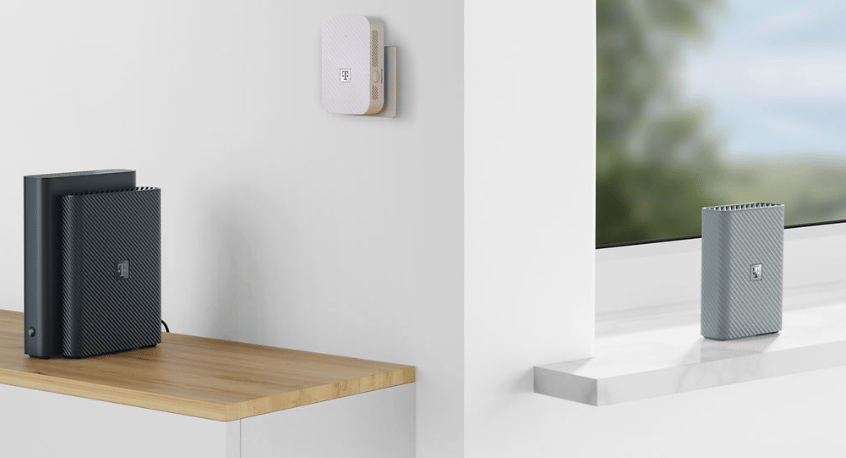
Deutsche Telekom’s long awaited first family of Wi-Fi 7 gateways was launched end of October last year – and the dual-band Speedport 7 indeed marks a huge step-up in home Wi-Fi services and networking: Up to 6.8 Gbps of Wi-Fi 7 connectivity speed, support for both DSL and fibre, sophisticated security features, coverage extension with the Speedport 7 Extender or Extender Plus, as well as a brand new app for users to control their home network settings and experience (we wrote about it here).
Now – only three months later – DT confirms that the new product has performed exceedingly well. “We’re extremely happy with the launch, both with regards to the performance of the gateway itself and its adoption into the German market. I’ve personally been involved in more than 20 product launches in my career and this has been by far the most successful,” says Pedro Bandeira, Senior Vice President of Home Products at Deutsche Telekom.
Above all, the Speedport 7 represents a sea change in DT’s product development strategy, the company says. “We wanted to expand our choice of vendors, which is why for this project we initially chose to work with MediaTek. MediaTek had some catching up to do but they’ve now done all of that and they’ve proven that they are at least as capable as any of the other major Wi-Fi platform providers,” Pedro Bandeira says.
Open source RDK-B platform has been a key to success
Another key contribution to the project’s success has been the choice of RDK-B as the Speedport 7’s software platform. “RDK-B has given us excellent visibility into gateway performance via telemetry data, which means we’ve even been able to pre-empt technical issues. Our strategy today is to develop our own software using RDK-B as the basis, which means we’re only using OEMs for hardware,” he says.
Pedro Bandeira says that the Speedport 7 represents the democratisation of access because customers can now easily manage and control their home network from the MyMagenta app. Previously, home network settings were only available via a web interface, a method that has been way too technical for the average subscriber. Also included in the Speedport 7 Extender Plus is automatic failover to the mobile network in case fixed Internet connectivity is disrupted. “This feature – which we like to call unbreakable Internet – is already remarkably popular,” he says.
The Speedport 7 system – in addition to core contributions from MediaTek – also spans solutions from two other vendors well known to the WiFi NOW community: Airties and CujoAI. Airties delivers remote home Wi-Fi optimisation including control of Speedport 7 extenders via EasyMesh while CujoAI delivers security including device fingerprinting. Pedro Bandeira says that a tri-band (meaning 6 GHz-capable) Speedport 7 version will be introduced in the not too distant future.
Deutsche Telekom famously chose RDK-B as its global software platform for broadband gateways in October of 2021 despite RDK-B having been mostly developed to support the cable industry in the US. DT says the choice fell on RDK-B because the open source platform ‘has proven its worth at scale’.
/Claus.