Guest blog by Randy Aneke, embedUR. embedUR builds firmware, drivers, and edge AI models on wireless silicon, including UWB, and takes products from evaluation board to production-ready.
Put three of the most popular radios in the same warehouse and ask each one to find a forklift. Wi-Fi names the aisle. Bluetooth names the same aisle, roughly, with more confidence than the measurement earns. UWB puts a dot on the screen, within a hand’s width of the machine. The dot stays accurate while the forklift reverses, turns, and vanishes behind racking. That is the difference between knowing the neighbourhood and knowing the exact address.
That gap is why every UWB demo wins the room. It also makes what comes next strange… the pilot closes, the report goes round, and the rollout never comes. In the pilot area, UWB did exactly what it promised. What nobody priced was the work of making it do that across the whole site. Which is why most UWB projects stall before they hit the production floor.
The density that kills the rollout
Turning a distance into a position is where the costs begin. One UWB exchange measures one thing: How far the tag sits from one fixed receiver. That alone will get you a circle on a map, not a point. Pinning the tag to a point takes at least three of those receivers, spaced apart, their own positions already known and trusted. Those receivers are anchors, and each is a small project of its own:
- Bolted to a wall or a ceiling
- Surveyed in, so its position can be trusted
- Cabled for power
- Calibrated, because every unit carries a built-in timing offset that has to be measured and stored before its readings mean anything
Deployment guidance for UWB real-time location systems recommends an anchor every 15 to 20 metres in open space, and a tighter grid around steel racking and thick walls. Call it one anchor per 100 to 200 square metres. A single distribution centre needs dozens of them.
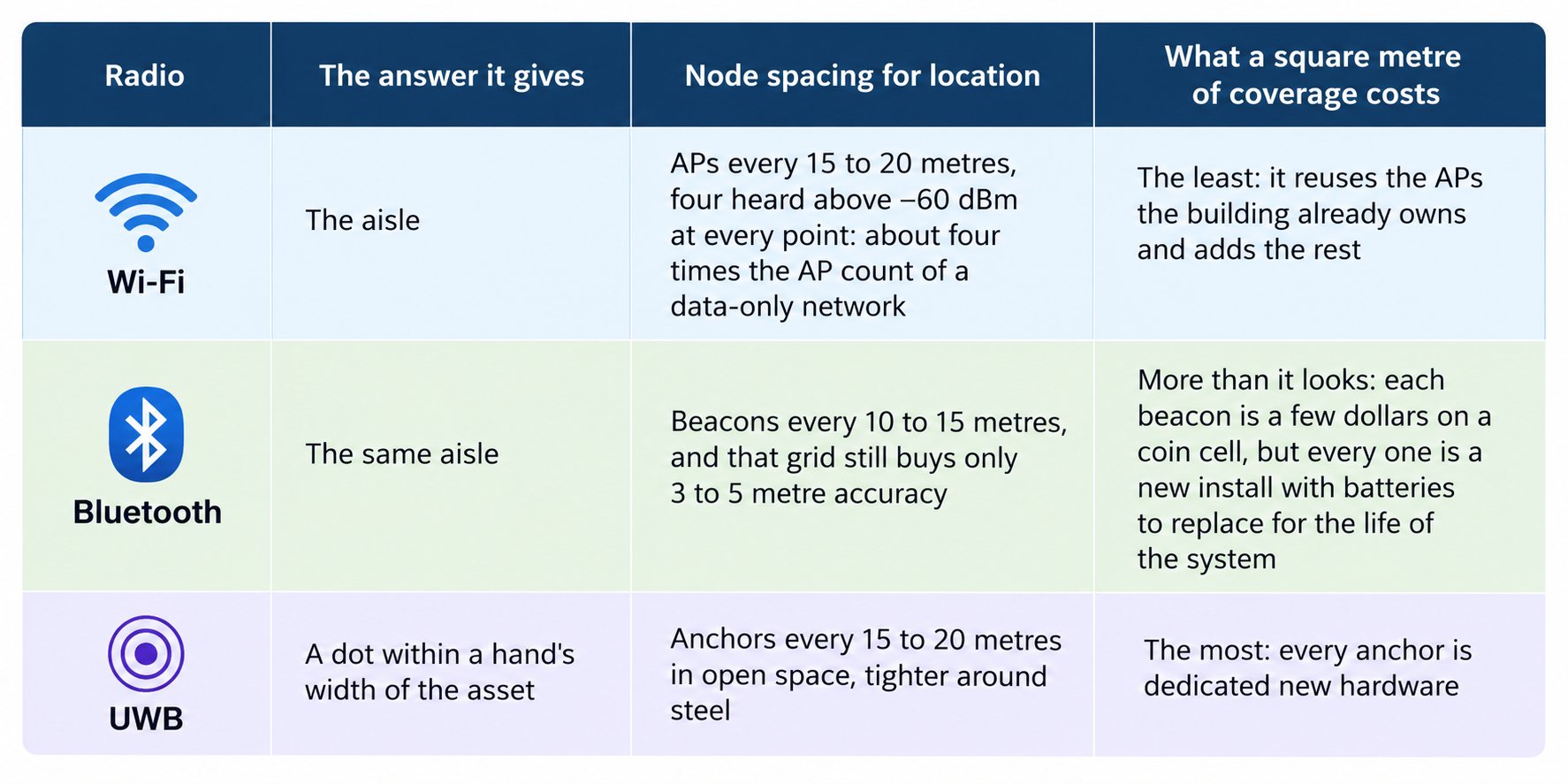
Accuracy has a price. The sharper the answer, the denser the grid, and the higher the bill. For UWB, the cost driver is the anchors… so can that cost come down? IEEE 802.15.4ab – the next amendment to the UWB standard – is the industry’s attempt at saying ‘yes it can’. However, it cannot aim through power.
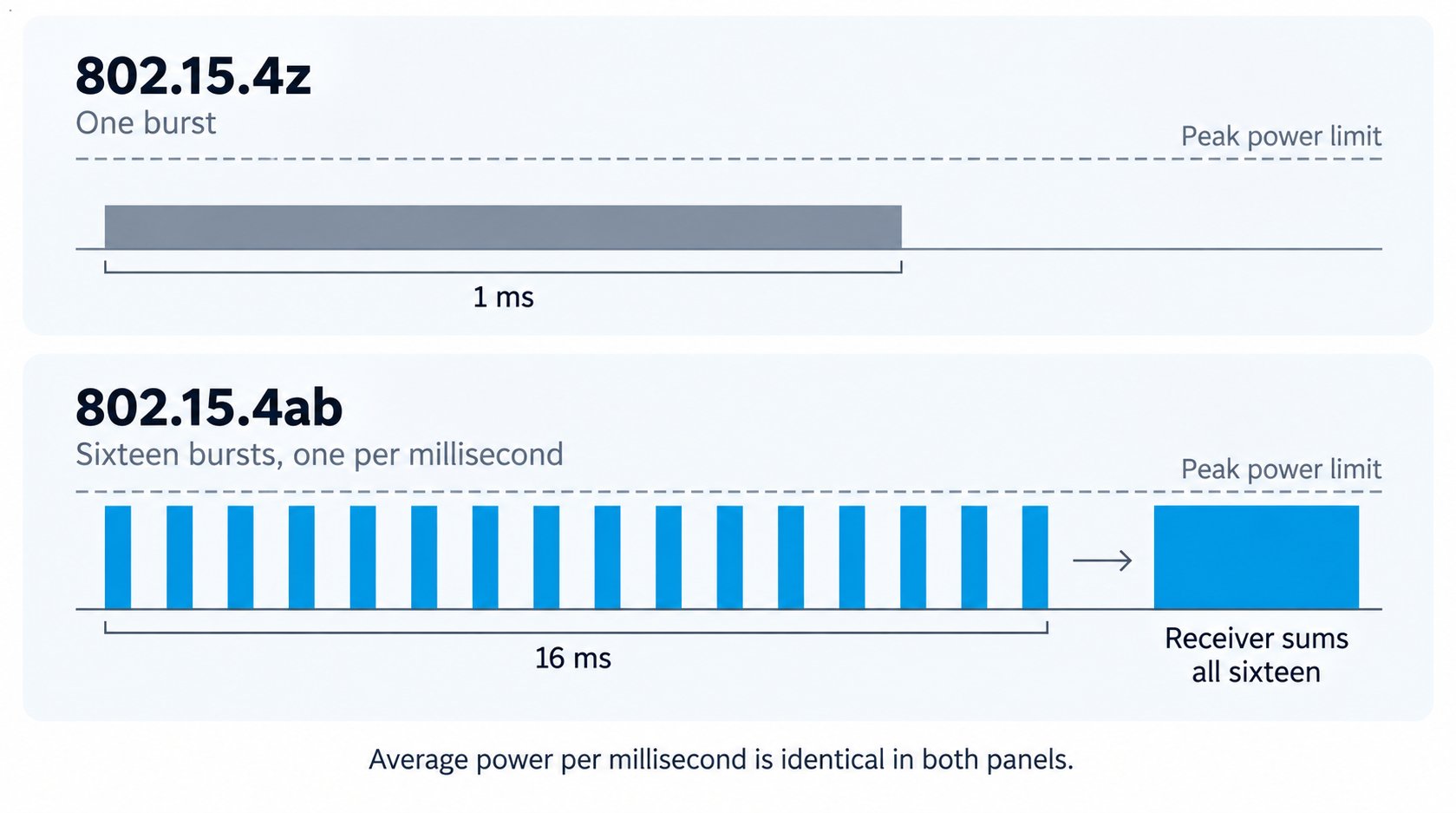
Since the FCC readmitted UWB to the airwaves in 2002, the radio has been barred from transmitting above the level a computer monitor leaks by accident, and in twenty-four years that ceiling has not moved by a decibel. So the amendment does the one thing the rule leaves open: it splits a single transmission across sixteen milliseconds and has the receiver add them all back up. Eight times the range, with no increase in average transmit power.
Which reads like the anchor problem solved. It is not, and the reason matters before anyone puts it in a business case.
Paying in time
The FCC caps UWB at minus 41.3 dBm per megahertz, averaged over one millisecond. The law does not care what happens inside the millisecond. It cares what the millisecond averages.
That distinction is the whole trick. A brief, sharp burst that fills a fraction of a millisecond averages out the same as a long, flat one. So the new standard’s ranging scheme, multi-millisecond ranging (MMS), speaks in short hard bursts, as many as sixteen of them, one per millisecond slot. The receiver adds all sixteen together before deciding what it heard. The transmitter never raises its average. The receiver simply becomes far more patient.
A Second Radio Helps
There is a second radio in this arrangement, and for a Wi-Fi audience it sits somewhere familiar. Narrowband assistance puts a conventional link in the 5 to 6 GHz range alongside the UWB one: The narrowband side handles discovery, timing and session control, while the UWB side does nothing but measure flight time. That drops the assist radio into Wi-Fi’s spectrum, which is why imec built its receiver to hold a weak ranging signal while a nearby Wi-Fi transmitter goes full tilt.
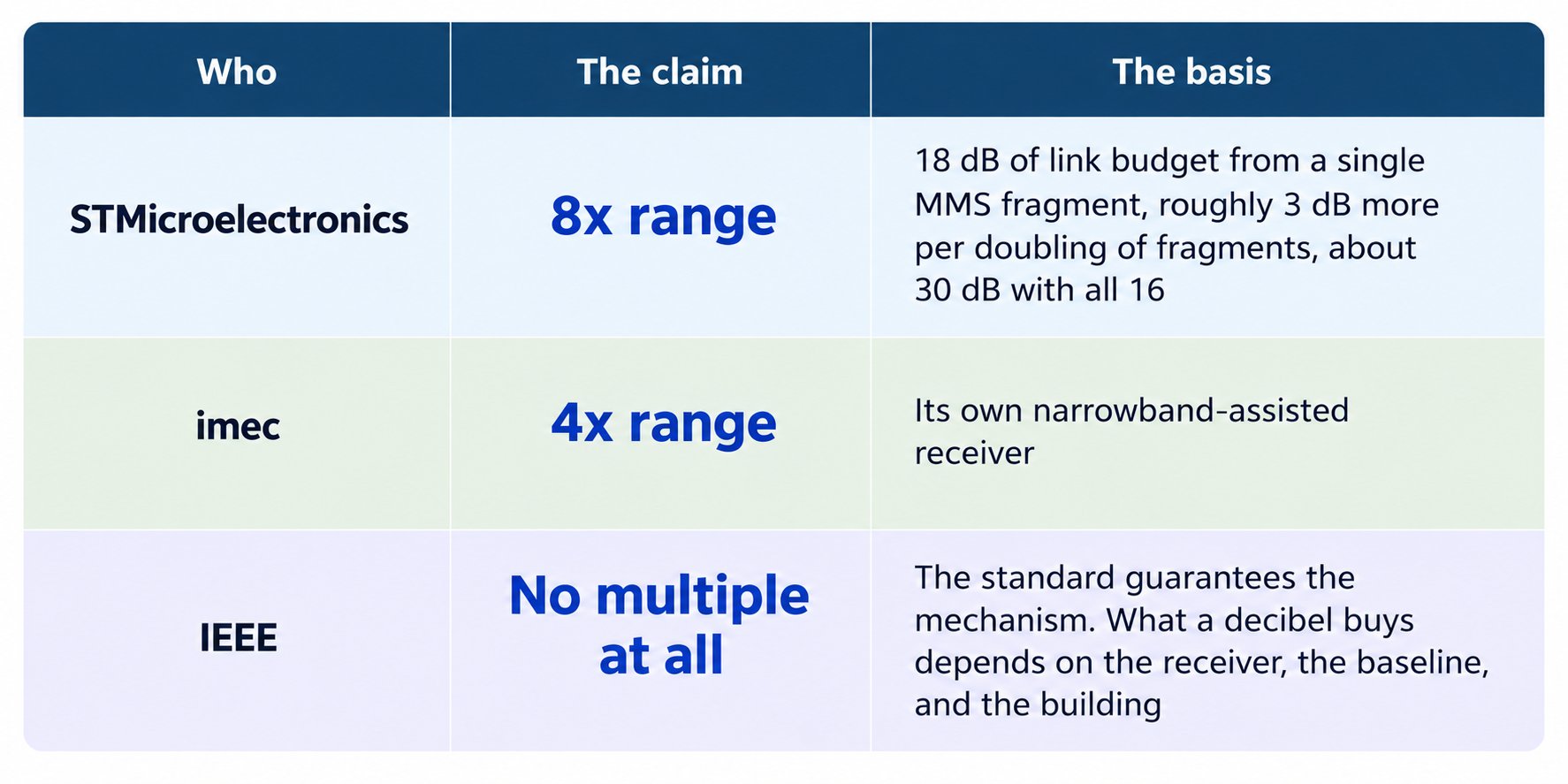
The multiple is the chipmaker’s claim, not the standard’s promise. So how much reach does the trick buy? Depends on who you ask:
The wall inside the rule
Why stop at 18 dB? If the trick works, why not 40? Because the same FCC ruling carries a second limit: No transmission may exceed 0 dBm in any 50 MHz stretch of spectrum. A cap written to keep sharp UWB pulses from blinding the radar and satellite services that held these frequencies first.
The two limits box MMS in from opposite sides. The average rule governs what a whole millisecond adds up to. The peak rule governs the loudest instant inside it. The room between them works out to roughly 24 dB, and ST’s 18 dB spends most of it. Once a burst hits the peak cap the transmitter has nothing left to give, and every further decibel has to come from the receiver adding more fragments together. That is exactly what the 3 dB per doubling is.
What the extra reach actually buys
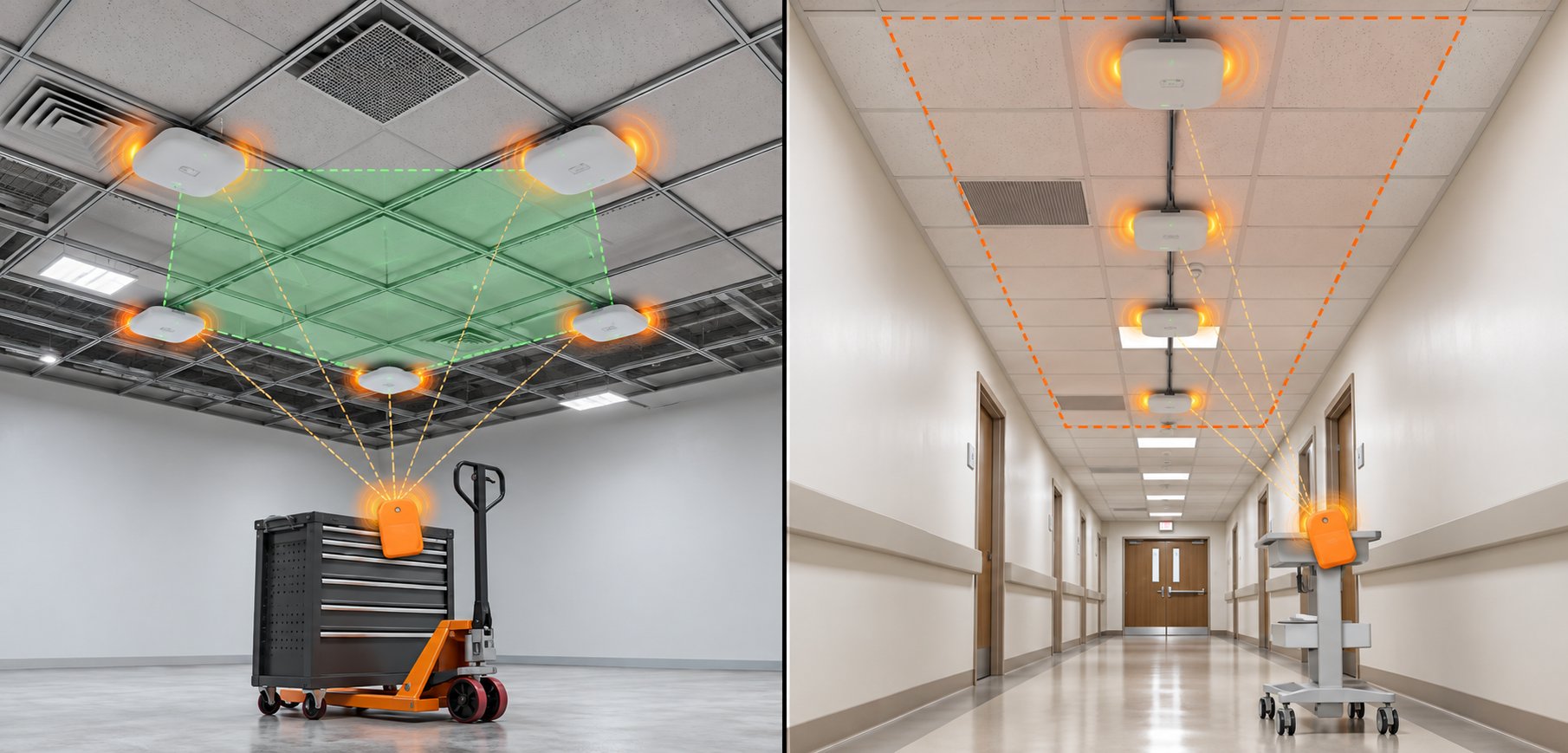
Whether your location sees fewer anchors depends on why the anchors were there in the first place. The extra reach cuts the count on some sites, leaves it standing on others, and the difference comes down to one rule. A stronger link answers one question: How far can an anchor stand from the tag and still hear it? Where anchors must stand is a different question, and Cisco answers it bluntly in its RTLS design guidance—geometry, not signal strength, decides accuracy.
Surround a tag with anchors and small errors stay small. String them down a corridor and the same errors multiply. And the floor does not move: a 2D fix still takes three anchors that are not in a line, a 3D fix takes a fourth at a different height.
So the reach pays off where range was the real limit – like big open floors with long sight lines, and above all high ceilings. Anchors sit on the ceiling, tags move at the floor, and a tall warehouse spends its range on the drop between them before it covers any ground. ABI Research notes today’s standard (802.15.4z) is already close to its limit on the vertical distance alone. Give those sites more reach and fewer anchors cover the same floor.
Corridors, multi-floor buildings and dense racking get something different. Links that used to break behind obstructions now hold, but the anchor count stays where it was: the shortage there was never signal, it was position.
You can read which kind of site you have off the floor plan before any hardware is ordered. What you cannot read anywhere is anchor spacing guidance for the 4ab era, because nobody has published it. That tells you the range claim is running ahead of the field engineering.
The bill comes back as engineering
The amendment moves cost around. What comes off the anchor line lands on three others.
- Listening costs power: A receiver held open across 16 millisecond fragments burns far more energy per fix than one catching a single 4z burst. Today a battery tag usually carries a second, simpler radio whose only job is to doze cheaply and listen for the signal that wakes the UWB chip. 802.15.4ab builds that wake-up function into the UWB radio itself, so the second chip comes off the board and off the power budget. Whether that saving covers the cost is unpublished: ST’s data briefs describe the mechanism and stay silent on MMS power draw. Budget for it as an open question.
- Airtime is capacity: A site tracking a fleet of tags at one MMS fragment per exchange may track a smaller fleet at sixteen. The channel fills faster. Ideally a tag would use one fragment while the link is strong and switch to sixteen only when it weakens, spending the airtime only when it has to. That is the obvious firmware answer, and no shipping chip documentation confirms any silicon can do it yet.
- Compliant does not mean compatible: The standard permits three ways to build MMS: First is narrowband-assisted, where a separate narrowband radio coordinates the ranging. Second is UWB-driven, where the UWB radio coordinates itself. The third way is out-of-band, where an existing link such as Bluetooth does the coordinating.
All are legal, none are automatically interoperable, and two conformant chips can fail to range with each other. Narrowband assistance adds its own cost: a second radio, a second band and a second certification path. Some vendors absorb all of that on-chip. Others leave it to your board.
So ask two questions before signing a bill of materials. Which of the three modes does this chip implement? And has it passed interoperability testing against the chips you intend to pair it with? “Supports 802.15.4ab” on a data sheet answers neither.
Reading the quote again
Go back to the stalled pilot, the taped-off corner of the warehouse where everything worked, and the quote that killed it. 802.15.4ab does not make that quote disappear. It changes its shape: Up to 75% fewer anchors where range was the constraint, steadier links where geometry was, and new engineering costs either way.
Sorting a site into the right column takes a floor plan and a survey. Keeping firmware ready for chips that exist only as early samples takes an abstraction layer between ranging stack and silicon. Sizing MMS depth against battery and tag count takes someone who treats them as one trade-off, because they are. That is the work embedUR does. We carry UWB from the evaluation board that wins the pilot to the deployment that survives the quote.
The power ceiling is not going anywhere. The teams that ship stopped arguing with it.
/embedUR