Guest blog by Guharajan (Guhan) Sivakumar, Founder & CTO, Aprecomm
With expertise in cloud, machine learning and artificial intelligence, Guharajan (Guhan) Sivakumar, Founder & CTO, Aprecomm (photo right), leads Aprecomm’s world-class technology and engineering teams. Before founding Aprecomm, he demonstrated a strong entrepreneurial spirit when co-founding Engrid Global Networks, a telepresence start-up. Guhan previously held engineering leadership roles at Relay2 and Qualcomm-Atheros and has secured multiple patents in the wireless communications space.

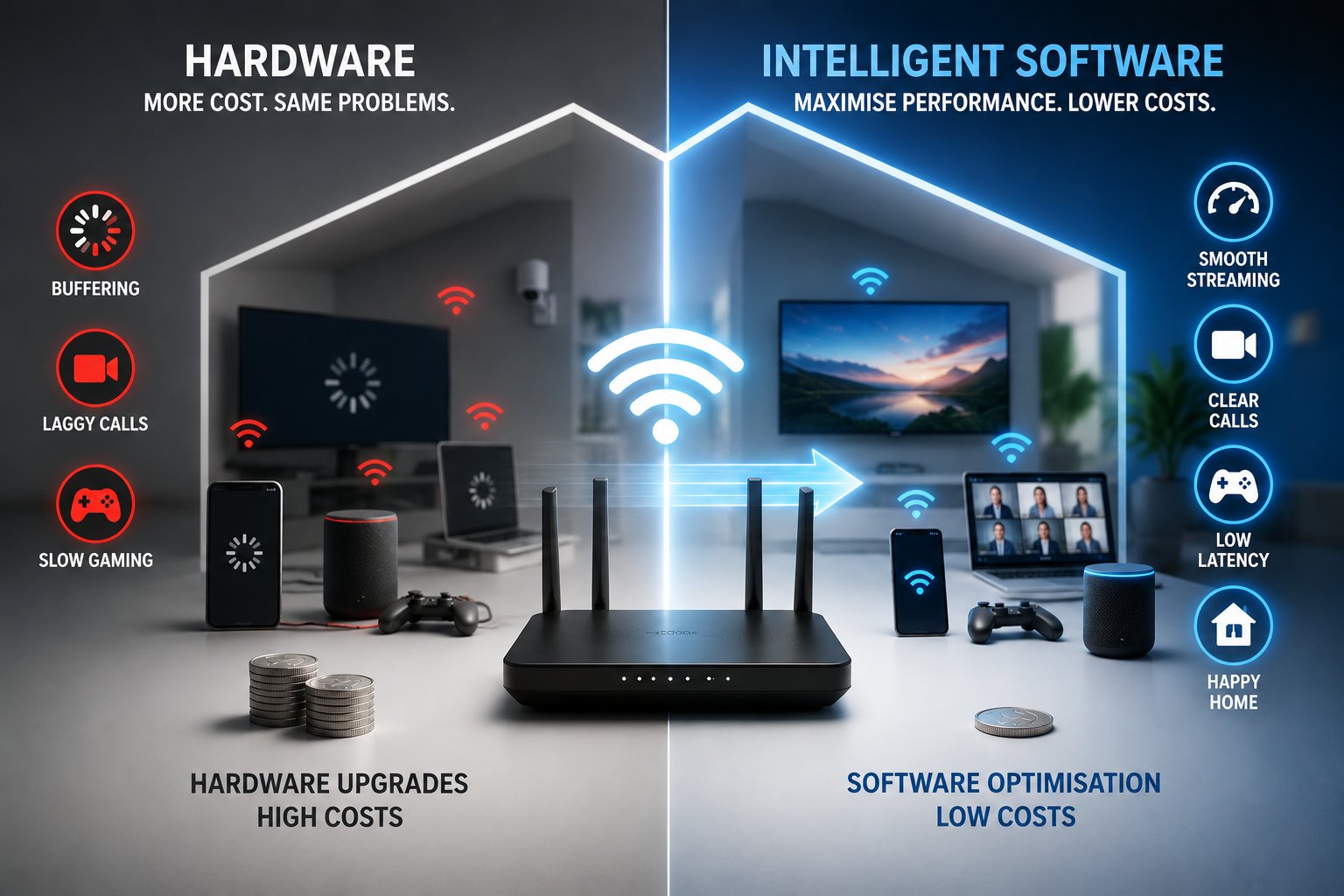
The race to WiFi 7 and beyond is heating up, and with every tech change, it can be tempting to invest in the latest hardware. However, it can be more cost-effective to maximise the investment in the installed CPE by using more intelligent software.
Telecom service providers respond to rising performance complaints the same way each time. They look to enhance their hardware. They focus on upgrading CPEs, adding new access points, and refreshing the devices. This standard response turns out to be an unnecessary financial burden; it also fails to mitigate the root cause. The real issue with most networks is that they are under-optimized, not under-equipped.
The solution therefore lies beyond the hardware. It lies in deploying an intelligent network optimiser across the CPEs in homes and businesses – one that will ensure delivery of the experience subscribers expect. That is why the conversation about performance must shift from hardware to software.
The Solution In Plain Sight: Intelligent Software
Consider what a modern home network is required to do. Video calls, 4K streaming, cloud gaming, smart home devices, and remote desktop sessions. All of these run simultaneously, competing for the same bandwidth, while overlooking the fact that each app has different tolerances for latency and packet loss. Raw throughput alone falls short until intelligent application-awareness is built into the network.
A hardware-only solution is boxed thinking. A faster router is unaware that a video call needs priority over a background software update. It lacks the discernment to dynamically queue traffic based on application type, real-time latency, or packet loss conditions. It simply moves data. Managing the data requires intelligent software.
What an Intelligent Network Optimizer Can Do
A network optimiser is a valuable addition to your existing infrastructure. It is a software layer that installs directly onto the CPE already deployed across your subscriber base. No truck rolls. No hardware swaps. No major capital expenditure cycle. Once deployed, it works invisibly. Subscribers experience the outcome without knowing the mechanism. And the mechanism is sophisticated.
The optimiser is an application-aware solution. It understands the difference between a Zoom call, a Netflix stream, and a file download, and it treats each accordingly. Using real-time knowledge of latency, packet loss, and throughput, it continuously prioritises and queues traffic for every application running on the network at any given moment. Every user on that connection, from the teenager gaming, the parent on a work call, and the smart TV running in the background, gets the quality of experience their application requires, without degrading anyone else’s.
The engine behind this is network slicing. Rather than treating the available bandwidth as a single undifferentiated resource, the optimizer partitions it dynamically, by allocating capacity based on what the network is carrying and what each application needs. The result is the network starts behaving like an intelligent delivery system.
The Business Case Is Immediate
For a CXO evaluating this decision, the answer is straightforward. The cost of deploying a software optimizer across your installed base is significantly lower than refreshing hardware. The impact on subscriber experience is tangible, measurable, and immediate. And the operational model is clean — the software runs autonomously, requiring no ongoing intervention from network operations teams. Zero-touch, self-managing, always on.
The reduction in support calls alone justifies the investment. A significant proportion of tier-one support volume at most ISPs stems from perceived performance issues – buffering, dropped calls, inconsistent speeds. Most of those complaints are rooted in bandwidth competition, prioritization, and application-level delivery, which is precisely what an optimiser addresses.
Churn tells a similar story. Subscribers do not leave because their headline speed is 100Mbps rather than 200Mbps. They leave because a video call dropped during an important meeting or a child’s online exam lagged at a critical moment. Experience drives retention. Software drives experience.
Building Networks That Are Ready for What Comes Next
WiFi 7 is already in active rollout across leading ISPs globally. So is the continued proliferation of connected devices, the growth of bandwidth-intensive applications, and the rising baseline expectations of subscribers who demand a network that keeps up.
The ISPs that will navigate that landscape most effectively are those that build intelligence into their networks now. This will create the software foundation that can absorb new technology, adapt to new traffic patterns, and continue optimizing as the environment changes.
An intelligent network is a dynamic asset. It learns. It adapts. It prepares your infrastructure to onboard the next generation of technology without having to start from scratch each time.
Why WiFi 7 Alone Cannot Solve the Experience Problem
Wi-Fi 7 or IEEE 802.11be is the latest wireless standard. With speeds of up to 46 Gbps, it reduces lag using ultra-wide 320 MHz channels and the 6 GHz frequency band. The expectation from Wi-Fi 7 is that it will effortlessly handle 8K video streaming, AR/VR gaming, and heavy cloud computing.
Wi-Fi 7 delivers this through:
- Multi-Link Operation (MLO) that allows devices to split traffic between multiple bands seamlessly during congested times.
- Higher Modulation(4K-QAM) that packs in more data per transmission than older standards.
- Wider channels with 320 MHz capacity which is more than twice than that of WiFI 6 with a maximum limit of 160MHz
- Multi-RU (resource units) that allow the router to split a single channel into smaller pieces to serve multiple devices simultaneously and quickly.
The catch here is that Wi-Fi 7 requires ideal conditions to deliver results.
Five Constraints that Neutralise Wi-Fi 7 Gains
- Physical Propagation & Building Materials
WiFi 7 operates on 6 GHz — a band that struggles to penetrate even standard drywall, let alone brick, concrete, or plaster. In multi-storey or older homes, signal attenuation ensures that devices beyond line-of-sight cannot leverage the new band’s capacity. - RF Interference & Spectrum Congestion
Dense residential environments create overlapping WLAN cells. Microwave ovens, baby monitors, and neighboring access points all compete in the 2.4 GHz and 5 GHz bands. While 6 GHz is cleaner today, its reach is the limiting factor in most homes. - Device-Side Limitations
Most connected home devices — smartphones, smart TVs, IoT sensors, streaming sticks — do not support WiFi 7 and never will. Throughput is governed by the least capable device in a given session, not the AP’s theoretical maximum. - ISP Backhaul Capacity
A WiFi 7 router capable of 40 Gbps aggregate throughput is irrelevant when the upstream broadband pipe is limited to 100–500 Mbps. The last-mile connection remains the binding constraint for internet-bound traffic. - Concurrent Usage & Contention
Multiple family members streaming 4K video, gaming, and attending video calls simultaneously create contention regardless of WiFi generation. Without prioritization, all traffic is treated equally, degrading the sessions that matter most.
Given these constraints, the subscriber could fail to see any change in performance despite hardware upgrades because of real-world constraints. In such a situation, an application-aware traffic management solution paired with the current network alone can deliver real, tangible results immediately and in the future. Consider a household with the following simultaneous demands on a 200 Mbps broadband connection:
- Parent on a business video call (Teams/Zoom) requiring 4 Mbps and <150 ms latency
- Teenager online gaming requiring <30 ms latency and low jitter
- Smart TV (Wi-Fi 5 or Wi-Fi 6) streaming 4K HDR consuming 25 Mbps sustained
- Automated cloud backup running in the background consuming 80+ Mbps bursts
- 12 IoT devices generating periodic traffic (doorbell, thermostats, sensors)
With a Wi-Fi 7 router and no traffic management, all traffic sources compete on equal terms. The cloud backup consumes headroom, degrading the video call and gaming session. The subscriber experiences packet loss, jitter, and re-buffering, resulting in calls to the operator’s helpdesk. Without application-aware management, even if the router is upgraded, outcomes do not improve.
The Opportunity in Front of You: From Preparation to Competitive Differentiation
The installed base you have today is more capable than it is currently being allowed to be. The right software stack unlocks that capability without a hardware cycle, significant capital outlay, or disruption to your subscribers. The smartest move available to an ISP right now is making every existing device work as if it were designed for exactly this moment.
Wi-Fi 7 is already arriving at your subscribers’ doorsteps. The ISPs extracting the most value from it are those who have the intelligence layer in place before the hardware did. The technology exists. The deployment path is straightforward. The question is, how long can you afford to wait?
/Guhan