
By Khushboo Kalyani, Product Marketing Manager at LitePoint
This week’s guest author is Khushboo Kalyani, Product Marketing Manager at test & measurement leaders LitePoint. Khushboo frequently shares her Wi-Fi insights with WiFi NOW readers and is also a frequent contributor at Wi-Fi World Congress events.
As AI and machine learning reshape how data is captured, processed, and shared, the wireless industry is scrambling to prepare AI-compatible Wi-Fi 8 hardware ahead of formal IEEE standards ratification. Even so-called “early access” Wi-Fi 8 routers are expected to support a heavy rotation of compute workloads that are more dynamic, latency-sensitive and uplink-intensive than past use cases.
From collaborative robotics to immersive AR/VR and wearables, AI applications demand new levels of reliability and determinism that previous Wi-Fi generations have struggled to guarantee. A survey of recent blogs and papers published by leading wireless chipset vendors frames the evolving environment as one in which Wi-Fi 8 is less of a speed upgrade and more of an architectural shift that ensures operational dependability.
At the center of the transition is the Wi-Fi 8 physical layer (PHY). Here, innovations such as improved LDPC coding, Unequal Modulation across Spatial Streams (UEQM), Enhanced Long Range (ELR), and Distributed Resource Units (DRU) are helping wireless networks adapt intelligently to changing conditions while supporting the demands of AI workloads.
Raw Speed vs Performance Under Pressure
The consensus opinion is that the “speed problem” was largely resolved with Wi-Fi 7 by driving data throughput into multi-gigabit territory – well beyond the requirements of most mainstream applications. Yet Wi-Fi 7 users still experience dropped calls, jitter and inconsistent roaming performance.
What unites the chipset community today is a shared understanding that Wi-Fi has entered a fundamentally new phase that emphasises coordination, determinism, and infrastructure-grade performance. While approaches vary, they reveal an industry converging on two realities: Wi-Fi 8 is an ultra-high reliability platform, and it is foundational to AI. In other words: By moving the goal posts from “peak” throughput to “effective” throughput, users are assessing Wi-Fi performance not by benchmark speeds but by continuity and reliability.
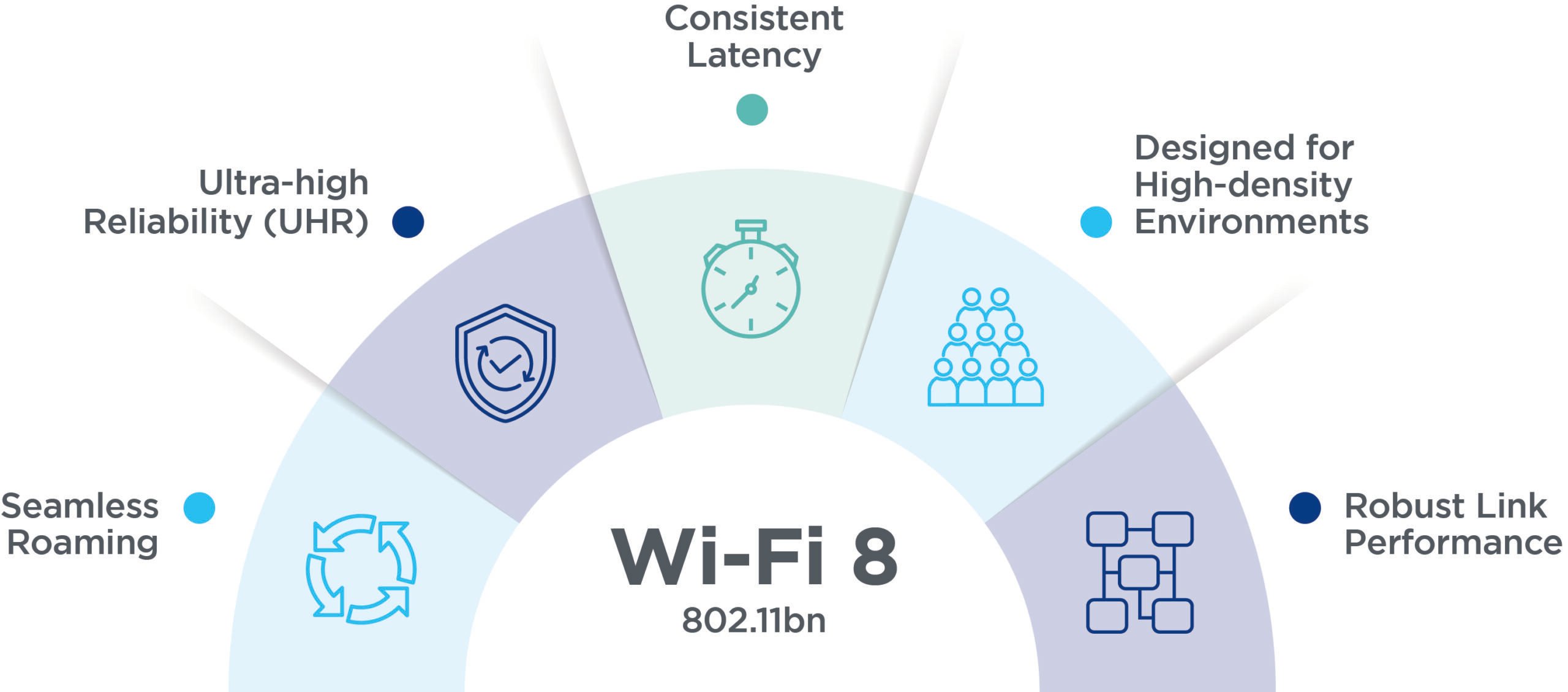
This positions Wi-Fi 8 as the first generation explicitly engineered for real-world conditions where congestion, interference, mobility, and overlapping access points can undermine performance. Under this scenario, technologies such as coordinated multi-AP behaviour, seamless roaming, spectrum management, deterministic latency and resilient uplinks determine how intelligently Wi-Fi systems behave under stress – rather than how fast they perform under ideal conditions.
Once a Convenience, Wi-Fi Is Now Critical Infrastructure
A second area of agreement is the evolution of Wi-Fi as an infrastructure-grade asset. Wireless connectivity is no longer a convenience, it’s an essential delivery system for AI, industrial automation, intelligent edge computing and other mission-critical applications.
As part of an AI stack, Wi-Fi 8 networks will operate as intelligent, predictive and security-aware platforms that support distributed AI inferencing, telemetry, industrial synchronisation and autonomous systems across enterprises, smart factories, public venues and connected homes.
This points to a future where Wi-Fi behaves less like “best effort” networking and more like infrastructure traditionally associated with wired Ethernet. The implications are profound: Wi-Fi is no longer being optimized merely for ease-of-mobility; its value lies in continuity, low-latency coordination and always-available access to AI services.
Room for Different Perspectives
While wireless chipset vendors broadly agreed on the direction Wi-Fi 8 is taking, some emphasise its ability to support telemetry, edge inferencing, operational technology and low-latency synchronisation for industrial systems such as autonomous mobile robots and AI-driven manufacturing. This included a focus on security, where MACsec, post-quantum cryptography, and hardware root-of-trust will help enterprise-level Wi-Fi contend with AI threat environments.
Others leaned into the everyday user experience where consistent performance must be ensured by correcting uplink-downlink imbalances and roaming interruptions and addressing edge-of-network usability and the growing complexity of mesh environments. By positioning Wi-Fi 8 as always-on connected infrastructure across homes, portable hotspots, conferencing environments and XR applications, they underscore user expectations that the next phase of innovation will be driven by difficult edge conditions rather than wider channels or higher peak PHY rates.
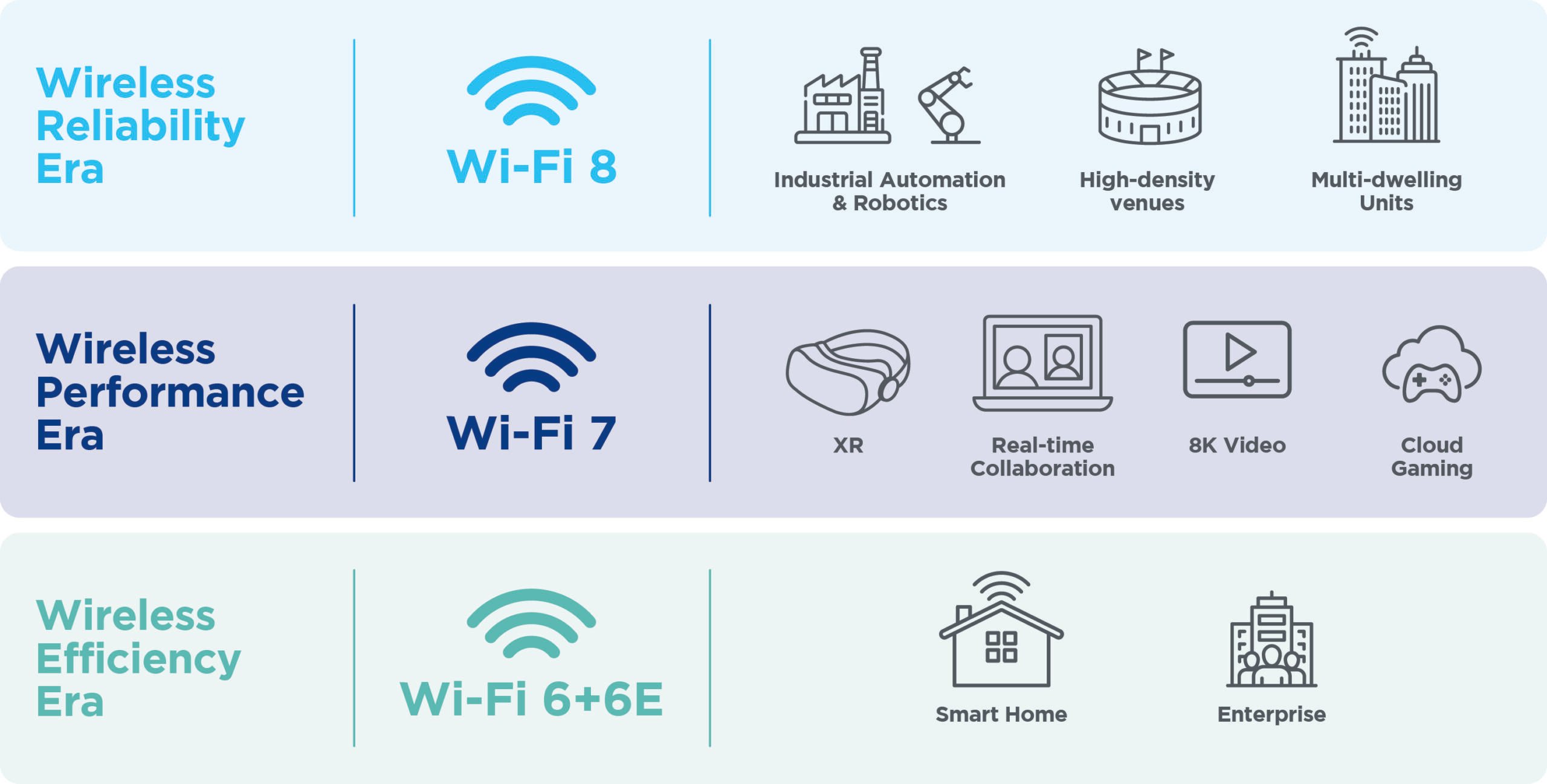
Yet another point of view centers on the ability of Wi-Fi 8 to enable seamless mobility and intelligent spectrum management where the wireless network operates as a unified system rather than a collection of independent access points. In this context, Wi-Fi 8 is driving an architectural evolution by delivering wired-class reliability with wireless accessibility.
A Shared Rallying Cry
Viewed collectively, these perspectives suggest that Wi-Fi 8 may be remembered not for delivering another leap in raw speed, but for redefining what wireless networking is expected to do. Reliability, coordination, deterministic performance and intelligent infrastructure are emerging as the defining characteristics of the next Wi-Fi era.
By enabling new technologies and applications, Wi-Fi 8 will serve a shared objective by providing critical infrastructure for AI-driven, always-connected and increasingly autonomous communications environments. The innovation paths may differ, but the direction of travel is the same.
/Khushboo Kalyani, LitePoint.