Guest paper by Synaptics: Architecting secure edge IoT systems with Wi-Fi 7
| GUEST BLOG | by Claus Hetting, Wi-Fi NOW CEO & Chairman
By Saravanan Shanmugham, Director of Software Engineering @Synaptics
Building secure Wi-Fi 7 IoT systems requires hardware-rooted trust, secure firmware management, and isolation between system domains. When these elements are integrated into the silicon architecture, engineers can deliver Wi-Fi-enabled devices that combine high performance with long-term resilience against evolving threats. In this paper, we dig into the details of architecting truly secure Wi-Fi 7 IoT systems.
Wi-Fi 7 introduces major advances in wireless connectivity, delivering multi-gigabit throughput, reduced latency, and improved reliability. These capabilities are particularly attractive for emerging edge IoT applications such as industrial automation systems, AI-enabled smart cameras, medical monitoring equipment, and intelligent retail infrastructure.
However, as IoT devices become more capable and connected, the wireless interface increasingly becomes a primary attack surface. Remote radio exploits, firmware tampering, and physical attacks frequently target connectivity subsystems first. As Wi-Fi 7 adoption accelerates, engineers designing connected systems must ensure that security architectures evolve alongside performance improvements.
Historically, many IoT designs have relied heavily on software protections, firmware updates, and network-layer security mechanisms. While these measures remain important, they are no longer sufficient for systems expected to operate for years in potentially hostile environments. Instead, robust protection requires security architectures that anchor trust directly in hardware and enforce isolation between system components.
Security foundations in Wi-Fi 7
Wi-Fi 7 devices are required to support WPA3 security, which eliminates legacy WPA2 operation and significantly reduces the risk of downgrade attacks that historically affected mixed-security wireless environments. WPA3 strengthens authentication using mechanisms such as Simultaneous Authentication of Equals (SAE) and supports robust encryption through ciphers including AES-GCMP-128, with optional support for AES-GCMP-256 in higher-security deployments.
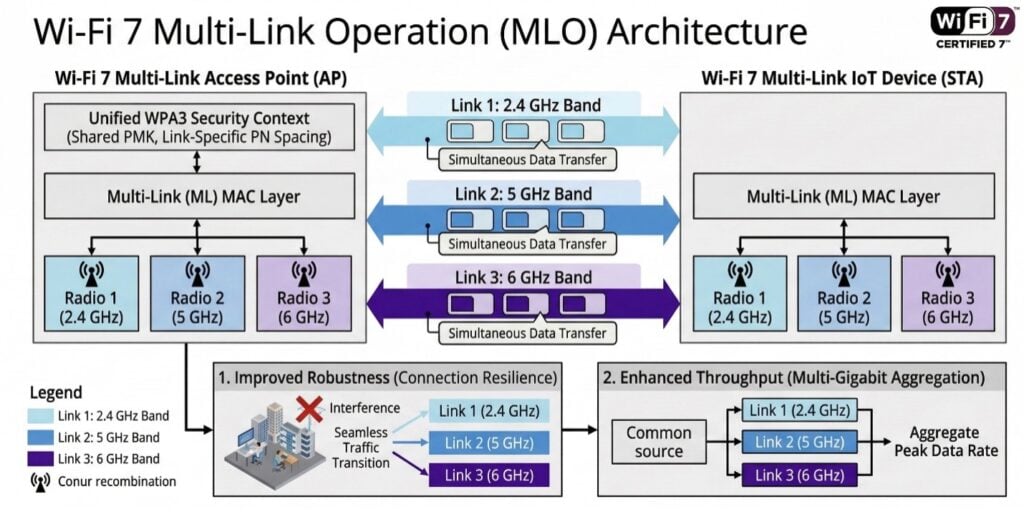
Wi-Fi 7 also supports faster key rotation and improved session isolation, helping reduce the risk associated with long-lived encryption keys. These capabilities integrate well with modern device identity frameworks such as certificate-based authentication and public key infrastructure (PKI), which are increasingly used to manage large fleets of IoT devices. Another key feature introduced in Wi-Fi 7 is Multi-Link Operation (MLO). MLO allows a device to simultaneously transmit and receive traffic across multiple frequency bands, including 2.4 GHz, 5 GHz, and 6 GHz.
Figure 1: Multi-Link Operation enables Wi-Fi 7 devices to communicate across multiple frequency bands simultaneously, improving throughput and connection robustness. Source: Synaptics
In an MLO connection, authentication occurs once for the multi-link device, and the resulting security association is shared across all participating links. While this shared context means the links are not cryptographically independent, Wi-Fi 7 implements specific safeguards to maintain link integrity. To prevent replay attacks that could exploit the multi-band nature of the connection, the architecture utilizes unique Packet Number (PN) spacing for each individual link. This ensures that even if traffic is distributed across multiple radios, each frame remains cryptographically unique and verifiable.
Distributing traffic across multiple radios also improves overall connection robustness. If interference, congestion, or localized RF disruption affects one band, traffic can continue across remaining links, improving availability for latency-sensitive applications. Although these protocol-level protections significantly strengthen wireless link security, they do not eliminate system-level attack vectors.
Beyond Protocol Security
Many real-world wireless vulnerabilities originate in firmware, driver stacks, or radio subsystem implementations rather than the encryption algorithms themselves. Several high-profile vulnerabilities in recent years have demonstrated that weaknesses in Wi-Fi firmware or driver implementations can expose systems even when strong encryption protocols are used.
As wireless bandwidth and device complexity increase, attackers frequently target these software layers instead of attempting to break the underlying cryptography.
For this reason, secure Wi-Fi system design must extend beyond protocol compliance. Establishing a hardware root of trust and enforcing strong isolation between processing domains are critical design principles for preventing vulnerabilities in one subsystem from compromising an entire device.
Establishing Hardware Root of Trust
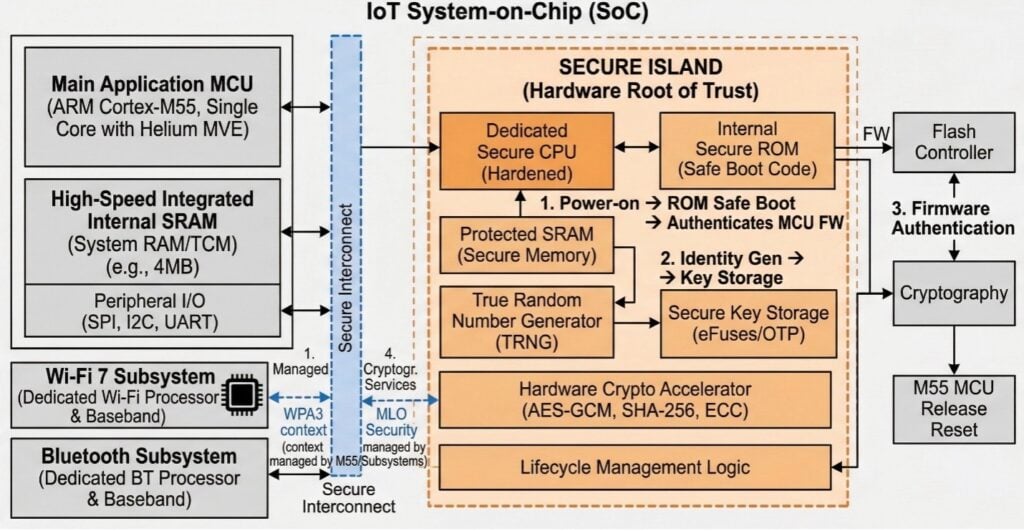
A hardware root of trust forms the security foundation of a device. It verifies firmware integrity before execution and protects cryptographic secrets from exposure. In modern IoT system-on-chip (SoC) architectures, this functionality is often implemented through a dedicated security subsystem sometimes referred to as a Secure Island.
Figure 2: A Secure Island establishes the root of trust for the system, enforcing secure boot, managing cryptographic keys, and controlling device lifecycle states. Source: Synaptics.
A Secure Island is an isolated and hardened processing environment responsible for security-critical operations. It establishes device identity, performs cryptographic services, verifies firmware integrity, and manages lifecycle states that govern debug access and system configuration.
Because this subsystem operates independently of application firmware and wireless stacks, it provides a trusted authority capable of enforcing security policies across the entire system.
Hardware-Bound Device Identity
Device identity is fundamental to securing large-scale IoT deployments. If an attacker can clone or impersonate a device, they may gain unauthorized access to networks or services.
Hardware-bound identity mitigates this risk by generating cryptographic keys directly within protected silicon. Using an on-chip true random number generator (TRNG), each device can generate unique cryptographic keys that never leave the secure environment.
These keys support secure onboarding, certificate provisioning, and mutual authentication with cloud services. Because the keys are generated and stored within secure hardware boundaries, they cannot be copied or extracted, preventing device cloning attacks.
Securing the Firmware Lifecycle
Firmware vulnerabilities remain one of the most common attack vectors for connected devices. Even when vulnerabilities are patched, attackers may attempt to reinstall older firmware versions that still contain exploitable flaws.
Hardware-enforced anti-rollback protection prevents this scenario by blocking attempts to load outdated firmware images. Secure lifecycle logic ensures that only approved firmware versions can execute, preventing attackers from reverting devices to previously signed but vulnerable software.
This protection becomes particularly important in modern IoT SoCs that integrate multiple processing subsystems, including application MCUs, Wi-Fi processors, and Bluetooth controllers.
Enforcing Zero-Trust System Architecture
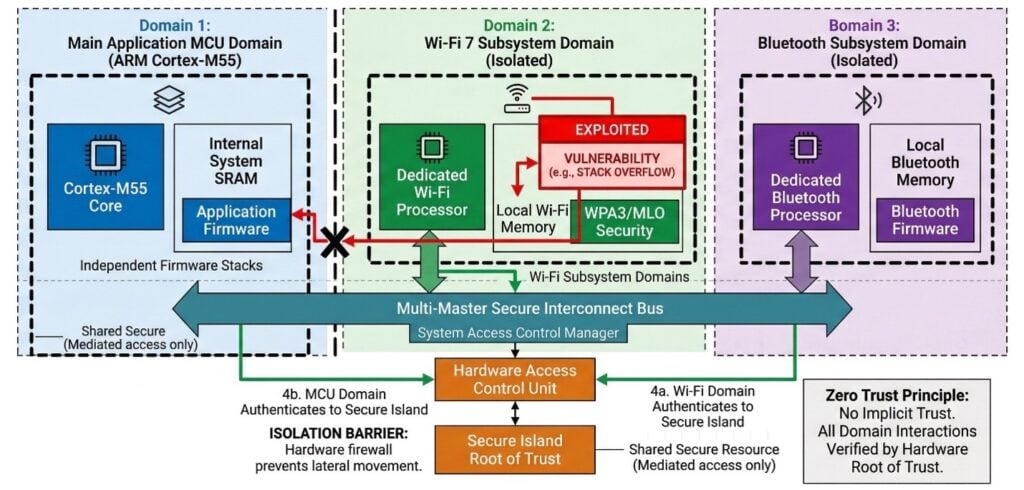
Complex IoT devices frequently integrate multiple processors running independent firmware stacks. Without proper isolation, vulnerabilities in one subsystem could propagate across the entire device. A zero-trust architecture addresses this challenge by enforcing strict separation between system components.
Figure 3: Zero-trust architecture isolates MCU, Wi-Fi, and Bluetooth domains so vulnerabilities in one subsystem cannot compromise the entire device. Source: Synaptics.
In this model, the application MCU, Wi-Fi subsystem, and Bluetooth subsystem operate within separate security domains. None of these domains implicitly trusts the others. Instead, each relies on the hardware root of trust to authenticate software and enforce access policies.
This architecture helps ensure that vulnerabilities in wireless firmware or application software cannot escalate into full system compromise.
Protecting Against Physical Attacks
IoT devices deployed in the field—particularly in industrial or retail environments—must defend against physical attack techniques such as fault injection, side-channel analysis, and invasive probing intended to extract secrets or manipulate system behavior.
Modern Wi-Fi 7 hardware security architectures mitigate these risks through hardened cryptographic engines that include Differential Power Analysis (DPA) resistance. By masking power consumption patterns during cryptographic operations, these engines prevent attackers from using external power monitoring to “leak” private keys.
Additionally, features such as active tamper detection can trigger an immediate zeroization of sensitive keys if the device enclosure is breached or if abnormal voltage/temperature swings are detected. Hardware-enforced lifecycle states further ensure that debug and test interfaces are disabled by default and can only be re-opened through secure, multi-stage authentication—preventing unauthorized “backdoor” access via physical headers once a device is deployed.
Secure Connectivity for Edge IoT
As edge IoT devices continue to evolve, they increasingly combine high-performance connectivity with local processing and AI inference capabilities. Applications such as industrial robotics, smart cameras, and intelligent retail systems rely on reliable wireless connectivity while handling sensitive data.
Wi-Fi 7 enables these devices to support demanding workloads through higher throughput, lower latency, and improved reliability. At the same time, securing these systems requires more than strong wireless encryption. Establishing hardware-rooted trust, enforcing firmware integrity, and isolating system domains provide the foundation for protecting connected edge devices against both remote and physical threats. Modern Wi-Fi 7 platforms that integrate these security capabilities directly into the silicon architecture can help engineers build edge IoT systems that deliver both high performance and long-term resilience against evolving security risks.
Design Checklist for Secure Wi-Fi 7 IoT Devices
As Wi-Fi 7 enables higher-performance connectivity for edge IoT systems, security must be integrated early in the system architecture. Engineers designing connected devices should consider the following principles:
Establish a hardware root of trust: Begin with a trusted hardware subsystem that verifies firmware integrity before execution and protects cryptographic keys.
Generate hardware-bound device identity: Use an on-chip True Random Number Generator (TRNG) to create unique device keys that remain inside protected hardware environments.
Implement secure boot across all processors: Ensure that application MCUs, Wi-Fi subsystems, and other processors verify signed firmware before executing.
Prevent firmware rollback attacks: Use hardware-enforced version control to block installation of outdated firmware that may contain known vulnerabilities.
Isolate system domains: Separate application, Wi-Fi, and Bluetooth subsystems into independent security domains to prevent lateral movement of threats.
Integrate DPA-resistant cryptography: Ensure the SoC provides protection against side-channel attacks for both data-at-rest and data-in-transit.
Control debug access throughout the lifecycle: Disable JTAG/SWD interfaces by default and enable them only through authenticated mechanisms during servicing.
Plan for physical attack resistance: Consider active tamper detection and protected key storage for devices deployed in uncontrolled or hostile environments.
Conclusion
Wi-Fi 7 brings transformative reliability, ultra-low latency, and enhanced efficiency to edge IoT devices, but as wireless connectivity becomes central to these devices, it also becomes a critical security boundary. Strong protocol protections such as WPA3 are only part of the solution. Building secure Wi-Fi 7 IoT systems requires hardware-rooted trust, secure firmware management, and isolation between system domains. When these elements are integrated into the silicon architecture, engineers can deliver Wi-Fi-enabled devices that combine high performance with long-term resilience against evolving threats.
About the author
Saravanan Shanmugham, Director of Software Engineering at Synaptics.
Saravanan Shanmugham is a Director of Software Engineering at Synaptics, where he defines and drives the security strategy for connectivity products spanning WLAN, Bluetooth, and MCU platforms. In this role, he sets the security direction for connected chips, ensuring robust protection across both protocol and silicon layers to enable trusted, scalable connectivity for modern IoT and embedded applications.
Saravanan brings deep hands-on expertise in connectivity security, working across chip architecture, firmware, and protocol stacks to translate complex security requirements into practical, product-ready solutions. His focus includes building security foundations that balance strong protection, performance, and deployability that is critical for emerging connected devices. Shanmugham holds a Bachelor of Engineering from the College of Engineering, Guindy (Anna University) and a Master’s degree from BITS Pilani.
This website uses cookies to improve your experience. Read more in our privacy statement. Accept
Privacy & Cookies Policy
Privacy Overview
This website uses cookies to improve your experience while you navigate through the website. Out of these, the cookies that are categorized as necessary are stored on your browser as they are essential for the working of basic functionalities of the website. We also use third-party cookies that help us analyze and understand how you use this website. These cookies will be stored in your browser only with your consent. You also have the option to opt-out of these cookies. But opting out of some of these cookies may affect your browsing experience.
Necessary cookies are absolutely essential for the website to function properly. This category only includes cookies that ensures basic functionalities and security features of the website. These cookies do not store any personal information.
Any cookies that may not be particularly necessary for the website to function and is used specifically to collect user personal data via analytics, ads, other embedded contents are termed as non-necessary cookies. It is mandatory to procure user consent prior to running these cookies on your website.