By Claus Hetting, WiFi NOW CEO & Chairman
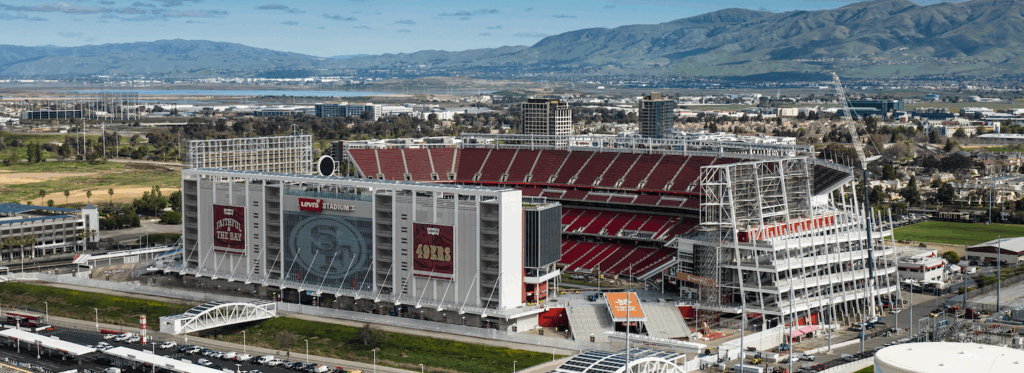
Sunday’s Super Bowl LX (aka sixty) arguably featured the most powerful stadium Wi-Fi network of all time: During the past year, connectivity at Levi’s Stadium in Santa Clara, California, has been upgraded to handle the extreme demands of mega-events, ranging from NFL games to the upcoming FIFA World Cup as well as global concert tours like that of pop icon Taylor Swift. The stadium’s Wi-Fi network – delivered by Cisco – now includes hyper-directional APs, 6 GHz with AFC, and – of course – Wi-Fi 7.
The Super Bowl is probably the world’s preeminent demonstration of ultra-high-density Wi-Fi and this year, Levi’s Stadium has been equipped to the hilt to take on massive data traffic from some 65,000 fans and staff. As an official technology provider for Levi’s Stadium, Cisco recently introduced a number of groundbreaking changes: For starters, more than 1400 Wi-Fi APs are now in operation – including during Sunday’s Super Bowl. But more important than raw network size are the innovations.
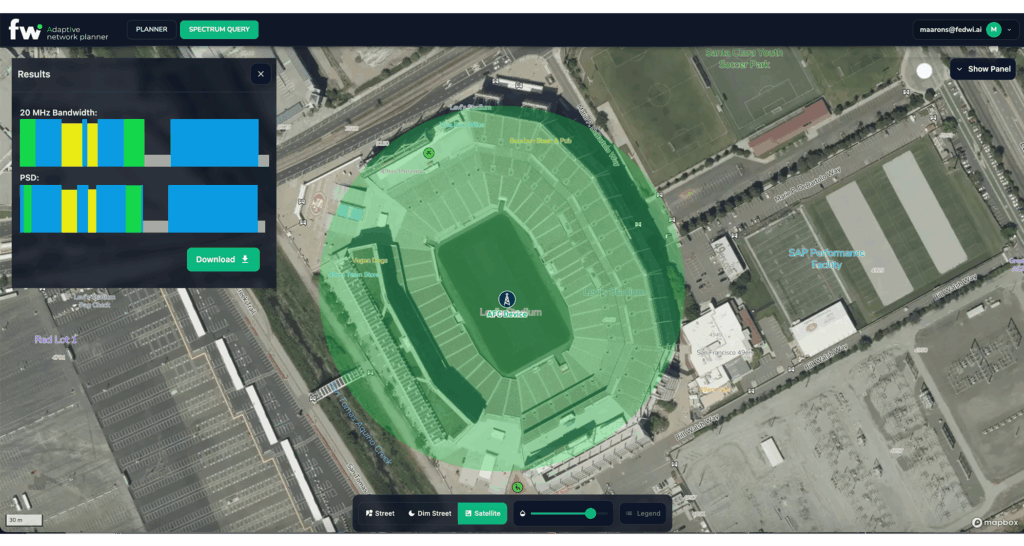
Sunday’s game was the first time in history that a top-to-bottom Wi-Fi 7 standard power network was in operation at a Super Bowl, which also means that AFC was in use for the first time. The AFC system queries a spectrum database in order to permit the Levi’s Stadium Wi-Fi 7 6 GHz network to operate (or not) in particular bands and at specified power levels.
In this case there were very few restrictions on standard power spectrum use because Levi’s Stadium happens to be located far from incumbent users of the 6 GHz band (see the illustration below). This is probably also the first time in history that AFC has been used at this scale.
“There can be huge differences between locations when it comes to the amount of spectrum available for operating standard power Wi-Fi. In this case, we’re fortunate because very few utilities in the area are using the 6 GHz band. In other parts of the US – for example if you’re close to a major port – the amount of available outdoor standard power spectrum shrinks by a lot. But what we can confirm is that the AFC system works flawlessly,” says Matt Swartz, Distinguished Engineer at Cisco.
Another important innovation designed to boost the Wi-Fi experience at Levi’s Stadium is the deployment of approximately 200 Catalyst 9179F overhead APs featuring integrated and configurable highly directional antennas. The specialised APs beam focused Wi-Fi signals to specific seating sections without interfering with adjacent areas (read more about it here). Hyper-directional APs are a fairly new innovation (the Catalyst 9179F was introduced by Cisco last summer) and are now gradually becoming the norm at large public venues, often in combination with existing underseat APs.
“Our goal was to deliver a Wi-Fi service so good that fans don’t notice they’re not at home, and we’ve achieved that. The cellular network at Levi’s Stadium is of course also useful but Wi-Fi makes a big difference especially when it comes to uplink. There’s a lot of uplink happening because fans love to take photos and video and send it to friends,” Matt Swartz says.
Tier 1 mega-events at Levi’s Stadium are unusually large also because they typically serve temporary entertainment areas adjacent to the stadium itself. The network includes separate SSIDs for press, security, and points of sale. Dedicated Wi-Fi channels are used for point-of-sale networks since the scanning of tickets is a critical process on game day. Levi’s Stadium employs WPA3 encryption to make sure all Wi-Fi connections are fully secure, Cisco says.
/Claus.