By Claus Hetting, WiFi NOW CEO & Chairman
Why is the EU recommending that the top half of the 6 GHz lie fallow and be reserved for future 6G? Arguments against this idea are voluminous – in particular when juxtaposed against the UK’s ‘best of both worlds’ approach accommodating Wi-Fi and prioritising future IMT (mobile) using AFC. A recent WiFi NOW webinar (available here) discusses Ofcom’s plans and the detriments of excluding Wi-Fi from the band.
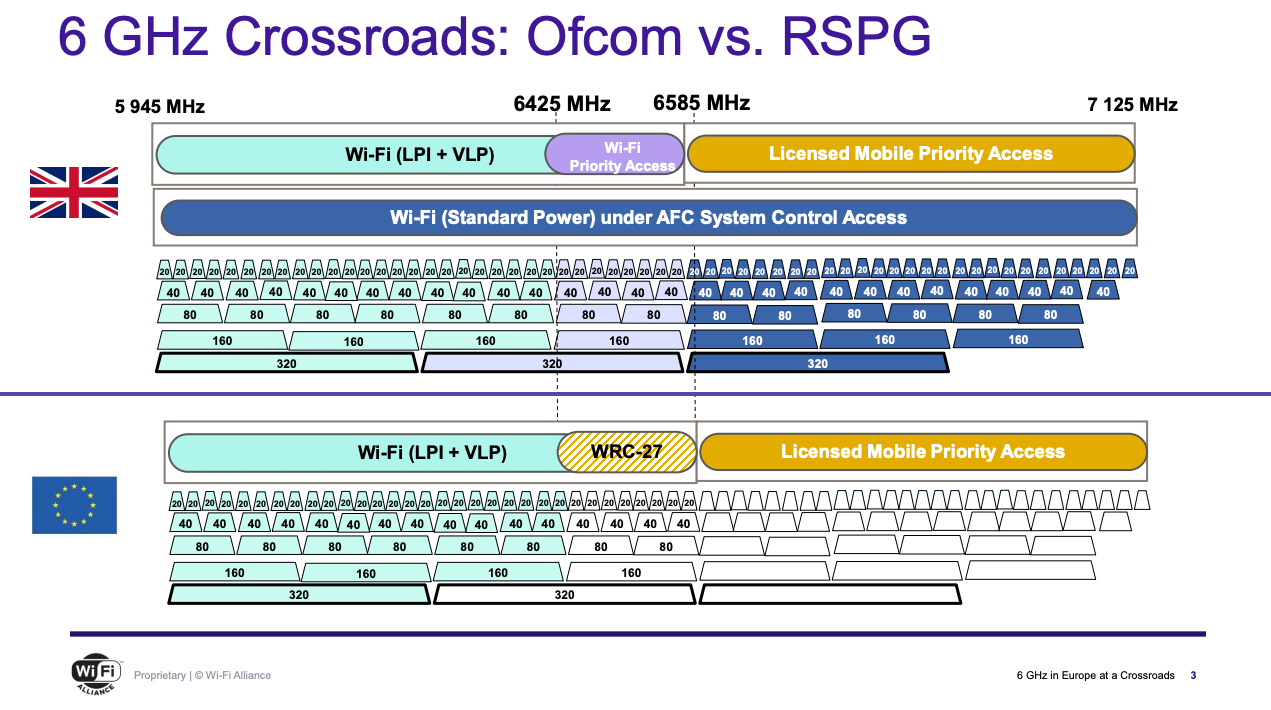
In November of last year the EU’s Radio Spectrum Policy Group – or RSPG – issued its official recommendation as to how the top half1 of the 6 GHz band should be regulated. To the chagrin of the Wi-Fi industry – and with little transparency as to the process (we wrote about it here) – the RSPG recommended reserving the spectrum for potential future IMT (mobile) use. Then in January this year, UK regulator Ofcom proposed an alternative solution: Accommodating both Wi-Fi and mobile but prioritising mobile in relevant areas if and when it becomes available.
Neither recommendation is final and both are still being widely discussed – including in this recent WiFi NOW webinar featuring Ofcom, Cisco, and Wi-Fi Alliance. Ofcom says the upper 6 GHz band matters because it supports next generation Wi-Fi capacity expansions including current standards Wi-Fi 6E and Wi-Fi 7. “The band is also a pathway for future mobile 6G evolution. To maximise the value of the band, our policy is to leverage currently available technology and make greater use of spectrum now while maintaining flexibility for future use,” said Ofcom Senior Policy Manager Siew Yoon Tan during the webinar. The webinar was streamed live by WiFi NOW last week.
WiFi NOW’s webinar on European 6 GHz regulation is available for viewing on demand here. The webinar featured expert representatives from Ofcom, Wi-Fi Alliance, and Cisco.
Ofcom’s proposal suggests using AFC to protect possible future mobile services (licensed in certain geographic areas) from potentially interfering indoor and outdoor Wi-Fi devices using the 6 GH band. In this way Wi-Fi services can be enabled now while remaining subject to future restrictions should priority later be granted to mobile services. The solution is elegant because it accommodates both mobile and Wi-Fi without delaying the productive use of spectrum.
The AFC system proposed by Ofcom in support of the new regulation is essentially the same as the current and field-proven AFC systems certified by the FCC and currently in use in the US and Canada. “AFC is a sharing enabler that supports high-performance use cases. It facilitates sharing with current users, and in this case will also enable future mobile use,” Siew Yoon Tan said.
Running big risks and slowing the introduction of AI
Wi-Fi Alliance says the band is uniquely suited for Wi-Fi expansion into the multiple 80/160/320 MHz channels required for next-generation performance.
“Europe would take a significant risk by following the RSPG recommendation to limit full access to the 6 GHz band for Wi-Fi. Full-band 6 GHz Wi-Fi is essential to maximise the value of Europe’s massive fibre infrastructure investments. At the same time, European mobile operators continue to face declining ARPUs and challenging economics, while proposed 6G use of the band remains speculative and would require billions in additional investment to deploy. In contrast, 6 GHz Wi-Fi is already delivering benefits today,” said Alex Roytblat, Vice President of Regulatory Affairs at Wi‑Fi Alliance.
But homes and consumers are not the only segments to suffer when Wi-Fi is blocked from evolving. Cisco says spectrum restrictions create opportunity costs for businesses that compound over time.
“Studies show that less spectrum will reduce competitiveness, introduce higher deployment costs, and slow down innovation, such as the introduction of AI into enterprise services and infrastructure. If Europe restricts access to the band, EU enterprises will be at a structural disadvantage as Wi-Fi empowers critical segments such as defence, healthcare, and the public sector to become more productive and competitive,” said Pelin Salem, Senior Technical Lead at Cisco.
/Claus.
1 – The full picture for Ofcom’s recommendation is a little more complicated and includes Wi-Fi priority access for 6425-6585 MHz. See the graphic below for a detailed comparison and click on it for a more detailed view.