By Claus Hetting, WiFi NOW CEO & Chairman
Wi-Fi 8 famously contains a long list of impressive new features – but how can we best understand precisely what benefits the new standard will bring? At Wi-Fi World Congress earlier this month, Intel Fellow & Wireless CTO Carlos Cordeiro delivered Intel’s vision on how Wi-Fi 8 will enable AI while strengthening a broad range of key Wi-Fi capabilities. Intel also expects to include features well beyond the standard itself, the company says.
Wi-Fi 8 will of course be all about enabling AI – but at the same time, Wi-Fi 8 features will deliver more robust, reliable, and secure Wi-Fi connectivity, said Intel’s Carlos Cordeiro at Wi-Fi World Congress in Mountain View earlier this month. Add to this that Intel intends to add capabilities beyond the IEEE 802.11bn standard in order to enhance the connected PC and laptop experience, he said.

“The Wi-Fi 8 standard itself is of course very important for the entire ecosystem – but for us at Intel, the next version of Wi-Fi is going to be more than what’s being defined by IEEE. It is going to be a suite of technologies that go above and beyond the changes happening at the PHY and MAC layers of the standard,” Carlos Cordeiro said.
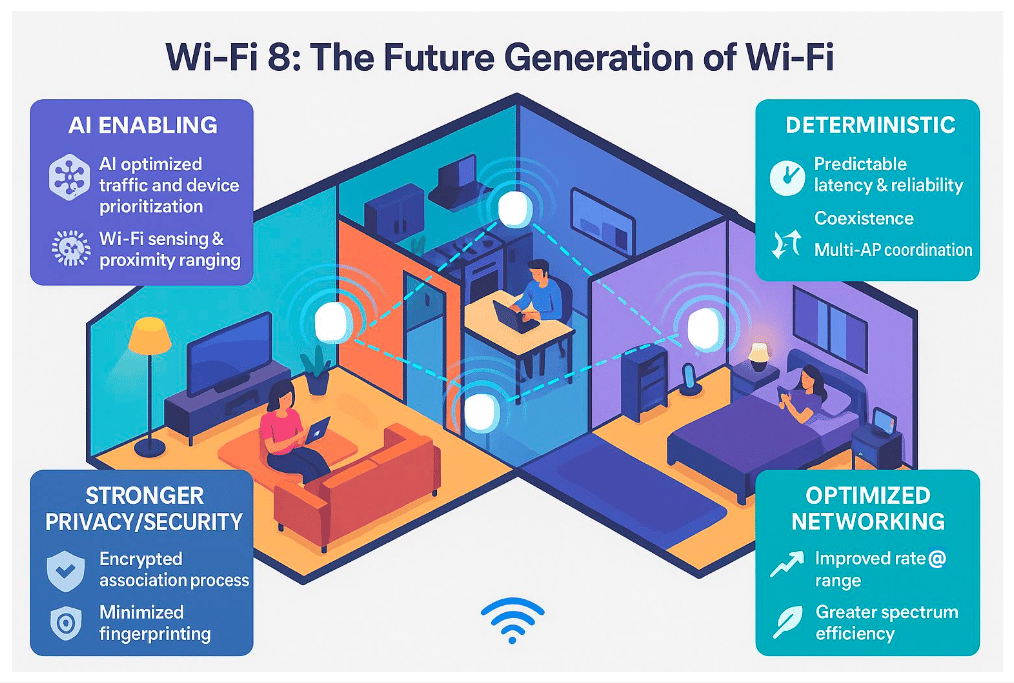
Intel’s Wi-Fi 8 vision can be described as four pillars: Enabling AI, better security, deterministic performance, and optimised networking. “We want to focus especially on what AI can do for Wi-Fi beyond the standard and that includes – for example – new QoS features that allow the network to identify low-latency traffic. We also see big value in sensing and proximity detection, for example for automatic transfer of a conference call between your phone and PC as you move away or towards your PC or automatically determining if your second display is to the right or the left of your main PC screen, for example. It’s about managing the contextual experience for you in the background,” he said.
But core Wi-Fi 8 reliability features are of course still important and their impact on the connected experience will be considerable, Intel says. “Deterministic operation is about achieving low latency not simply as a peak metric in distinct cases but broadly and reliably, such as for example connecting at less than 10 millisecond latency 95% of the time. Attaching reliability to key performance metrics is one of the big differences in Wi-Fi 8,” Carlos Cordeiro said.
Wi-Fi 8 core features for determinism include EDCA (Enhanced Distributed Channel Access), multi-AP coordination, as well as enhanced coexistence & roaming. For better privacy Wi-Fi 8 offers encryption of the entire client association process as well as protection of management frames and security enhancements for ultra-low latency roaming between APs, Intel says.
The fourth pillar can broadly be called optimised networking and consists of a number of improvements to the MAC and PHY. “You can view this as the traditional evolutionary step introduced for each new standard, meaning this is about better spectral efficiency, higher capacity, improved modulation schemes, and even reduced power consumption. Wi-Fi 8 is for example adding four new coding schemes for better rate at range performance with smaller ‘jumps’ between MCSs as well as Non-Primary Channel Access (NPCA) for better spectrum utilisation,” said Carlos Cordeiro.
“Wi-Fi 8 is poised to be the wireless technology of choice for the AI era but it’s not only about what Wi-Fi can do for AI – which is a lot – it’s also about how AI can be used to improve the connected user experience for example on PCs and laptops. Even though the standard doesn’t define higher peak data rates, Wi-Fi 8 will certainly in practice be faster, much more reliable, safer, and ultimately built from the ground up for a future where connectivity quality will be even more important than today,” he said.
/Claus.