By Claus Hetting, WiFi NOW CEO & Chairman
EU energy-efficiency regulations are beginning to apply pressure on the power budgets of home gateways, making energy-efficient CPEs and low-power Wi-Fi silicon increasingly important. During a keynote today at Network X in Vienna, MediaTek’s James Chen highlighted how on-chip AI can be applied to reduce Wi-Fi power consumption in gateways by as much as 50%. He also said that with the advent of AI-native Wi-Fi (and cellular) chipsets, the need for operators to source AI technology from third parties will be much reduced.
The energy efficiency of broadband equipment is beginning to weigh heavily on the minds of European broadband service providers as the EU is gradually ramping up its regulatory focus on energy savings. While limits on power consumption of gateways in networked standby mode are already mandatory, other voluntary guidelines – specifically the European Commission’s voluntary Broadband Equipment Code of Conduct – suggest upper limits on active gateways.
To meet this trend head-on, MediaTek this week highlighted how on-chip AI can be used to monitor, analyse, and intelligently reduce Wi-Fi power consumption on home gateways.
“A typical MediaTek Wi-Fi 7 or Wi-Fi 8 implementation on a home gateway will deliver on average 1 Gbps of data capacity while consuming just below 8 Watts (Wi-Fi only). When home traffic demand is substantially lower during off-peak hours – for example around 250 Mbps – Wi-Fi power consumption can be reduced dynamically by about half,” said James Chen, VP Product & Technology Marketing for MediaTek, during a keynote today at Network X in Vienna.
“The savings are meaningful”
James Chen says AI on edge devices (such as home gateways) can be used to configure and adapt the Wi-Fi platform to follow and match wide variations in home traffic across the day – of course without otherwise impacting connectivity performance. “The solution includes being able to reduce the number of active transmit antennas, while also reducing power amplifier (PA) transmit power, whenever traffic requirements are lower or when client devices reside closer to the gateway. These two features – and others – significantly reduce the average Wi-Fi power consumption for home gateways,” he said.
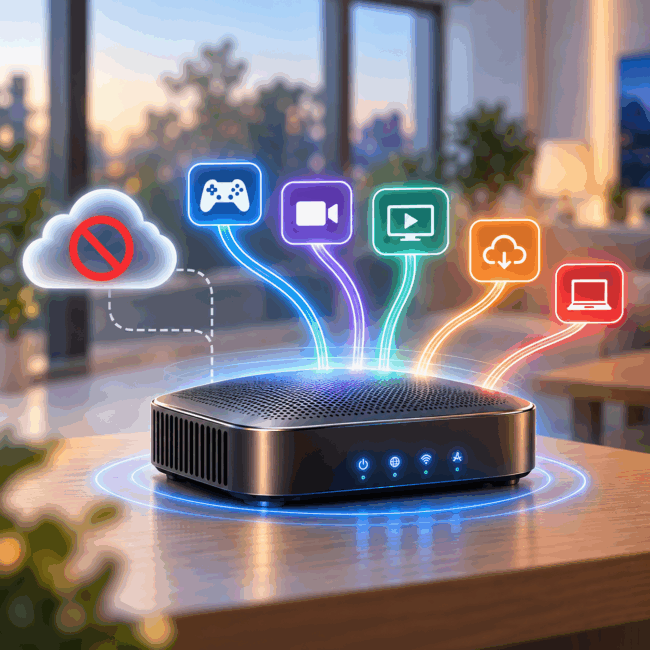
This AI power management solution is now part of MediaTek’s Filogic 8000 Wi-Fi 8 platform, although the feature is unrelated to the standard itself and not a Wi-Fi 8 requirement. Also noteworthy is that MediaTek’s Wi-Fi power management solution runs entirely at the edge – meaning it does not depend on the Cloud – nor does it require additional NPU processing power or increased memory. It can be run as an AI application on the CPU, thus preventing higher gateway costs, MediaTek says.
“The savings are meaningful not only per device but at scale because a reduction of about 4 watts per household – multiplied across millions of homes – becomes a grid-level energy issue. This is also why the EU and European operators are particularly interested in setting limits,” James Chen said.
EU Ecodesign rules already impose limits on networked standby consumption for routers and other network equipment, while the European Commission’s voluntary Broadband Equipment Code of Conduct defines maximum power-consumption targets for gateways in normal operation. Together, the initiatives point towards increasingly stringent energy-efficiency expectations for home connectivity equipment.
Operators reduce dependence on third parties for AI
“In the future, new wireless standards – regardless of whether it is Wi-Fi or cellular – will include support for AI frameworks that allow communications to be an integral part of the AI use case. Native AI support on Wi-Fi or cellular silicon platforms will represent a profound change for broadband operators, as they can now shift the sourcing of AI edge technology from third party developers to chipset technology providers. For operators, this makes the selection of a chipset provider an even more important decision,” James Chen said.
MediaTek became one of the first major chipset vendors to launch a Wi-Fi 8 platform at this year’s CES in January (read more here). The company says that it is using AI extensively to improve home Wi-FI quality including by introducing AI-powered Network Doctor that automatically detects and resolves Wi-Fi issues. This creates closed-loop Wi-Fi troubleshooting automation that will aid in driving down service provider support costs, James Chen said a a recent WiFi NOW Tech Watch interview available here.
/Claus.