By Claus Hetting, WiFi NOW CEO & Chairman
AI’s share of global Internet traffic is expected to reach 33% while direct consumer AI traffic growth will exceed a CAGR of 50% towards 20331. This means that new Wi-Fi network architectures – including Wi-Fi 8 – will be needed to serve an increasing number of proactive, intelligent devices specifically designed to make their own decisions. These were key messages delivered by Qualcomm’s Ganesh Swaminathan at WWC last month.
What changes in Wi-Fi network architecture will be required to accommodate mass market adoption of AI within the home? Perhaps the clearest answer to this looming question was provided by Qualcomm’s VP & GM Ganesh Swaminathan at Wi-Fi World Congress in Mountain View last month. As Wi-Fi evolves towards its next generational upgrade, network architectures need to shift to match a sea change in services, device intelligence, traffic, and associated performance requirements, he said.

“AI is going multi-modal, which means devices will be designed to react to and manage speech, vision, touch, sensors, even gestures. All of this will drive up data consumption both within the home and towards the Cloud. In addition, more intelligence and therefore more processing will shift to devices. This will happen not just because of privacy concerns and personalisation, but also to allow for better responsiveness. Finally, AI agents will be made continuously available, operating in a proactive state where they are always on. As these elements come together, the underlying infrastructure of course has to be capable of making it all work,” Ganesh Swaminathan said.
This shift puts new pressure on networks – especially within the home. The home gateway is the critical enabling network node because it can be seen as an extension of the service provider’s network into the home while being aware of contexts (including for example real-time details of the home environment, its users, preferred applications, and so on) for AI-based services. “The mass market introduction of AI is a great opportunity for the home gateway to become instrumental in delivering new and increasingly immersive experiences,” he said.
And while many Wi-Fi chipset providers are focusing strongly on AI at the edge, Qualcomm says new architectures will need to rely on the entire broadband infrastructure path, meaning the Cloud, the access network, and the edge. “Our view is that these three elements will need to be tightly integrated and work seamlessly together to deliver the right experience. This also means there must never be a weak element among them,” Ganesh Swaminathan said.
Meanwhile, Wi-Fi 8 is being developed to address AI-type services by providing consistent and continuous throughput in more locations, ultra-high reliability, and deterministic low latency. “Let’s not forget Wi-Fi 8’s much improved uplink, which will be critical for AI services, as well as – not least and very importantly – AI and compute on the platform itself. In fact, we look at this as an opportunity to further develop our connectivity and compute platform for the future. Gone are the days where we’re introducing just another PHY and MAC Wi-Fi connectivity standard,” he said.
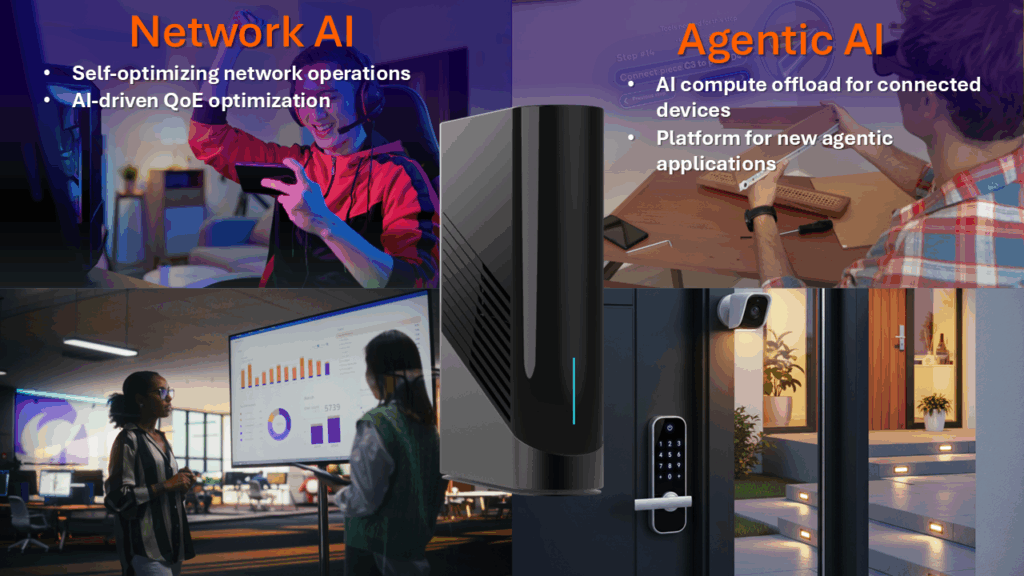
The two newest architectural components are processing (compute) for Agentic AI support with on-device inference and compute for network AI capabilities, including real-time QoE optimisation as well as telemetry and AIOps. “Network AI is going to be always on, constantly analysing and understanding traffic, network health, using telemetry to detect early warning signs of potential failures, and so on. Part of this exists already today but it will become increasingly powerful and beneficial to Wi-Fi-based services as platforms evolve,” Qualcomm says.
Qualcomm introduced a complete portfolio of Wi-Fi 8 platform solutions at Mobile World Congress earlier this year. Read our coverage here.
/Claus.
1 According to Nokia Global Network Traffic Report 2024.