By Claus Hetting, WiFi NOW CEO & Chairman
FCC wants to expand direct-to-device satellite connectivity to unlicensed devices
The FCC now wants to start “a new proceeding to explore new avenues to allow innovative unlicensed wireless devices to communicate directly with satellites,” the FCC said in a statement here. The idea is to allow so-called ‘Part 15 unlicensed devices’ to communicate with satellites directly in addition to being connected by Wi-Fi and Bluetooth, for example. To do this, the new “proceeding will look at the more than 225 megahertz of unlicensed spectrum to potentially support the capacity requirements and complement other bands for D2D services,” the FCC said.
According to the FCC, so-called Part 15 governs low-power, non-licensed radio frequency devices. These devices can operate without an individual spectrum license, provided they meet strict technical standards. The Part 15 rules ensure these devices do not cause harmful interference, and they must accept any interference received from other similar sources (this is currently how Wi-Fi works). The new proceeding is expected to begin in the form of a NPRM (Notice of Proposed Rule Making) to be issued shortly, according to an expert knowledgable on the matter.
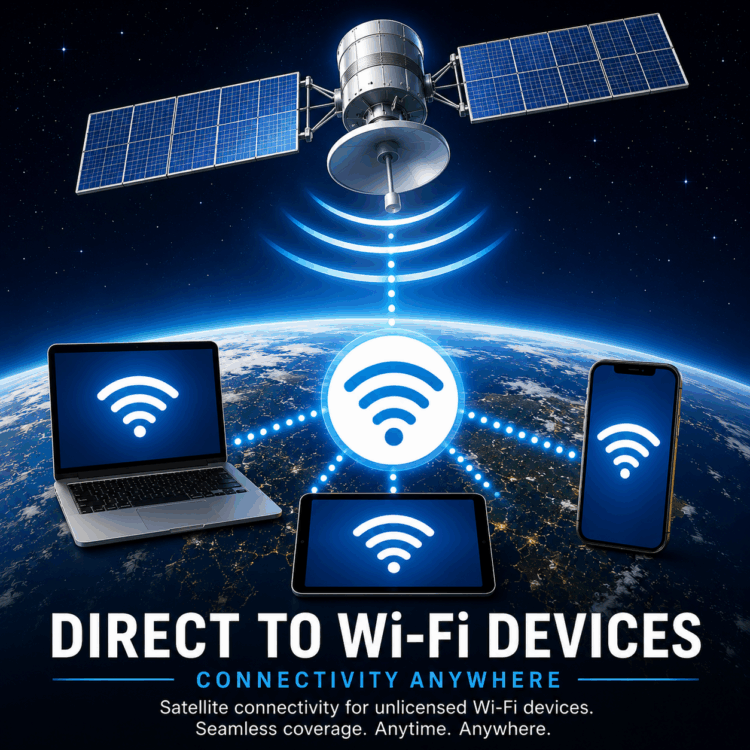 The FCC has yet to suggest how this might work. Typically, Wi-Fi devices – including APs and gateways – are relatively low power. It seems unlikely that their signals would be capable of reaching even low-earth orbit satellites, which means Starlink-like terminals with tracking antennas would likely be required. Receiving RF signals from space would be easier but also not without challenges. Unlicensed presumably means that devices would have to circumvent contention in order to communicate with satellites.
Update! The FCC’s Notice of Proposed Rulemaking on this initiative is now available here.
Our take: The FCC’s proposal is important because it explicitly places Wi-Fi among the technologies being considered for future direct-to-device satellite communications. Rather than replacing terrestrial wireless, future systems could be hybrid – combining Wi-Fi, Bluetooth, cellular, and satellite connectivity to deliver seamless coverage. If the FCC’s vision proves technically and commercially viable, it could fundamentally expand the role of Wi-Fi and other unlicensed technologies in global connectivity.
IEEE 802.11 approves Draft 2.0 specification for 802.11bn (Wi-Fi 8)
According to this LinkedIn post by Qualcomm’s VP of Standards Rolf de Vegt, this week’s IEEE 802.11 working group meeting in Montreal, Canada, yielded the result that most were hoping for: The approval of the 802.11bn Draft 2.0. This usually means that Wi-Fi 8product development can now proceed more quickly as the remaining changes to the standard are likely to be minor. Rolf de Vegt also said that work on what will eventually become Wi-Fi 8 is ramping up.
“Building on a large number of submissions in the Wireless Next Generation Group since January 2026, the Working Group passed a motion to create a study group to develop the scope document next mainstream MAC / PHY standard, meaning what will become the Wi-Fi 9 generation. This WIN (WLAN Intelligent Networking) Study Group will investigate technologies for example to further improve throughput, latency predictability and adaptation to emerging application requirements such as from AI traffic or services,” Rolf de Vegt said.
Verizon launches 5 Gbps broadband plan with Wi-Fi 6E gateways
The new plan is more than twice as fast as Verizon’s existing top-tier 2 Gbps plan and is available for $105 per month in certain locations, according to reporting by Engadget here. But as Wi-Fi aficionados will know, any Gbps plan won’t do much for you without the right Wi-Fi equipment on the inside of the house. To deliver Wi-Fi to your devices within the home, Verizon offers a Wi-Fi 6E router as well as associated mesh units for whole-home coverage. While ranking highly, Verizon’s new 5 Gbps plan is not the fastest in the country. Google Fiber offers a symmetrical 8 Gbps service while Frontier Fiber provides residential packages of up to 7 Gbps. Verizon is not yet shipping Wi-Fi 7 home gateways.
Our take: Multi-gigabit broadband is arriving faster than Wi-Fi upgrades in many operator deployments (we also know this from multiple analyst reports). Wi-Fi 7 gateways will increasingly become necessary to fully exploit services beyond 2–5 Gbps as will Wi-Fi 7-capable client devices.
Costa Rica adopts full-band 6 GHz Wi-Fi with AFC
Costa Rica is adopting low-power indoor and standard-power Wi-Fi with Automated Frequency Coordination (AFC) across the full 1,200 MHz of the 6 GHz band (similar to the regulation adoption in the US and Canada). “This forward-looking framework will enable Wi-Fi to deliver higher capacity, lower latency, and more reliable performance for homes, businesses, schools, healthcare, manufacturing, and public services,” says Wi-Fi Alliance’s Alex Roytblat in a LinkedIn post. See more details below.
Our take: Another important win for full-band 6 GHz Wi-Fi. Every additional country adopting AFC strengthens the global ecosystem and encourages wider device support. Also see our AFC and regulatory coverage in our Resource Centre.